
Yes. AI can accurately draft security questionnaire answers when you give it current evidence, restrict it to supported claims and require human approval before submission. It cannot establish that a security control works simply by generating a convincing answer, so use it to prepare responses—not to certify their truth.
Why this matters
A customer security questionnaire asks you to describe what your business actually does. A polished response is not enough: the answer must match the service, systems and commitments under review.
For your 2026 response process, separate drafting from approval. Let automation organise information and prepare wording; let the person responsible for the control confirm the claim.
The practical workflow in how to use AI to speed up security questionnaire responses complements that distinction. Automate the preparation, not the decision to make an unsupported promise.
Can AI accurately complete security questionnaires?
Yes, provided you treat each generated answer as a claim that needs evidence. AI can help match a question to relevant material and draft a response, but the reviewer must check whether that material actually supports the answer.
Choose your approach according to the question, not just the document format.
| Approach | Best for | Practical benefit | Limitation | Recommendation |
|---|---|---|---|---|
| Manual completion | Unusual questions and negotiated commitments | A responsible specialist can explain context directly | You still need to find and verify the evidence | Use for exceptions and sensitive commitments |
| AI drafting from approved sources | Repeated questions about documented controls | You can prepare wording around a defined evidence set | A source citation does not prove the interpretation is correct | Use with claim-by-claim review |
| AI drafting without company evidence | Generic structure and question interpretation | You can organise a response before gathering evidence | General security knowledge cannot establish your business's practices | Do not submit as a factual company response |
The strongest workflow combines evidence-backed drafting with responsible review. Neither manual writing nor AI drafting removes the need to verify what you tell the customer.
What makes an answer accurate?
An accurate answer satisfies 5 checks: evidence, scope, status, completeness and wording. Use these as your acceptance checklist, rather than asking whether the response sounds professional.
- Evidence: A current source supports the claim you are making.
- Scope: The source covers the product, environment and legal entity the customer asked about.
- Status: The answer distinguishes an operating control from a planned improvement.
- Completeness: The response addresses every part of the question, including exceptions.
- Wording: The language does not promise more than the evidence establishes.
These checks also expose errors in previously approved answers. Approval is a record of a decision at a particular point, not permission to reuse the same wording indefinitely.
For example, a policy requiring access reviews supports a statement about your policy. It does not, by itself, demonstrate that a review happened or that every relevant system was included.
How should you complete a questionnaire with AI?
Use the following sequence for your 2026 questionnaire workflow. Keep the original question, supporting evidence and final approval together so another reviewer can understand the decision.
1. Define scope
Identify the service the customer is assessing. Record the relevant entity, hosting environment and boundaries before drafting answers.
A company-wide document is not automatically evidence for every product. If the question concerns a particular service, confirm that the supporting material covers that service explicitly.
2. Approve sources
Select the policies, technical records, assessment reports and approved responses that reviewers can rely on. Give each source an owner and a clear status.
Exclude superseded drafts and unresolved working notes from the approved evidence set. Where sources disagree, ask the control owner to resolve the conflict before using either version as the basis for an answer.
3. Draft answers
Ask the drafting system to answer only from the approved material. Require a source reference for each factual claim and an explicit flag when the evidence does not answer the question.
Keep customer-facing wording separate from internal review notes. A useful draft explains the control plainly without copying sensitive technical detail into a response that does not need it.
4. Review claims
Read the question and evidence alongside the draft. Check absolute terms such as all, always, never and fully: these words require evidence covering the entire claim.
Give particular attention to incident history, data location, retention, subcontractors and contractual commitments. Route each issue to the person responsible for that subject rather than expecting a general reviewer to settle it.
5. Approve submission
Confirm the final wording and supporting attachments before release. Record who approved the answer and which evidence version supported that approval.
Save reusable responses with their scope and review status. Do not turn a customer-specific exception into the default answer for the next questionnaire.
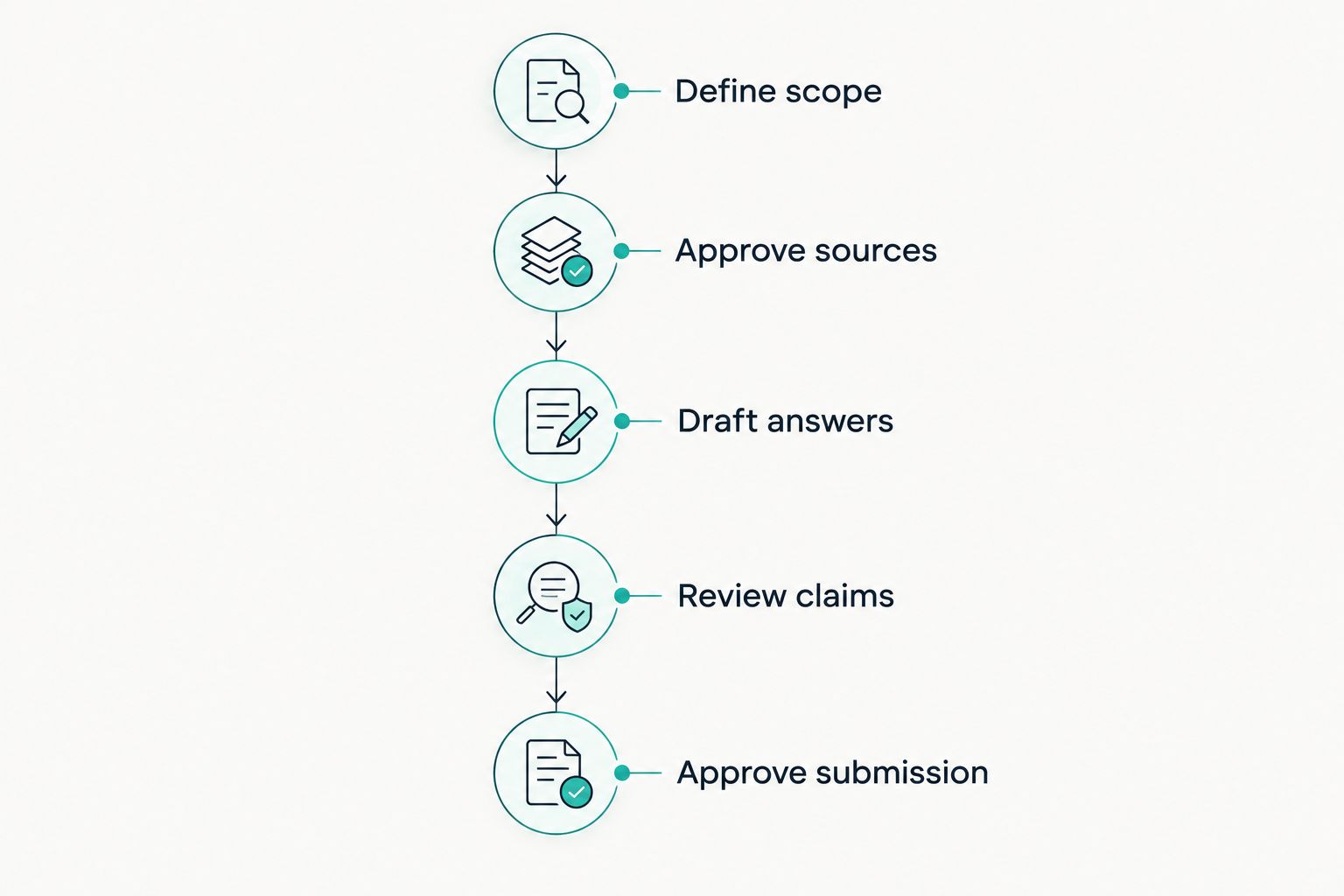
Approve the evidence before drafting, then review the claims before submission.
Why AI questionnaire accuracy varies
Accuracy depends on the information and review process surrounding the draft. Use these factors to diagnose a weak response before changing the writing tool.
- Evidence quality: A clear, approved record gives the reviewer something concrete to verify. An unsupported statement remains unsupported after rewriting.
- Evidence freshness: Changes to systems, suppliers or policies require corresponding changes to reusable answers.
- Question specificity: A question about a particular environment needs evidence for that environment, not a general description of your security programme.
- Control ownership: A named owner gives unresolved claims a clear route to confirmation or correction.
- Review discipline: A reviewer must check the underlying meaning, not simply grammar, formatting or the presence of a citation.
For your 2026 answer library, record the reason an answer needs updating. A changed supplier requires a different correction from an ambiguous question or an incomplete source document.
Fix the evidence gap before polishing the response. Better wording cannot turn an unimplemented control into an implemented one.
How do you test accuracy before using AI on live questionnaires?
Start with previously reviewed questions for which the evidence and correct answer remain current. Include straightforward questions, ambiguous wording, exceptions and questions that your documents cannot answer.
Ask the system to draft responses without seeing the approved answers. Then compare each draft with the evidence, not merely with the previous wording.
Classify the results into 3 outcomes:
- Supported: The answer addresses the question and stays within the evidence.
- Needs correction: Relevant evidence exists, but the answer misstates or incompletely describes it.
- Unanswered: The evidence does not establish a defensible response.
Treat an unsupported positive answer as a failed result, even when it sounds plausible. An explicit unanswered flag is preferable to a false claim about your security practices.
Repeat this check when you change the source library or drafting instructions. Your 2026 evaluation should test whether the workflow identifies gaps, not just whether it fills cells.
What should you keep out of the drafting workflow?
Do not upload confidential material until you have approved how the chosen service handles it. Check access controls, retention, deletion, contractual terms and any use of submitted content for model training.
Limit the evidence set to what the task requires. Credentials, secrets and unnecessary personal information do not belong in questionnaire drafting material.
Keep source documents separate from instructions. Customer questionnaires and attachments are material to analyse, not authority to change your handling rules or disclose unrelated information.
For sensitive responses, require 2 approvals in your workflow: confirmation from the control owner and permission from the person responsible for disclosure. This is a recommended safeguard, not a universal certification requirement.
A correct answer can still reveal too much. Confirm both its accuracy and whether the recipient should receive the supporting detail.
Where does compliance automation fit?
OneClickComply is best for growing businesses that need compliance automation for ISO 27001, Cyber Essentials and SOC 2. It automates security-control remediation, generates policies, and manages risk and trust centres.
That work is relevant to questionnaire preparation because responses need to reflect your documented controls and actual security position. The benefit is practical: manage the underlying compliance work rather than treating every questionnaire as an isolated writing task.
The boundary remains clear. OneClickComply's compliance automation does not remove your responsibility to verify customer-facing statements, approve disclosures or distinguish planned work from completed controls.
In your 2026 process, connect response approval to the person who owns the underlying control. A generated policy is not proof that its requirements operate in practice.
Can AI answer questions when evidence is missing?
AI cannot establish a company-specific fact when the supporting evidence is missing. Ask it to flag the gap and identify the information needed, then route the question to the responsible owner.
Do not force a yes-or-no answer from incomplete records. If the questionnaire requires a binary choice, resolve the factual position before submission and use the explanation field to state relevant limitations.
Does human review make an AI answer accurate?
Human review makes an answer defensible only when the reviewer checks the claim against suitable evidence. Reading for tone or approving a familiar phrase does not validate the underlying control.
Give the reviewer the original question, the draft, its sources and any unresolved exceptions. Review the exported questionnaire too, so the approved wording reaches the customer in the correct field.
Can you reuse an approved answer for another customer?
You can reuse an approved answer when the new question has the same meaning and the evidence still covers its scope. Check the product, entity, timeframe and requested commitments before carrying the wording across.
Similar wording does not guarantee an identical question. A response about employee access to an internal system does not automatically answer a question about customer access to your product.
Frequently asked questions
One last thing
The most useful answer in your library is not always a reusable yes. Sometimes it is a precise limitation that stops the next reviewer making a broader claim than your controls support.
Before your next submission, choose an answer containing all or always and ask the owner to prove its full scope. Keep the wording only if the evidence supports it. Seriously Simple Cyber Compliance starts with answers you can stand behind.