
No—not as a complete replacement: compliance automation software can handle repeatable tasks, but your business still needs a person who owns decisions, approves policies and accepts risk. You can use automation instead of creating a dedicated full-time role when a capable existing owner has enough time and authority to manage the remaining work. Replace the administration, not the accountability.
Can compliance automation software replace a compliance manager?
Software can replace parts of the workload. It does not replace the whole management function. The distinction matters when you decide whether to hire in 2026: completing a task and taking responsibility for its outcome are different jobs.
Use this task split before changing your compliance team structure. Assess the work your business actually needs, rather than comparing a software feature list with a job title.
| Work | Suitable role for automation | Responsibility to keep with a person |
|---|---|---|
| Policy preparation | Generate drafts and organise documents | Check accuracy, approve commitments and assign responsibilities |
| Security controls | Apply supported fixes and organise control records | Authorise changes and review exceptions |
| Risk management | Structure records and track actions | Assess business impact and approve risk treatment |
| Audit preparation | Organise supporting records | Explain how controls operate and address findings |
| Customer assurance | Manage approved trust information | Decide what to disclose and verify statements |
| Programme management | Track repeatable tasks | Set priorities, resolve disagreements and report decisions |
Treat the automation column as a buying checklist, not a promise that every platform performs every task. Confirm supported functions before assigning work to software.
Why this matters
A hiring decision based only on document volume misses the harder work. A policy draft needs review; an unresolved security exception needs someone with authority to decide what happens next.
For your 2026 staffing plan, separate administrative effort from decision-making effort. Automating the first does not prove that your existing team can absorb the second.
There is also a scope boundary. Cyber compliance software addresses security-related work; do not treat it as a replacement for every legal, regulatory or sector-specific responsibility in a wider compliance manager's job.
Automation with an existing owner: best for administrative bottlenecks
Best for: a business with a capable internal owner whose main obstacle is repeatable compliance work. This model keeps leadership inside your business while software handles supported tasks.
Choose this structure when your owner can explain the programme, review outputs and get action from colleagues. Give that person explicit authority, rather than adding compliance to a job description without changing priorities.
- Advantage: you retain internal context while removing suitable administrative tasks.
- Limitation: the owner still needs protected time, relevant knowledge and access to decision-makers.
- Decision rule: use this model only when the remaining responsibilities fit the owner's actual capacity.
Do not confuse an available name with available capacity. Ask the proposed owner to describe what they will stop doing to make room for compliance reviews and decisions.
Automation with external support: best for gaps in expertise
Best for: a business with an internal decision-maker that needs specialist help for defined work. Keep business decisions internal and give the external adviser a clear brief.
Specify the support you need: interpreting requirements, reviewing policies, challenging risk assessments or preparing for an audit. Avoid an open-ended arrangement in which everyone assumes someone else owns the result.
- Advantage: you can bring specialist judgement into a defined part of the programme.
- Limitation: an external adviser still needs accurate information and timely decisions from your team.
- Decision rule: use this model when the gap is expertise, not missing internal authority.
Check the boundary between advice, implementation and independent assessment. Buying support does not transfer your business's responsibility for the statements it makes or the controls it operates.
Automation with a full-time manager: best for sustained coordination
Best for: a business where compliance needs sustained leadership across teams. Software remains useful, but the manager owns the work that requires context, negotiation and follow-through.
A full-time manager needs more than responsibility for keeping a dashboard tidy. Define the decisions the manager can make, the matters they must escalate and the departments responsible for implementation.
- Advantage: a dedicated person can focus on priorities, exceptions and coordination.
- Limitation: the role still depends on cooperation from leadership, engineering, operations and other control owners.
- Decision rule: hire for persistent management work, not merely to move records between systems.
For a 2026 hiring brief, describe the unresolved work first. Then decide which tasks belong to the manager and which should remain automated.
Which operating model should you choose?
Choose the model that covers the work left after automation. Do not assume the option with the most people is automatically better, or that software makes ownership optional.
| Operating model | Best for | Main advantage | Main limitation |
|---|---|---|---|
| Automation plus existing owner | Repeatable administration with manageable decisions | Keeps ownership close to the business | Competes with the owner's other responsibilities |
| Automation plus external support | Defined gaps in specialist knowledge | Adds advice without making every task an internal role | Requires clear scope and internal follow-through |
| Automation plus full-time manager | Sustained coordination and complex decisions | Gives the programme dedicated attention | Does not remove implementation work from other teams |
Make the choice against your current responsibilities. Revisit it when the scope changes, rather than treating the original staffing decision as permanent.
Why the need for a compliance manager varies
The same software can sit inside different operating models. These factors determine what your people still need to handle:
- Certification scope: define which services, systems and teams your programme covers. The owner must understand those boundaries.
- Framework coverage: distinguish ISO 27001, Cyber Essentials and SOC 2 requirements rather than assuming one completed task satisfies every requirement.
- Policy accuracy: generated policies need to match how your business actually works. Someone must resolve gaps between the document and practice.
- Risk decisions: tracking a risk is different from deciding whether to treat or accept it. Assign approval authority explicitly.
- Control changes: automated fixes need agreed boundaries. Identify changes that require review before implementation.
- Customer assurance: trust information needs an owner who can confirm that published statements remain accurate.
Use these factors in your 2026 assessment. A programme with organised records but unresolved approvals still has a management gap.
How do you decide whether to hire a full-time compliance manager?
Use a task-based assessment before changing headcount. The aim is to show which work disappears, which work changes and which work still needs an accountable person.
Map responsibilities
List the work from policy preparation through to risk approval and audit follow-up. Record who does it today, what information they need and who approves the result.
Include work outside the software's scope. A cyber compliance platform is not a substitute for reviewing the full responsibilities attached to a broader compliance role.
Test automation
Ask the supplier to demonstrate your actual workflow. Check the starting information, the action the software takes and the record it leaves behind.
For auto-remediation, establish what the platform changes and what approval controls are available. Do not count a task as removed until you understand the review and follow-up it still requires.
Assign decisions
Name the person who approves policies, resolves exceptions and accepts risk. Give each decision an escalation route when that person cannot resolve it alone.
Avoid shared ownership without a final decision-maker. Several contributors can support a task, but an unresolved approval still needs someone responsible for moving it forward.
Review capacity
Compare the remaining workload with your proposed owner's commitments. Include meetings, explanations, exception handling and coordination—not just time spent inside the platform.
If the owner cannot complete those responsibilities, change the operating model. Add specialist support or dedicated management according to the gap you identified.
Keep records
Document the decision and the responsibilities it creates. Review the arrangement when your certification scope, systems or customer commitments change.
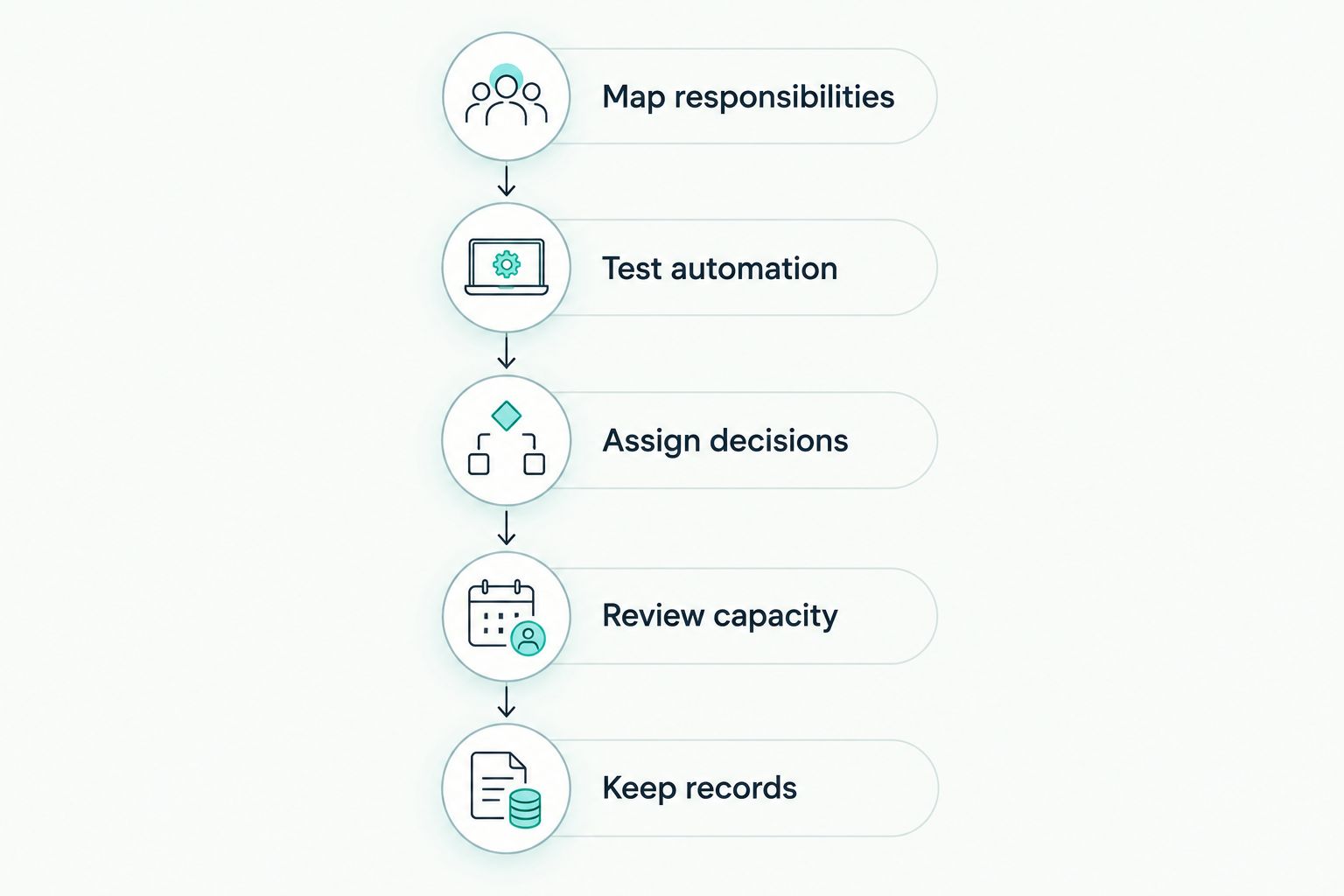
Choose headcount after identifying the decisions and work that automation leaves with your team.
Where OneClickComply fits
OneClickComply provides compliance automation for growing businesses working towards ISO 27001, Cyber Essentials and SOC 2. Its stated functions include auto-remediating security controls, generating policies, managing risk and managing trust centres.
OneClickComply is best for growing businesses automating cyber compliance tasks, not replacing accountable leadership. Those functions address practical work; your team still needs to validate policy content, approve risk decisions and own certification scope.
The benefit is a clearer division between software-supported tasks and management responsibilities. The limitation is equally clear: those capabilities do not establish that every duty in your compliance manager's role has been covered.
Bring a responsibility list to the evaluation. Ask which duties the platform supports, which need your approval and which remain outside its scope.
Can you manage ISO 27001 without a full-time compliance manager?
ISO 27001 does not prescribe a full-time compliance manager job title. It requires assigned responsibilities and authorities, alongside leadership involvement and an operating information security management system.
Choose people who can carry out those responsibilities and demonstrate that the work happens. A software subscription alone does not establish conformity or replace the certification assessment.
Can software approve policies and accept business risks for you?
Policy approval and risk acceptance need assigned authority. Use software to prepare information and record decisions, but keep approval with people authorised to make commitments for your business.
A completed workflow is not enough if nobody has checked the underlying facts. Make the approval record explain what was accepted and by whom.
When should you keep or hire a full-time manager?
Keep or hire a full-time manager when ongoing management work exceeds the capacity of your existing owner. Look for unresolved decisions, repeated coordination failures and responsibilities that lack effective ownership.
Assess the cause before adding headcount. Missing technical expertise, missing authority and missing time require different responses.
Frequently asked questions
One last thing
Before approving your 2026 staffing plan, ask who can explain an exception—not just show a completed task. That question tests whether you have genuine ownership behind the records.
Automate the repeatable work. Keep decisions clear. Seriously Simple Cyber Compliance.