
A penetration test has no fixed duration: the testing time depends on the systems, access and checks agreed in its scope. Your full schedule also includes preparation, reporting, fixing findings and any retesting, so the last testing day is not necessarily the completion date. For your 2026 plan, get a scope-based estimate and a separate report delivery date before you book.
How long does a penetration test take?
Use the provider’s written scope to set the duration, not a generic average. A test of a defined application and a test covering applications, cloud infrastructure and internal networks involve different work.
Start by scoping your penetration test before you buy one. Ask the provider to separate the engagement into these 5 stages, with an owner and an agreed completion point for each.
| Stage | What happens | Completion point |
|---|---|---|
| Preparation | Agree targets, permission, access and safe testing rules | The provider confirms readiness |
| Active testing | Examine the agreed systems and validate weaknesses | The agreed testing work ends |
| Reporting | Explain findings, evidence, limitations and recommended fixes | You receive the agreed report |
| Remediation | Your team fixes findings or records its response | Changes are ready for verification |
| Retesting | Check whether agreed fixes address the original findings | You receive updated finding statuses |
These stages do not all belong to the testing provider. Your team controls access and remediation, while the provider controls its testing and reporting commitments.
Keep those responsibilities visible. Otherwise, a completed test can sit waiting for a report, a decision or a software release without anyone owning the next step.
Why this matters
You need the right deliverable by your deadline. A customer requesting a penetration test report needs something different from an engineering team requesting confirmation that a specific weakness has been fixed.
For a 2026 product launch, define the acceptance condition before selecting the testing window. Decide whether you need the initial report, completed fixes, retest evidence or a combination of these.
Book backwards from the required outcome. Do not treat the end of active testing as proof that remediation is complete.
Tester-days and calendar time are different
Tester-days describe the amount of testing effort. Elapsed working days describe how long the work runs on the calendar, including its scheduling and dependencies.
Ask for these 2 measures separately. A provider’s effort estimate does not, by itself, establish when you will receive the report.
More testers do not automatically make every activity finish sooner. Some checks depend on earlier discoveries, and the team still needs to combine its evidence into a clear report.
Use these questions when reviewing a proposal:
- How much effort covers active testing?
- Does the effort estimate include preparation and reporting?
- What are the planned start and finish dates?
- When will you receive the final report?
- What happens if access problems stop testing?
- How will a scope change affect the agreed schedule?
Compare proposals on the same scope and deliverables. A shorter engagement is not a better engagement if it leaves important systems or user roles untested.
Why penetration testing duration varies
The scope is more than a list of website addresses. It defines what the provider can test, how deeply it can investigate and which activities are excluded.
These factors shape the work:
- Target coverage. Applications, APIs, networks and cloud environments require different checks. List the actual targets rather than describing everything as your platform.
- User roles. Different permissions introduce different access paths. Give the provider the roles needed to test the agreed boundaries.
- Technical complexity. Workflows, integrations and trust relationships affect what needs investigation. Explain how important components connect.
- Starting information. Documentation and supplied credentials change the tester’s starting point. Agree whether discovery is part of the objective.
- Testing restrictions. Approved hours, excluded techniques and production safeguards constrain the work. Put these rules in writing.
- Access readiness. Working accounts, connectivity and permissions let testing begin as planned. Validate them before the start date.
Do not remove relevant coverage merely to shorten the estimate. Narrow the scope only when you can explain what remains outside the test and why.
Which testing approach fits your deadline?
Black-box, grey-box and white-box approaches give the tester different starting information. Choose the approach that answers your security question, not the approach with the shortest-looking proposal.
For your 2026 engagement, ask the provider to state the approach explicitly. Do not assume that supplied credentials or source access are included unless the scope says so.
| Approach | Starting position | Best for | Benefit | Limitation |
|---|---|---|---|---|
| Black-box | Little or no internal information | Examining exposure from an outside starting point | Includes discovery from that position | Does not provide the same informed internal coverage as a source-informed assessment |
| Grey-box | Some information or agreed user access | Checking authenticated workflows and permission boundaries | Lets testers examine relevant user journeys | Coverage depends on the access and information supplied |
| White-box | Detailed technical information, potentially including source code | Examining implementation with an informed starting point | Supports investigation of internal design and logic | Requires preparation and does not reproduce an uninformed attacker’s starting position |
Select the approach against the objective. An outside-access test and an authenticated permission test answer different questions, even when they target the same application.
Ask how the provider will handle missing documentation or unusable credentials. That conversation belongs in scoping, not midway through the engagement.
How do you build a realistic penetration testing schedule?
Use a sequence that keeps readiness, testing and closure separate. Each stage should end with a clear decision or deliverable, rather than an assumption that the next team has everything it needs.
Agree scope
List the systems, environments and user roles you want tested. Record exclusions, authorised techniques and the person who can approve changes.
State the objective in plain language. For example, checking whether users can access another customer’s data is clearer than asking for a general security check.
Prepare access
Create and validate the agreed accounts before testing starts. Confirm connectivity, authentication and any permissions needed to reach the targets.
Use suitable test data and agree production safeguards. Tell the provider who can resolve access problems during the engagement.
Run testing
Confirm the testing window and the escalation route for urgent findings. Agree how the provider will communicate progress and interruptions.
Keep an authorised contact available. If the provider needs a decision on a newly discovered system, someone must decide whether it is in scope.
Review findings
Read the report with the people responsible for the affected systems. Separate the technical evidence from the business decision about what to fix first.
Assign each action to an owner. Record any finding that needs clarification before your team starts making changes.
Verify fixes
Agree which findings need retesting and what evidence the provider will produce. Confirm the environment and version that will be checked.
Close findings only against the agreed verification result. A deployed change is not the same thing as a verified fix.
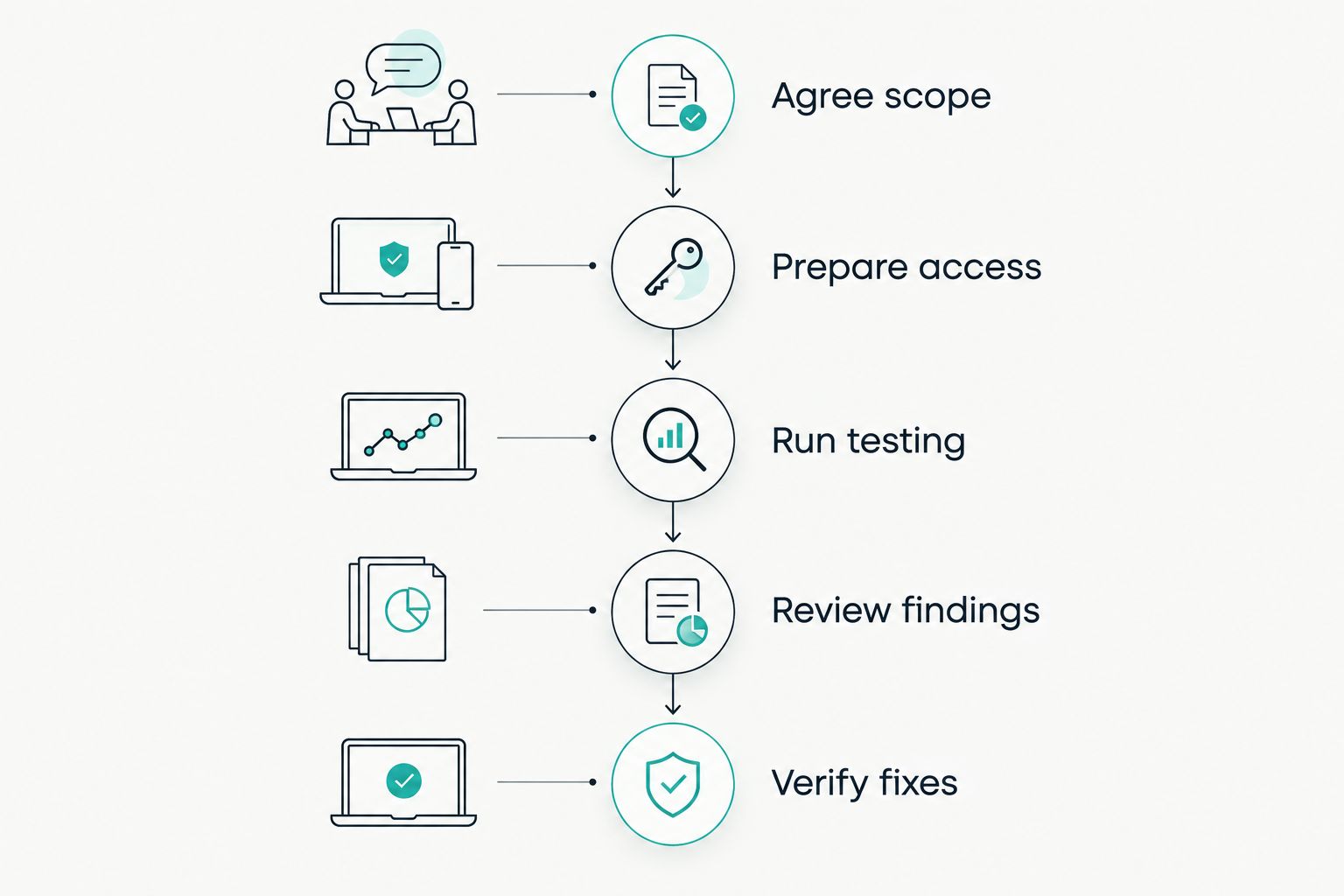
The schedule continues after active testing when you need fixes verified.
What should you confirm before booking?
Get 3 dates in writing: the testing start, report delivery and any agreed retest appointment. If a retest cannot yet be scheduled, record how it will be booked and who owns that action.
For your 2026 booking, keep the agreement specific enough that both teams can recognise a delay. A promise to deliver after testing finishes does not establish a report deadline.
Your booking checklist should cover:
- Named targets and excluded systems.
- Required accounts, documentation and connectivity.
- Permission to test and any third-party approval requirements.
- Allowed testing hours and prohibited activities.
- A contact for access problems and urgent findings.
- The report format and delivery date.
- The process for approving scope changes.
- Retest coverage and the expected evidence.
Ask the provider to identify dependencies on your team. Then assign those tasks internally before confirming the start date.
Does reporting count towards penetration testing time?
Reporting is part of the engagement, but a proposal can describe it separately from active testing. Ask whether the stated duration covers testing alone or delivery of the final report.
A useful report explains what was tested, what was found and where coverage was limited. Your team also needs enough evidence to understand and address each finding.
An urgent notification is not the final report. Agree how the provider will notify you of a serious finding during testing without confusing that alert with the completed deliverable.
Does fixing vulnerabilities count towards the test duration?
Fixing vulnerabilities belongs to your remediation schedule unless the engagement explicitly includes that work. The tester’s finish date does not establish when your engineering or IT team will complete its changes.
Some findings require a configuration change. Others require investigation, development, testing and deployment through your normal change process.
Plan remediation with the people who will do it. Do not promise a closure date before they have reviewed the findings and dependencies.
How long does penetration test retesting take?
Retest duration depends on the findings and changes agreed for verification. It is not automatically the same duration as the original test, and it is not automatically included in the original schedule.
A targeted retest checks specified fixes. It does not establish that unrelated systems or newly added features have been tested.
Tell the provider if the application or environment changed substantially after the original assessment. Agree whether targeted verification still answers your question or whether additional testing is needed.
Where compliance automation fits
OneClickComply is best for growing businesses that want to automate cyber security compliance management. OneClickComply provides software for managing compliance end-to-end across certifications and frameworks such as ISO 27001, Cyber Essentials and SOC 2.
That role is distinct from testing a system’s security. OneClickComply’s compliance automation does not replace an agreed penetration testing scope, a technical report or verification of fixes.
Keep your compliance deadline and testing schedule connected, but separate. Record the required deliverable, responsible owner and current status so that report delivery does not get mistaken for remediation completion.
Frequently asked questions
One last thing
A report date and a security closure date are different commitments. Before you book a 2026 penetration test, write down what must exist at the end: a report, completed fixes or evidence that those fixes work.
That decision makes the schedule useful. Manage the work against a clear outcome, not a vague promise to finish testing. Seriously Simple Cyber Compliance.