
Yes—Cyber Essentials is worth it for a small business in 2026 when a customer requires it or you need a clear baseline for securing your devices and accounts. The certificate does not guarantee protection from every attack, and preparation includes fixing technical gaps, not just completing a questionnaire. Choose Cyber Essentials Plus when you need independent technical verification of those same controls.
Is Cyber Essentials worth it for a small business in 2026?
Certify when you can name the business requirement the certificate will meet. That requirement might be a supplier condition, a customer's request or a decision to establish consistent security controls across your business.
The National Cyber Security Centre's Cyber Essentials guidance distinguishes two certification levels. Both address the same five technical control areas; the difference is how the controls are assessed.
| Certification level | Best for | Assessment approach | Main benefit | Main limitation |
|---|---|---|---|---|
| Cyber Essentials | Small businesses needing the baseline certificate | An assessor reviews your completed self-assessment | Gives you a recognised way to demonstrate baseline technical controls | Does not independently test the implementation in the same way as Plus |
| Cyber Essentials Plus | Businesses whose buyers require technical verification | Adds independent technical testing | Checks that the assessed controls work in practice | Requires additional assessment preparation and access for testing |
Before committing, separate the assessment from the work needed to pass. The guide to Cyber Essentials certification costs in 2026 explains the budgeting question; your readiness determines the work you need to plan.
A certificate is evidence of meeting the scheme's requirements within its stated scope. It is not evidence that every application, supplier or business process has been examined for every security risk.
Why this matters
You need a decision that separates useful security work from unnecessary administration. Cyber Essentials gives that work a defined target, but the target must match what your business and buyers need.
For your 2026 decision, start with the exact wording in customer contracts and supplier questionnaires. A request for Cyber Essentials is not automatically a request for Cyber Essentials Plus, ISO 27001 or a penetration test.
Match the requirement before choosing the certification level. You avoid preparing for the wrong assessment and give your team a clear outcome to work towards.
Cyber Essentials: best for a baseline customer requirement
Cyber Essentials is the right starting point when a buyer requests the standard certificate and does not specify Plus. It also gives a small business a structured way to check its basic technical protections.
You complete a self-assessment covering the organisation and systems within scope. An assessor reviews the answers, so an optimistic answer is not a substitute for a setting that is actually enabled.
The NCSC identifies five technical control areas:
- Firewalls: control traffic between your systems and other networks.
- Secure configuration: remove unnecessary access and avoid insecure default settings.
- User access control: give people the permissions they need, without unnecessary privileges.
- Malware protection: protect devices against malicious software.
- Security update management: keep supported software updated and address relevant vulnerabilities.
These controls are practical. You can check who holds administrator access, whether devices use supported software and who owns the update process.
The benefit is a defined baseline with a certificate you can present where it is requested. The limitation is its scope: the scheme does not provide a complete review of your business's security management, application design or ability to recover from an incident.
Choose Cyber Essentials when the baseline certificate meets the requirement. Do not describe it to customers as a guarantee that your business cannot suffer a cyber incident.
Cyber Essentials Plus: best for independent technical verification
Cyber Essentials Plus is worth choosing when your customer explicitly requires it or you need independent testing of the baseline controls. The technical verification is the reason to choose Plus.
The NCSC describes Plus as using the same technical controls as Cyber Essentials, with hands-on verification. You still need accurate scoping and working controls before the assessment.
Prepare for testing, not just a form. Confirm which systems the assessor needs to examine and arrange the access needed to carry out the assessment.
- Check the certification level named in the contract.
- Confirm the assessment scope with the certification body.
- Identify the person who can explain your device and account settings.
- Resolve known control gaps before testing.
- Arrange assessment access with your IT provider where needed.
Plus provides stronger evidence about implementation than a reviewed self-assessment alone. Its limitation is that the assessment remains focused on the scheme's controls; it does not become a full application penetration test or a guarantee of future security.
Choose Cyber Essentials Plus for a defined verification need. Do not choose it solely because the word Plus sounds more complete.
Why the value of Cyber Essentials varies
The certificate has a different role in each business. Use these factors to decide whether certification deserves a place in your 2026 plan.
- Customer requirements: an explicit contractual requirement gives certification a direct business purpose. A general request to explain security does not necessarily require this particular certificate.
- Certification level: a buyer that specifies Plus needs more than the standard certificate. Check the wording rather than assuming the levels are interchangeable.
- Existing controls: supported devices, controlled access and managed updates reduce the technical gaps you need to close. Unmanaged systems require work before assessment.
- Assessment scope: the certificate needs to cover the organisation and systems relevant to the claim you make. A narrow scope does not demonstrate that excluded systems meet the requirements.
- Ongoing ownership: controls need an owner after certification. Staff changes, new devices and software changes still need to be managed.
- Wider obligations: Cyber Essentials does not replace data protection duties, incident planning or another framework expressly required by a customer.
The strongest case combines a real requirement with useful technical improvements. The weakest case is a certificate bought for an unspecified future buyer while existing security problems remain unresolved.
You do not need to predict a sales uplift to make this decision. Record the requirement, the work needed and the person responsible for maintaining the controls.
How do you decide whether to certify?
Use a short decision process before you begin the assessment. Keep the commercial requirement separate from the technical work so both remain visible.
1. Confirm demand
Ask the customer or procurement team which certificate they require. Get the level, required scope and deadline in writing.
If no customer requires certification, state your internal objective instead. Establishing a documented technical baseline is a valid objective; expecting a guaranteed increase in sales is not.
2. Define scope
List the business operations, devices and services that need to sit within the assessment. Include remote working arrangements and relevant cloud services when reviewing the scope with your assessor.
Do not assume that outsourcing IT removes your responsibility for accurate answers. Your provider can explain the configuration, but your business still needs to understand what the certificate covers.
3. Check controls
Review the five technical control areas against the current scheme requirements. Ask for evidence of settings and processes rather than accepting a general statement that everything is secure.
For security updates, the NCSC's Cyber Essentials requirements include a 14-day deadline for relevant high-risk or critical vulnerability fixes. Check the current definitions and applicability with your assessor rather than treating every update as identical.
4. Fix gaps
Assign each gap to a named owner. Separate changes your team can make from work that requires your IT provider or a decision about unsupported software.
Fix the implementation before answering that a control is in place. A written policy cannot turn an unsupported operating system into a supported one.
5. Maintain controls
Keep the controls working after the assessment. Add security checks to device onboarding, account changes and software maintenance rather than waiting until renewal.
Cyber Essentials certification is valid for 12 months. Plan the renewal alongside ongoing maintenance, not as an isolated exercise at the end of that period.
The process follows a clear order: establish the requirement, define what is covered, check the controls, fix gaps and maintain the result.
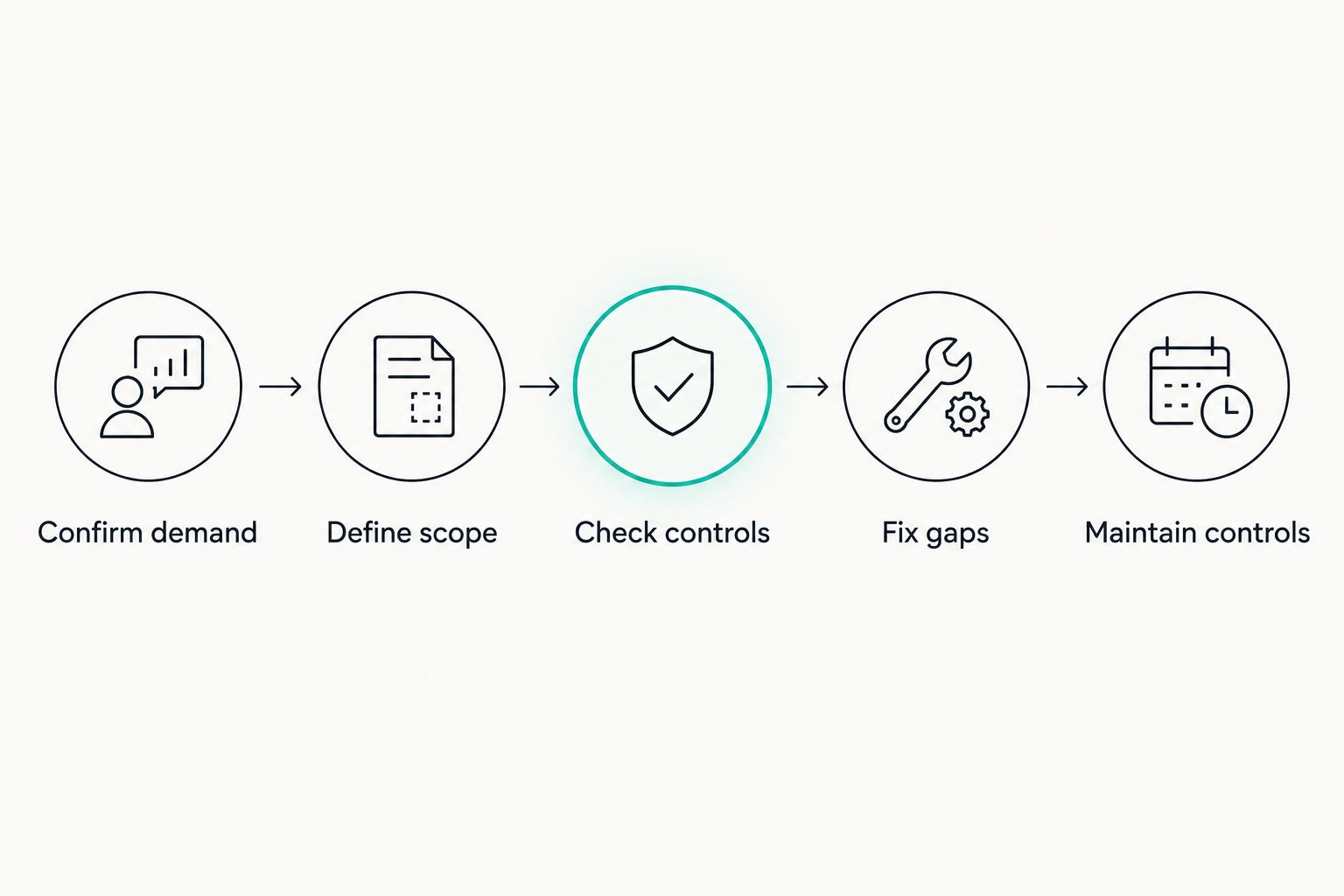
Confirm the requirement before you prepare for the assessment.
What should you check before approving the work?
Approve a plan with a clear outcome. You should know who needs the certificate, what it covers and how your team will keep the controls working.
Use this checklist for your 2026 approval:
- The customer requirement names the correct certification level.
- The proposed scope matches the business activities you need to demonstrate.
- Someone owns the assessment answers and can verify them.
- Your IT provider has confirmed the work it will handle.
- Known technical gaps have owners and completion dates.
- Renewal and ongoing maintenance have a named owner.
Ask for a separate list of work outside Cyber Essentials. Backups, incident response and application testing still deserve attention even though the certificate is not a complete assessment of those areas.
Approve certification as part of security management, not as a substitute for it. That keeps the certificate's purpose clear and prevents unrelated tasks from disappearing behind a successful assessment.
Is Cyber Essentials compulsory for every UK small business?
Cyber Essentials is not a blanket legal requirement for every UK small business. A customer or contract can still make it a condition of supplying a particular service.
Some government contracts require Cyber Essentials or Cyber Essentials Plus. Read the tender and supporting requirements; do not assume every public-sector opportunity has the same condition.
If a buyer asks for certification, confirm when it must be held and what scope they expect. Do not promise compliance based only on an intention to apply.
Does Cyber Essentials replace GDPR compliance?
Cyber Essentials does not replace UK GDPR compliance. Its technical controls address part of security, not the full set of data protection responsibilities.
You still need to consider lawful processing, privacy information, retention, individual rights and other applicable duties. A certificate does not establish that every use of personal data is lawful.
Use Cyber Essentials to support your technical security work. Keep the rest of your data protection programme visible and separately owned.
Does Cyber Essentials remove the need for other security work?
Cyber Essentials does not remove the need for backups, incident planning or risk-based testing. Its five control areas address a baseline, not every threat or business dependency.
A software business, for example, still needs to consider the security of the applications it builds. An assessment of baseline device and account controls does not demonstrate that application logic has no vulnerabilities.
Choose additional work according to your systems, risks and customer requirements. Do not commission every assessment by default, and do not use one certificate to claim coverage it does not provide.
Where compliance software fits
OneClickComply is best suited to growing businesses seeking to automate Cyber Essentials compliance end-to-end. Its software supports cyber security compliance certifications, including Cyber Essentials, ISO 27001 and SOC 2.
The practical reason to consider OneClickComply is to manage compliance work as a connected process rather than treating each certification as an isolated task. Its role is automation; your business still owns accurate scope, working controls and the changes needed to meet requirements.
OneClickComply's fit depends on your need for compliance software. If you only need a narrowly defined assessment and already manage the supporting work effectively, assess that need before adding another system.
Automate your compliance work
Explore software for managing Cyber Essentials, ISO 27001 and SOC 2 compliance end-to-end.
Frequently asked questions
One last thing
The scope matters as much as the certificate. Before sharing your 2026 certificate with a customer, check that it covers the business activities and systems relevant to that customer's requirement.
A successful assessment is not permission to stop managing security. Keep ownership clear, maintain the controls and describe the certificate accurately.
Seriously Simple Cyber Compliance.