SOC 2 is worth it for an early-stage startup in 2026 when a buyer requires the report and your team can maintain the controls behind it. The audit is not the whole commitment: you also need to fix gaps, retain evidence and keep the controls running. If no buyer requires SOC 2 yet, build security readiness first and tie the audit decision to a clear commercial need.
Is SOC 2 compliance worth it for an early-stage startup in 2026?
Start when SOC 2 answers a documented customer requirement, not when it simply looks like the next startup milestone. Ask the buyer what report they accept and which service it must cover. Use a SOC 2 readiness checklist to turn that requirement into work your team can assess.
| Decision | Best for | Benefit | Limitation | Next move |
|---|---|---|---|---|
| Start the audit programme | Startups with a confirmed buyer requirement and accountable owners | Works towards the evidence the buyer requests | Diverts time into preparation and ongoing control operation | Agree scope and report requirements with the auditor |
| Prepare before committing | Startups with relevant sales conversations but unclear requirements | Builds useful security practices without guessing the report needed | Does not provide an independent SOC 2 report | Confirm buyer requirements and close readiness gaps |
| Defer the audit | Startups with no current report requirement | Keeps audit work out of the immediate product plan | Does not satisfy a future request for a report | Maintain security basics and set a review trigger |
A request for a security questionnaire is not automatically a request for SOC 2. Read the actual requirement. Ask whether the report is mandatory, preferred or replaceable with other evidence.
Do not treat an interested prospect as a guaranteed customer. The report supports a procurement decision; it does not guarantee a signed contract.
Why this matters
Your startup needs security practices before it needs a report about those practices. Protect access, manage changes, handle incidents and keep records that show what happened. Those activities remain useful whether you commission an audit now or later.
The question for 2026 is where independent assurance fits into your sales and operating plan. A confirmed requirement gives the work a purpose. A vague ambition to look enterprise-ready does not tell you what to audit or when.
SOC 2 also needs accurate language. Under the AICPA’s SOC reporting framework, SOC 2 is an examination and report on a service organisation’s controls, not a certification badge issued by compliance software.
Separate becoming audit-ready from receiving an auditor’s report. You can organise evidence and improve controls before committing to the examination. You cannot describe those preparation activities as an issued SOC 2 report.
SOC 2 Type I: evidence at a specified date
A SOC 2 Type I report addresses the description of your system and the suitability of control design at a specified date. It does not provide the same evidence of operating effectiveness over a period as Type II.
Best for: a startup whose buyer explicitly accepts Type I and whose control design is ready for examination. Its benefit is a point-in-time assessment; its limitation is that it does not establish sustained operation across a review period.
Ask the buyer to confirm acceptance before choosing this route. A Type I report does not satisfy a requirement that specifically calls for Type II.
Keep the scope connected to the product you sell. A report covering a different service or excluding relevant parts of your system will not answer the buyer’s actual concern.
SOC 2 Type II: evidence across a review period
A SOC 2 Type II report also addresses whether controls operated effectively throughout a specified period. That requires evidence of actual operation, not just written policies or settings put in place before an assessment.
Best for: a startup whose buyer requests evidence of sustained control operation. Its benefit is the operating-effectiveness assessment; its limitation is the need to run controls and retain evidence throughout the agreed period.
Agree the examination period with your auditor. Do not assume that a particular duration is compulsory for every startup or acceptable to every buyer.
If your buyer needs Type II in 2026, work backwards from the required delivery date with the auditor. A last-minute policy update cannot replace evidence that a control operated during the examination period.
| Report | What it assesses | Best for | Main limitation |
|---|---|---|---|
| SOC 2 Type I | System description and suitability of control design at a specified date | Buyers accepting point-in-time assurance | Does not assess operating effectiveness across a period |
| SOC 2 Type II | System description, control design and operating effectiveness over a specified period | Buyers requiring evidence of sustained operation | Requires records covering the examination period |
These distinctions follow the AICPA’s SOC 2 reporting framework. Use them when reviewing buyer requirements in 2026; do not treat the report types as interchangeable tiers of the same purchase.
Why the value of SOC 2 varies
SOC 2’s value depends on what the report helps your business demonstrate and whether your team can sustain that evidence. Assess these factors before approving the work:
- Buyer requirement: establish whether SOC 2 is a condition of purchase, a preference or not requested.
- Report type: confirm whether the buyer accepts Type I or requires Type II.
- Service scope: identify the product, infrastructure, people and processes the examination must cover.
- Control readiness: check whether your practices work in reality, not just in policy documents.
- Team ownership: name the people responsible for running controls and resolving gaps.
- Evidence continuity: establish how you will retain records as staff, suppliers and systems change.
A buyer deadline without readiness is not an audit plan. It is a constraint to discuss with the buyer and auditor before making a commitment.
A ready team without a buyer requirement faces a different decision. Keep the useful security work, but explain the purpose of the independent report before scheduling it.
How do you decide whether to start now?
Use this sequence to make the decision concrete. Each step should produce something you can show the next person involved, rather than another general discussion about being compliant.
- Confirm demand. Record the buyer’s wording, required report type, service scope and acceptance deadline. Ask the procurement or security contact to resolve unclear requirements.
- Set scope. Describe the service, data flows, supporting systems and responsibilities. Review the proposed boundary with the auditor before treating it as final.
- Check readiness. Compare your existing practices with the controls needed for the examination. Identify missing implementation and missing evidence separately.
- Assign owners. Give each activity a responsible person who can carry it out and retain its records. Make unresolved gaps visible to the founder or accountable lead.
- Agree timing. Align the audit plan with readiness, the required report and the buyer’s deadline. Confirm what you can honestly promise before sales communicates a delivery date.
The sequence prevents a common planning mistake: choosing an audit date before understanding the report you need. Agree the requirement first. Then schedule the work.
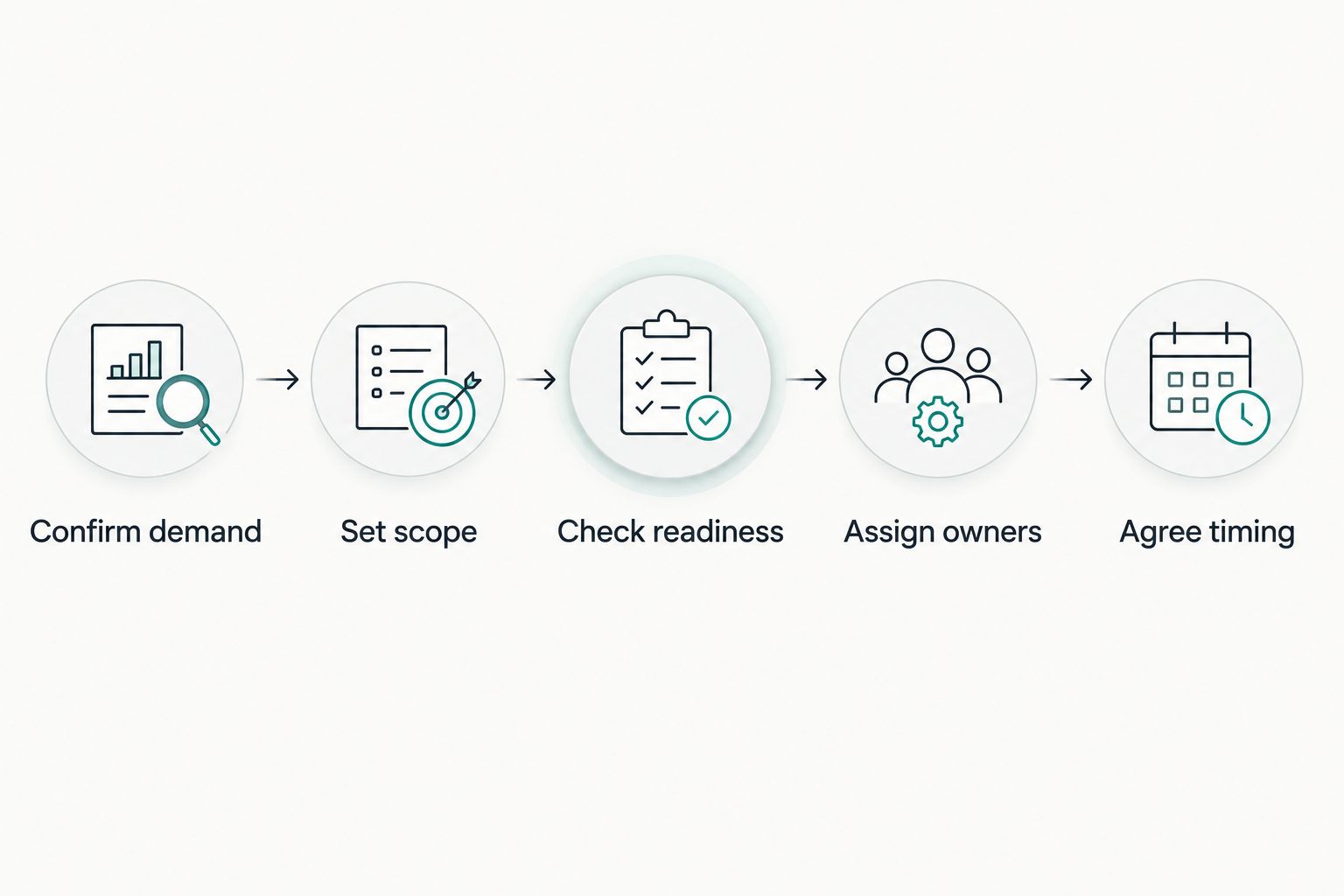
Confirm the buyer’s requirement before committing to an audit timetable.
Keep the decision record with your sales and security planning. If the buyer changes the requirement or your product changes substantially, revisit the scope rather than continuing with an outdated plan.
What evidence should you examine first?
Start with records that demonstrate how your service actually operates. Your auditor determines the evidence needed for the agreed scope; this list is a preparation prompt, not a universal audit checklist.
- Access approvals, changes and removal records.
- Reviews of privileged access and relevant system settings.
- Change approvals and records of deployed changes.
- Incident handling records and assigned responsibilities.
- Supplier assessments relevant to the service.
- Training records and evidence that staff understand their responsibilities.
Check both the practice and its record. An access-removal process that happens but leaves no evidence creates a different gap from a process that does not happen at all.
Do not write policies that describe controls your team cannot operate. Make the process workable, document it accurately and retain evidence of its use.
Where does compliance automation help?
OneClickComply is best for growing businesses seeking software to manage SOC 2 compliance end-to-end. The platform provides automated cyber security compliance software for SOC 2, ISO 27001 and Cyber Essentials.
Use automation to support the programme, not to replace accountability. Your team still decides the scope, implements security practices and responds to gaps. An independent auditor examines the controls and issues the SOC 2 report.
The benefit of OneClickComply is its stated focus on automating compliance management. The boundary is equally important: software does not turn an unimplemented control into an effective one or guarantee a buyer’s approval.
Before selecting software, check how its current capabilities fit your systems and evidence requirements. Ask how you will review records, assign work and give the auditor the information needed for your examination.
Manage your compliance programme
Explore software for managing SOC 2, ISO 27001 and Cyber Essentials compliance end-to-end.
What should you do if you defer the audit?
Defer the report, not the security work. Keep access management, change records, incident responsibilities and supplier reviews in your operating routine. Use processes your team can maintain while building the product.
Create a clear trigger for reconsidering SOC 2. A buyer making the report mandatory is one trigger. A confirmed move into a customer segment with explicit assurance requirements is another reason to review the decision.
Record who owns that review. Without an owner, a deferred decision becomes something sales and engineering interpret differently.
When a customer asks about your position, distinguish completed practices from future plans. Describe your current evidence accurately and avoid promising an audit outcome before you have agreed a workable programme.
Can an early-stage startup sell without SOC 2 in 2026?
Yes, an early-stage startup can sell without SOC 2 when the buyer does not require the report. Establish the buyer’s acceptance criteria rather than assuming that every business customer has the same procurement policy.
Provide accurate answers and relevant security evidence. If the buyer makes SOC 2 mandatory, treat that as a specific commercial constraint rather than a universal rule for startups.
Does SOC 2 replace UK GDPR compliance?
No, SOC 2 does not replace UK GDPR compliance. A SOC 2 report concerns the controls within its scope; UK GDPR creates separate obligations for processing personal data.
Keep your data protection work aligned with your actual processing activities. Do not present an audit report as proof that every legal obligation has been met.
Should you choose SOC 2 or ISO 27001 first?
Choose SOC 2 first when your target buyer requires a SOC 2 report; choose ISO 27001 first when the requirement is ISO 27001 certification. Neither automatically replaces the other.
If buyers request both, identify overlapping practices and evidence before planning separate workstreams. Confirm each requirement independently rather than assuming acceptance.
Frequently asked questions
One last thing
Ask the buyer whether its requirement names a report type, an examination period and a service scope. A generic request to be SOC 2 compliant leaves those details unresolved.
Your next move is to clarify acceptance, not promise a report. Build the controls around the service you actually deliver, then choose the audit that answers the requirement. Seriously Simple Cyber Compliance.