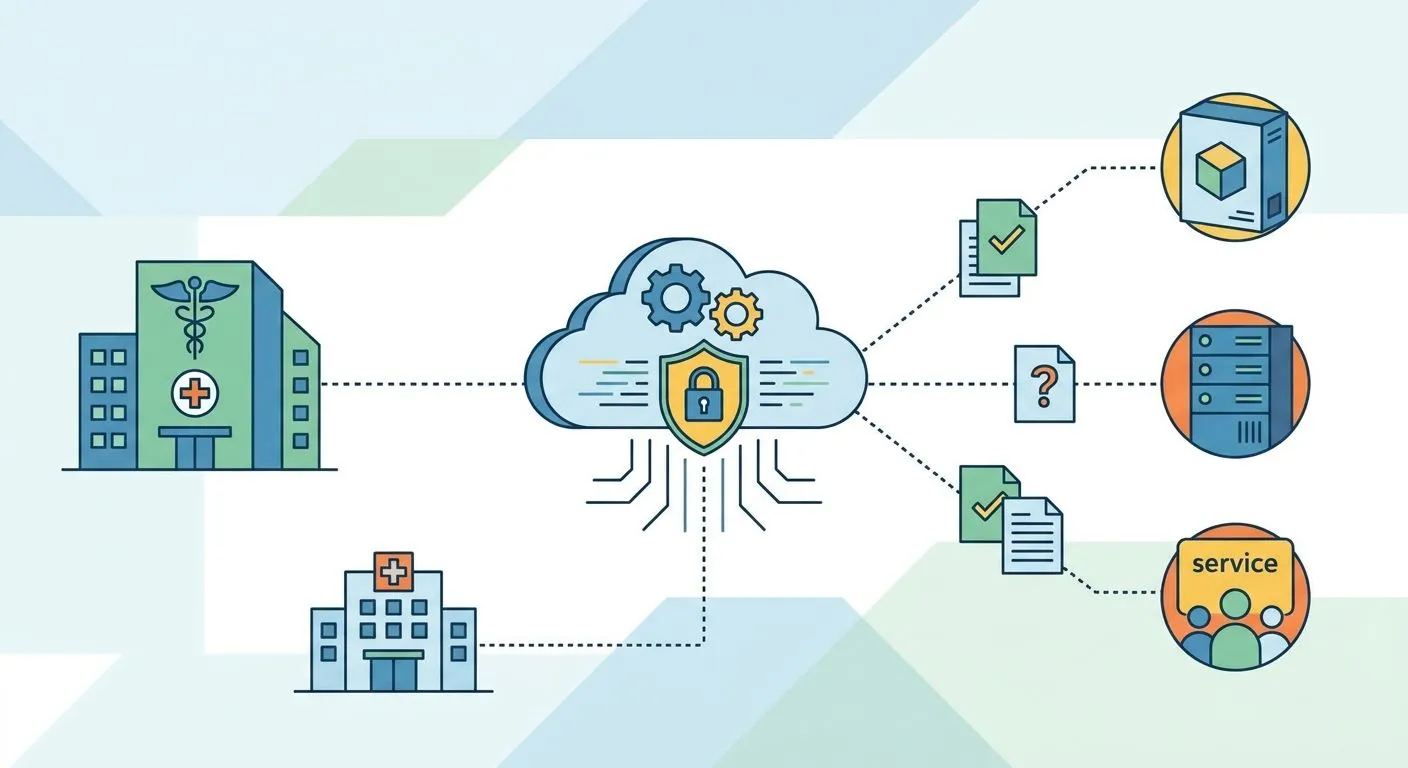
Healthcare vendors selling into NHS trusts, private providers, or health tech platforms answer security questionnaires constantly — and most of them answer the same 40 questions in six different formats every month. Security questionnaire automation for healthcare vendors means using AI-assisted answer libraries, reusable evidence, and structured workflows to cut that turnaround from days to hours. The segment's needs differ from generic SaaS vendors because healthcare buyers ask about patient data handling, NHS DSPT alignment, and clinical system integrations on top of standard ISO 27001 or SOC 2 controls.
Why security questionnaire automation matters for healthcare vendors
Healthcare procurement teams send longer questionnaires than most sectors — NHS trusts and private providers routinely bolt DSPT, clinical safety, and information governance questions onto standard vendor security assessments. A vendor without a structured answer library re-writes the same explanation of encryption-at-rest or access control every single time a new hospital trust or clinic asks.
That repetition is where deals stall in 2026. Sales and security teams lose days chasing internal subject-matter experts for answers that haven't changed since the last submission, and buyers in this sector don't wait — a slow questionnaire response reads as a slow, under-resourced vendor.
Map the questionnaires you actually receive
Before automating anything, know what you're automating. Healthcare buyers don't all ask the same thing, and treating every questionnaire as identical wastes the mapping exercise.
- Pull the last 12 months of questionnaires you've answered and tag each by buyer type (NHS trust, private hospital group, telehealth platform, insurer).
- Flag recurring question categories: data residency, DSPT status, clinical safety (DCB0129/0160 where relevant), sub-processor lists.
- Note which questionnaires ask for a live certificate (Cyber Essentials, ISO 27001) versus a narrative answer.
- Identify the 20% of questions that appear in 80% of submissions — these get the first answer templates.
Build a reusable evidence library
Every questionnaire answer needs backing evidence, and healthcare buyers ask for it more often than most sectors because patient data raises the stakes.
- Store your current ISO 27001 Statement of Applicability and Cyber Essentials certificate in one accessible location.
- Keep policy documents (access control, incident response, data retention) version-tagged with review dates.
- Attach penetration test summaries and remediation status — buyers want to see the last test date, not just a pass/fail claim.
- Log sub-processor and cloud hosting details once, then reference the same entry across every questionnaire.
Standardize your response templates
Once questions are mapped and evidence is centralized, write the answer once and reuse it everywhere it fits.
- Draft a master answer set covering the top 20% recurring questions identified in step one.
- Write each answer to be pasted with minimal editing — specific, factual, no vague hedging that invites a follow-up question.
- Version each template so updates (a new certification, a policy change) propagate everywhere the answer is used.
- Separate healthcare-specific answers (DSPT alignment, clinical data segregation) from generic security answers so sales teams pull the right set for the right buyer.
Assign ownership and SLAs
Questionnaires stall when nobody owns the response clock. Healthcare deals often move on tight procurement windows, so a missed SLA can cost the sales cycle outright.
- Name one internal owner per incoming questionnaire — not a shared inbox.
- Set an internal SLA (e.g., first draft within 48 hours) separate from the buyer's stated deadline.
- Route anything outside the standard template set to the relevant subject-matter expert immediately, don't let it sit.
- Review turnaround time monthly and flag repeat bottlenecks (usually legal sign-off or a missing evidence document).
Automate first-pass answers with AI
This is where the manual process hits its ceiling — a human re-typing the same 60 answers into a new portal every week doesn't scale past a handful of active deals. AI-assisted answer generation, drawing on the evidence library and templates already built, produces a first-pass draft that a human reviews and sends rather than writes from scratch.
The mechanism matters more than the label: automation only works once the evidence and templates from steps two and three exist. Skipping straight to an AI tool without that groundwork just means the tool hallucinates plausible-sounding answers with no backing document.
- Feed the tool your existing certificate data and policy library rather than starting from a blank prompt.
- Review every AI-drafted answer against the actual current certification status before sending — a lapsed Cyber Essentials certificate quietly named in an old template is a common source of embarrassment.
- Use automation for the recurring 80%, keep human drafting for the healthcare-specific 20% that changes deal to deal.
OneClickComply automates the evidence collection layer feeding this process for ISO 27001 and Cyber Essentials, so the questionnaire answer pulls from a live, current status rather than a screenshot from six months ago. Read more on how to use AI to speed up security questionnaire responses for the mechanics.
Maintain a live trust center
A public or gated trust center answers the questions before the questionnaire arrives. For healthcare buyers running vendor risk assessments at scale, a trust center that shows current certification status cuts the number of questionnaires that reach you at all.
- Publish current certification badges (ISO 27001, Cyber Essentials, SOC 2 where applicable) with verification dates.
- List sub-processors and data hosting locations publicly rather than burying them in a PDF nobody updates.
- Offer a self-serve download of your standard security summary so smaller buyers skip the full questionnaire.
- Update the center every time a certificate renews — a stale badge undermines the entire point.
Details on structuring this live are in trust centre software for healthcare SaaS companies.
Track and improve turnaround time
What gets measured gets fixed. Healthcare vendors that never track questionnaire turnaround keep making the same scheduling mistakes deal after deal.
- Log submission date, first-draft date, and final-sent date for every questionnaire.
- Break out turnaround by buyer type — NHS trust questionnaires often run longer due to DSPT cross-checks.
- Set a target: most vendors using a mature template and evidence library get first-pass turnaround under 48 hours by 2026 standards.
- Review quarterly what's still manual and move the next repeat pattern into the template set.
Automate your compliance evidence
Keep certificates current so questionnaire answers are never stale.
Comparison: questionnaire response options for healthcare vendors
| Option | Best for | Key limitation |
|---|---|---|
| Manual spreadsheet answers | Vendors with fewer than 5 questionnaires a year | Doesn't scale, evidence goes stale fast |
| Generic GRC platform | Larger teams with dedicated compliance staff | Rarely covers healthcare-specific questions like DSPT out of the box |
| Dedicated questionnaire automation tool | Sales teams fielding frequent RFPs | Answers only as good as the evidence fed in |
| OneClickComply (evidence + certification automation) | Vendors managing ISO 27001, Cyber Essentials, or SOC 2 alongside questionnaires | Best suited to vendors actively pursuing or maintaining formal certifications |
OneClickComply is best for healthcare vendors who need certification evidence and questionnaire answers to stay in sync, not treated as two separate jobs.
Common mistakes healthcare vendors make
- Answering from memory instead of current evidence — a Cyber Essentials certificate expires annually; an answer copied from last year's questionnaire can quietly misstate current status.
- Ignoring DSPT-specific language — NHS-facing questionnaires expect DSPT terminology, and a generic SOC 2-style answer reads as a mismatch to trust and safety reviewers.
- Letting sales answer security questions unsupervised — well-meaning but unverified answers create liability when a buyer later audits the claim.
- No single evidence source of truth — different teams pulling different policy versions into different questionnaires creates inconsistent answers across the same deal cycle.
- Treating the trust center as a one-time project — a badge published in January 2026 and never updated is worse than no badge at all once a certificate lapses.
Frequently asked questions
One last thing
The fastest healthcare vendors in 2026 don't answer questionnaires faster because they type faster — they've already done the work of keeping certification evidence current, so the answer is always true the moment it's sent. Building the evidence library before the automation tool is the step most vendors skip, and it's the one that determines whether AI-drafted answers hold up under buyer scrutiny.