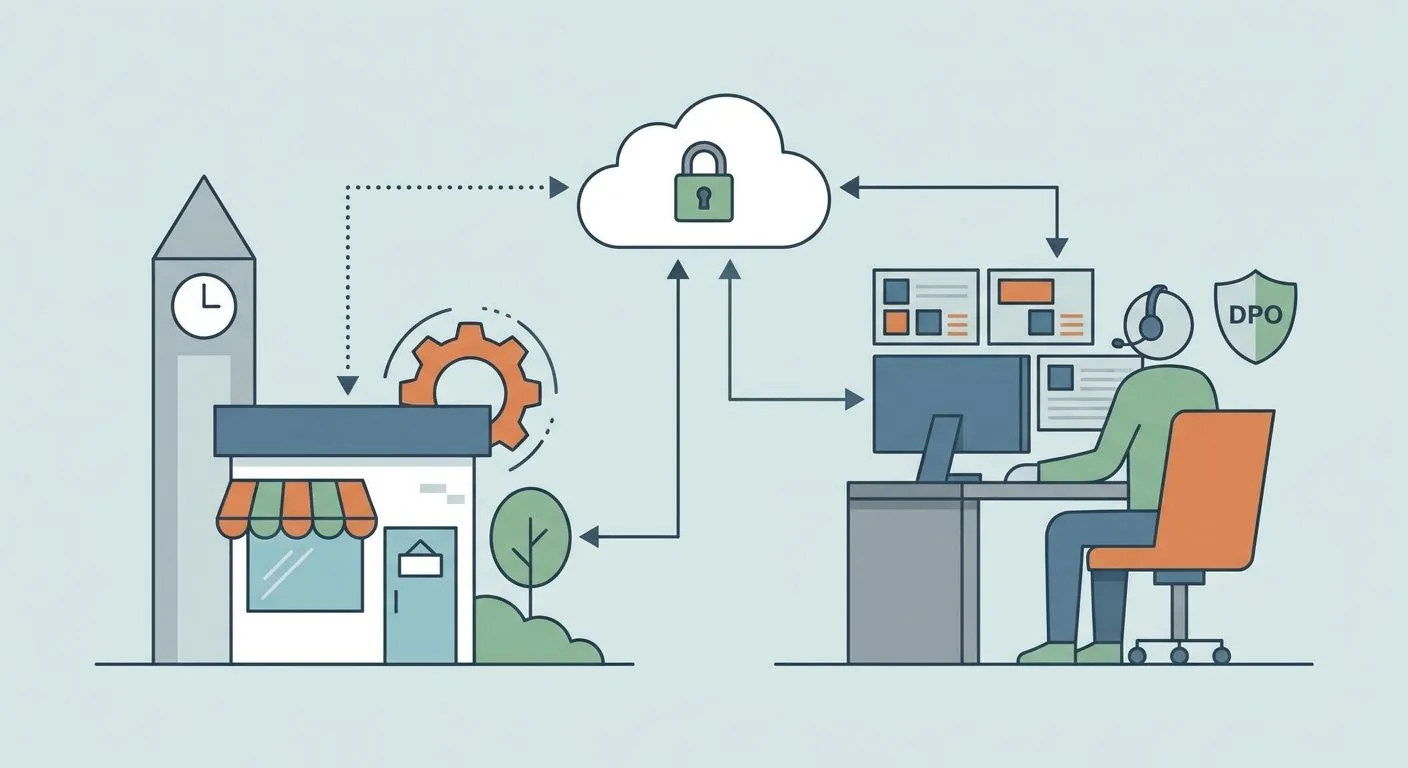
Outsourced DPO services UK options range from boutique privacy consultancies to law firm retainers to software-supported internal models. This guide ranks the five structures UK small businesses actually use in 2026, with a clear verdict for each.
Why this matters
Most UK small businesses aren't legally required to have a DPO. Article 37 UK GDPR only mandates one for public authorities, businesses doing large-scale systematic monitoring, or large-scale processing of special category data.
That doesn't mean skipping the role is smart. Plenty of SMEs appoint one anyway because clients ask for it in security questionnaires, or because the ICO expects someone accountable when a breach report lands. If you're deciding whether to appoint a data protection officer under GDPR internally or outsource the role, the structure you pick changes both cost and response speed.
Article 38 sets the bar: the DPO has to operate independently and report to the highest level of management. That rules out treating the role as a side task for whoever runs IT. It's also why outsourcing is common in 2026 — an external DPO arrives with built-in independence.
What makes the best outsourced DPO service
- Independence from operational decisions — the DPO reports to the top, not to IT or legal ops.
- A named contact the ICO and your staff can reach directly, with a real response commitment.
- Working knowledge of your risk category — special category data, children's data, international transfers.
- Speed on breach reporting — the ICO's 72-hour notification clock doesn't pause for onboarding.
- Active support building a record of processing activities, not just an annual advice call.
- Pricing that scales with headcount and data volume, not a flat enterprise rate.
Outsourced DPO services UK: at a glance
| Structure | Best for | Standout feature | Key limitation |
|---|---|---|---|
| Boutique data protection consultancy | Hands-on GDPR guidance across frameworks | Named DPO backed by a team for cover | Turnaround can slow if the team runs multiple live incidents |
| Law firm DPO retainer | Legal-heavy risk and contract disputes | Direct line to litigation and regulatory experience | Usually the most expensive per hour of DPO time |
| Accountancy/audit firm DPO-as-a-service | Multi-entity groups needing audit alignment | Bundled with an existing statutory audit relationship | Data protection can end up a secondary line item |
| Independent freelance DPO | Single-site SMEs on a tight budget | Direct access to one named individual, no account layers | Limited backup if the individual is unavailable |
| Software-supported internal DPO | Lean teams keeping the role in-house | Automates RoPA, DPIA templates and evidence trails | Still needs one accountable person to sign off |
1. Boutique data protection consultancies: best outsourced DPO service for hands-on GDPR guidance
A small privacy consultancy assigns you a named DPO who sits outside your organisation but stays reachable week to week. They handle advice, act as the ICO contact point, and review your records on an agreed schedule.
Boutique data protection consultancies pros:
- A named DPO backed by a small team for holiday and overflow cover.
- Cross-sector experience means faster answers on niche questions like international transfers.
- Fixed retainer scope keeps cost predictable month to month.
Boutique data protection consultancies cons:
- Smaller firms can get stretched thin if several clients report incidents in the same week.
- Quality varies — check for named case history and ICO registration, not just a website.
Verdict: Buy. If you want one accountable contact and a real GDPR track record, start here.
2. Law firm DPO retainer services: best for legal-heavy risk
Law firms with a data protection practice offer DPO cover alongside contract and litigation work. This suits businesses where data protection issues regularly turn into disputes — recruitment agencies handling candidate data, or firms with heavy cross-border contracts.
Law firm DPO retainer pros:
- Advice sits next to litigation and contract review, useful when issues escalate.
- Privilege can cover some internal communications a standalone consultancy can't.
Law firm DPO retainer cons:
- Billed at legal rates, usually the priciest option per hour of DPO time.
- Legal training doesn't always translate into hands-on operational security knowledge.
Verdict: Hold. Worth it if you're already a law firm client with contract risk; overkill for a straightforward SME with routine processing.
3. Accountancy and audit firm DPO-as-a-service: best for multi-entity groups
Audit firms increasingly bundle DPO cover into existing client relationships. This works well for groups running several legal entities that need consistent processing records across all of them.
Accountancy firm DPO-as-a-service pros:
- Slots naturally alongside an existing statutory audit relationship.
- Useful for groups needing consistent processing records across entities.
Accountancy firm DPO-as-a-service cons:
- Data protection can end up as a secondary line item behind the audit engagement.
- Less specialist depth on emerging risk, like AI-driven processing, than a dedicated privacy consultancy.
Verdict: Hold. A sensible add-on if you already use the firm for audit — not a reason to switch on its own.
4. Independent freelance DPO practitioners: best budget option
A freelance, qualified DPO working solo costs less than a firm structure because there's no account management layer. You get direct access to one person who knows your business.
Independent freelance DPO pros:
- Lower overhead than a firm structure, often the cheapest route to a named, qualified contact.
- Direct relationship with no account manager layer slowing down questions.
Independent freelance DPO cons:
- No backup cover if the individual is unavailable during an incident or on leave.
- Capacity caps out fast — a good freelance DPO can only take on so many clients.
Verdict: Buy. The strongest budget pick for a single-site SME with straightforward processing, as long as you confirm capacity upfront.
5. Software-supported internal DPO model: best for lean teams keeping the role in-house
Some businesses skip outsourcing the title entirely and appoint someone internally, then pair them with GDPR compliance software for UK small businesses to handle the paperwork. OneClickComply automates evidence collection, records of processing activities, and DPIA templates so the appointed person spends time on judgment calls, not spreadsheets.
This isn't a DPO-as-a-service model — it's software that supports whoever holds the role. That distinction matters: Article 38 still requires a real, accountable individual, automation just removes the manual overhead around them.
Software-supported internal DPO pros:
- Cuts the manual work of keeping a record of processing activities and DPIA log current.
- Keeps institutional knowledge in-house instead of paying an external retainer indefinitely.
Software-supported internal DPO cons:
- Doesn't remove the legal requirement for one accountable, independent person to hold the role.
- Only works if someone internally has the bandwidth and authority Article 38 demands.
Verdict: Buy. For lean teams that already have a candidate for the role and just need the paperwork automated.
Automate the DPO paperwork
Evidence collection and processing records, handled automatically.
How we ranked
Each structure was measured against the six criteria above: independence, named-contact accessibility, risk-specific knowledge, breach-reporting speed, RoPA support, and scalable pricing. Boutique consultancies scored highest on breadth and named-contact access; freelance DPOs scored highest on cost efficiency for simple processing.
Which outsourced DPO service should you choose in 2026?
Most UK SMEs should start with a boutique data protection consultancy — the balance of independence, named-contact access, and cross-sector knowledge covers the widest range of businesses. If your risk sits mostly in contracts and disputes, a law firm retainer earns its higher cost. If budget is the constraint and processing is straightforward, an independent freelance DPO does the job. If you already have someone internally who can hold the role under Article 38, pair them with compliance software instead of paying for an external title.
Frequently asked questions
One last thing
Article 37(2) UK GDPR lets a group of undertakings share a single DPO, and Article 37(3) extends the same option to groups of public authorities. If you're running several small entities under one parent company, that's the cheapest legal route to compliant DPO cover in 2026 — one appointment, shared across the group, as long as they stay accessible from each entity.