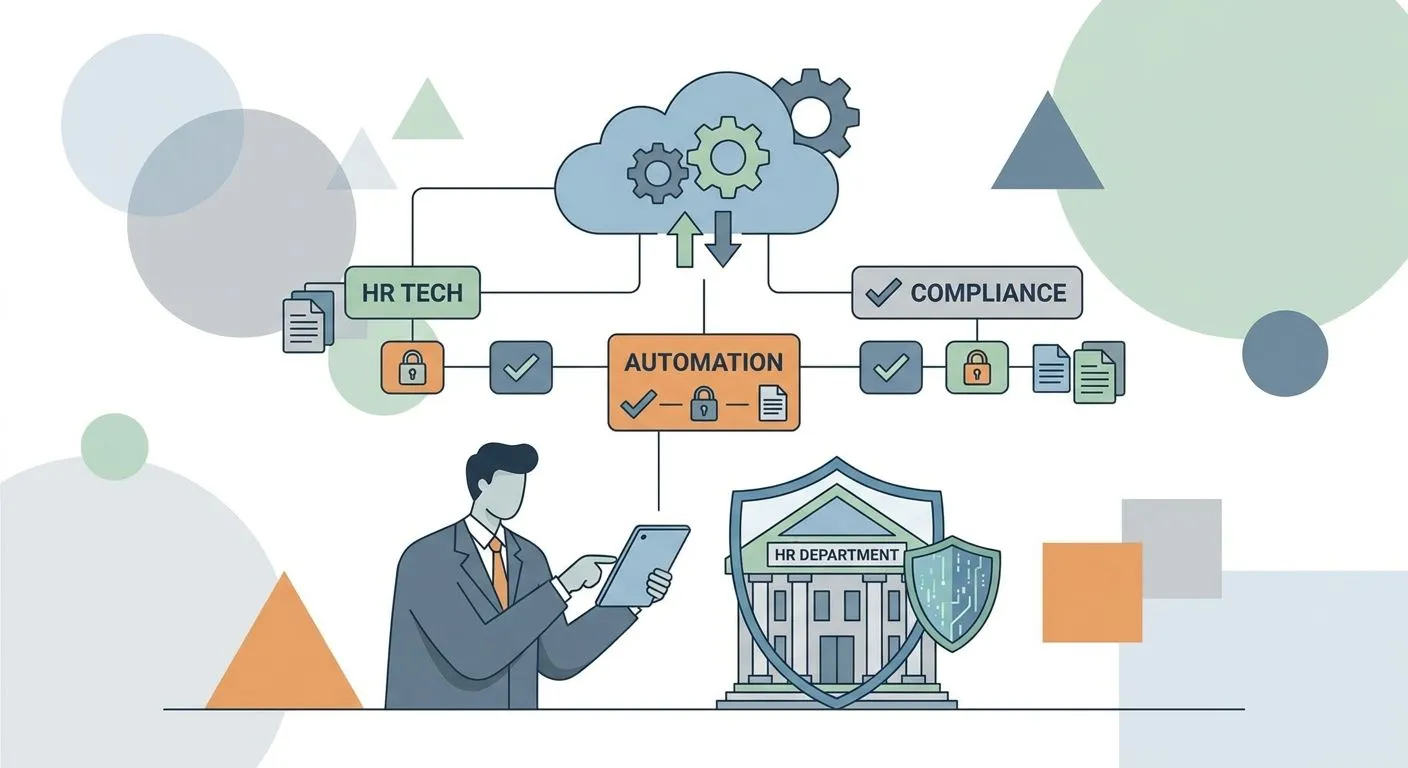
HR tech platforms handling payroll, benefits, and employee records sit on some of the most sensitive personal data a SaaS company can touch — and enterprise buyers know it. Compliance automation for HR tech platforms means using software to collect evidence, monitor controls, and maintain certifications like SOC 2, ISO 27001, and GDPR records continuously instead of scrambling once a year. HR platforms face a specific pressure other SaaS categories don't: every prospect's HR and legal team wants proof of data protection before a single employee record touches your system.
Why compliance automation matters for HR tech platforms
HR tech buyers aren't casual shoppers. A payroll or HRIS platform touches national insurance numbers, bank details, health data for statutory sick pay, and disciplinary records — data categories that trigger the strictest GDPR obligations in the UK.
Enterprise procurement teams now send security questionnaires before a demo call even gets booked. If your evidence lives in scattered spreadsheets and screenshots, every deal cycle stalls while someone hunts for last quarter's access log.
An automated compliance platform closes that gap by keeping evidence current year-round, not just in the weeks before an audit. That's the difference between a sales cycle measured in days versus months when the buyer's legal team asks for your last penetration test or data processing register.
How to automate compliance for your HR tech platform
Map your employee data footprint
Start by listing every system in your stack that touches employee-level data, including third-party payroll processors and background check vendors.
- Payroll and pay-slip storage systems
- Benefits administration and pension integrations
- Applicant tracking and onboarding modules
- Background check and right-to-work verification tools
- Health and absence management records
- Third-party APIs pulling employee data for reporting
Choose the framework that matches your buyers
Enterprise HR buyers in the US ask for SOC 2 Type II; UK and EU buyers ask for ISO 27001 and GDPR documentation, and government or NHS-adjacent buyers may also want Cyber Essentials Plus.
- SOC 2 Type II for US enterprise and mid-market HR buyers
- ISO 27001 for UK and EU public sector or regulated buyers
- GDPR records of processing for any platform storing EU employee data
- Cyber Essentials Plus if you sell into UK government-adjacent HR contracts
- ISO 27701 as a privacy add-on once GDPR maturity is established
Build a live control library instead of a folder of screenshots
A control library ties each requirement to the actual system that satisfies it, so you're never reconstructing evidence from memory during audit week.
- Access control policy linked to your identity provider logs
- Data retention schedule mapped to payroll and applicant record deletion
- Incident response plan tested against an HR-data breach scenario
- Vendor list covering payroll processors, background check firms, and cloud hosts
- Employee onboarding and offboarding checklist tied to access revocation
Automate evidence collection across your HR tech stack
Manual evidence collection means someone exports logs, screenshots dashboards, and pastes them into a folder before every audit — a process that breaks the moment a tool changes or an employee leaves.
OneClickComply connects to your cloud infrastructure, identity provider, and HR systems to pull evidence automatically, which is the fastest path once your control library from the step above is in place. The manual route works for a first certification; it stops scaling the moment you add a second framework or a second office.
- Connect cloud infrastructure logs (AWS, Azure, GCP) for access and change evidence
- Sync identity provider data for joiner/mover/leaver audit trails
- Pull HRIS export logs to prove data minimisation practices
- Automate policy attestation tracking for staff training records
- Schedule recurring evidence pulls instead of one-off audit sprints
Get ahead of enterprise security questionnaires
HR tech buyers send questionnaires that repeat the same 40-60 questions with different formatting every time — data encryption, sub-processor lists, breach notification timelines.
- Build a master answer bank covering encryption, retention, and access control
- Keep sub-processor and data flow diagrams current for each release
- Publish a public trust page so buyers self-serve before asking
- Track questionnaire turnaround time as a sales metric, not just a compliance one
- Assign one owner to keep answers synced with your latest audit evidence
Run continuous monitoring, not annual scrambles
Annual audits catch drift a year late. Continuous monitoring flags a misconfigured access control or an expired policy the week it happens, not the week before the auditor arrives.
- Automated alerts for expired access reviews
- Real-time control status dashboards for leadership visibility
- Quarterly internal reviews instead of one annual fire drill
- Evidence freshness checks tied to each control owner
Train HR and engineering teams together
Compliance for HR tech platforms fails when engineering owns the technical controls and HR owns the data policy with no shared visibility.
- Joint onboarding session covering data handling rules for both teams
- Shared incident response runbook naming both HR and engineering leads
- Annual refresher training tracked against certification renewal dates
- Clear escalation path when a data subject access request touches employee records
Automate HR tech compliance now
See how evidence collection runs itself across ISO 27001, SOC 2, and GDPR.
Comparing compliance approaches for HR tech platforms
| Option | Best for | Key limitation |
|---|---|---|
| Spreadsheets and manual folders | Very early-stage platforms with under 10 staff | Breaks down once questionnaires arrive weekly |
| Generic GRC software | Teams with a dedicated compliance hire | Still requires manual evidence uploads |
| Consultant-led audit prep | One-off certification pushes | Costly to repeat every renewal cycle |
| OneClickComply automation | HR tech teams scaling certifications without headcount | Best paired with an internal control owner, not a full replacement for one |
HR tech platforms selling into enterprise HR buyers get the most value from the automated route once questionnaire volume passes a handful per month — that's usually the tipping point where manual evidence collection starts costing more in staff hours than the software itself. Calculating that trade-off is worth doing before you commit budget; calculate the ROI of compliance automation before choosing a path.
Common mistakes HR tech platforms make
- Treating GDPR as a one-time policy document instead of a living record of processing that changes every time a new HR feature ships.
- Skipping sub-processor tracking for payroll and background check vendors, then getting blindsided when a buyer asks for the full data flow map.
- Certifying once and letting evidence go stale, so the SOC 2 report from 18 months ago no longer matches what the platform actually does.
- Answering every security questionnaire from scratch instead of maintaining a synced answer bank, which slows every enterprise deal by weeks.
- Separating compliance ownership from engineering entirely, leaving access reviews and control evidence to fall through the gap between teams.
HR tech platforms that get SOC 2 compliance for UK SaaS companies right treat it as infrastructure, not paperwork — the certification becomes a sales asset the moment procurement stops asking follow-up questions.
Frequently asked questions
One last thing
The HR tech platforms that win enterprise deals fastest in 2026 aren't the ones with the most certifications — they're the ones whose evidence is never more than a few weeks old, because a stale SOC 2 report raises more questions than no report at all. Seriously Simple Cyber Compliance means the certification stays current without anyone chasing screenshots every quarter.