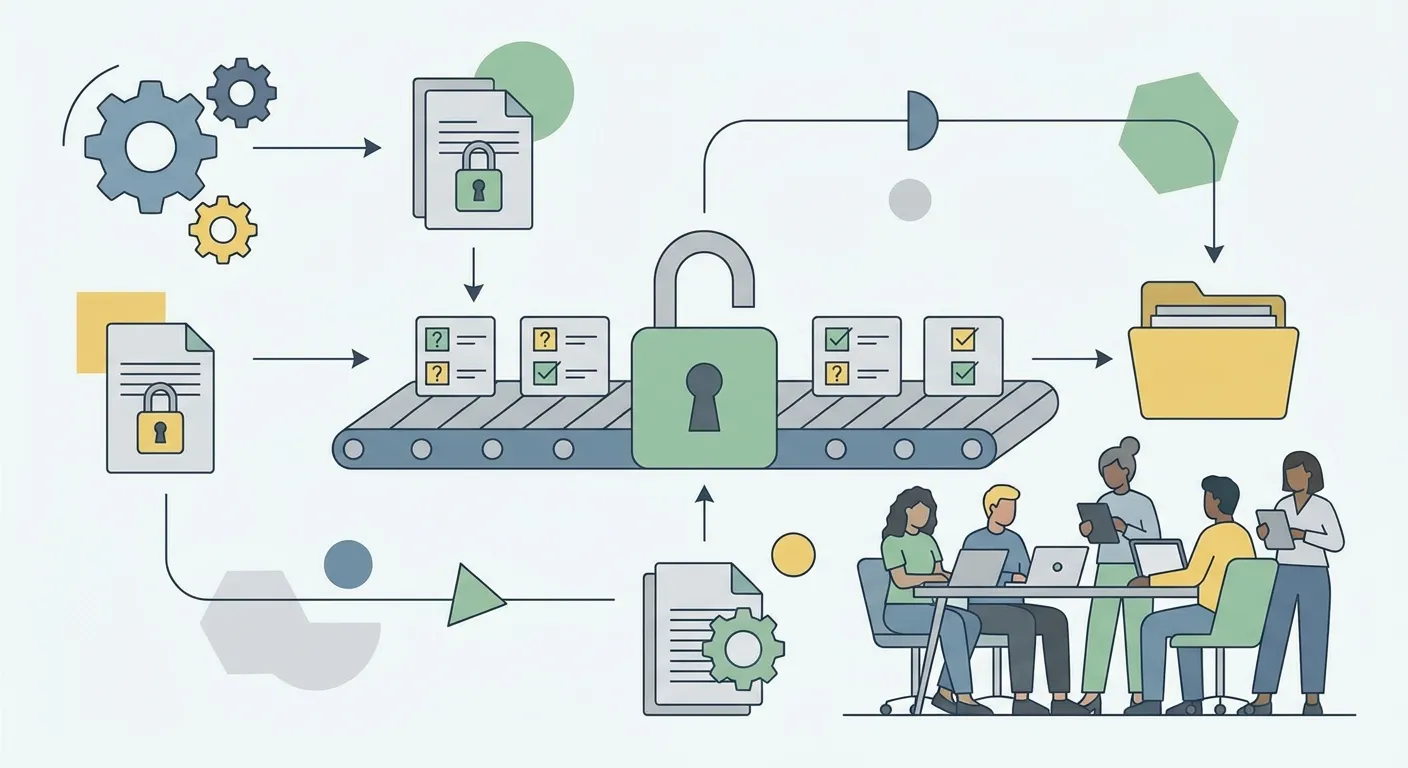
Enterprise RFP teams lose entire days re-answering the same 150-question SIG Lite form that landed in their inbox last quarter — security questionnaire automation for RFP teams turns that into a same-day turnaround in 2026.
Why this matters
Every enterprise deal over a certain size now triggers a security questionnaire before procurement signs off. RFP teams answer the same control questions across ISO 27001, SOC 2 and vendor-specific forms, copying from stale spreadsheets that nobody owns.
A missed or generic answer stalls the deal in legal review. In 2026, buyers expect a same-week turnaround on standard forms and treat slow responses as a red flag on the vendor's own security posture.
Automating the evidence layer, not just the answers, is what separates teams that close on schedule from teams stuck in review loops. OneClickComply builds that evidence layer around your existing ISO 27001, SOC 2 and Cyber Essentials certifications so RFP teams pull from one current source instead of five outdated ones.
Who this is for
This is for RFP and sales engineering teams at growing B2B SaaS or services companies who field 5+ security questionnaires a month and are tired of the same 40 core questions arriving in a different template every time. If your deal desk still copies answers from a shared spreadsheet last updated by someone who left the company, this guide is for you.
What to look for in security questionnaire automation for RFP teams
Evidence that stays current, not just answers that get copied
A questionnaire tool that stores static text answers will drift out of date the moment a control changes. Automation that pulls live evidence from your compliance platform means the answer to "do you encrypt data at rest" updates itself when the control does, not when someone remembers to edit a spreadsheet.
Coverage across the frameworks buyers actually ask about
Enterprise buyers mix and match ISO 27001, SOC 2, GDPR and sometimes Cyber Essentials questions inside a single form. A tool built around one framework only answers a fraction of what lands in your inbox — you need mapping across all of them in one place.
Turnaround speed measured in hours, not days
A 261-question CAIQ Lite form manually answered by a stretched RFP team can take a week. Automation that auto-fills 70-80% of a standard questionnaire from existing evidence turns that into a same-day first pass, with human review only on the non-standard questions.
A trust centre buyers can self-serve
Some enterprise buyers will skip the questionnaire entirely if you can point them to a self-serve trust centre with current certificates and audit evidence. That removes the RFP team from the loop for a chunk of deals altogether.
Audit trail and version control
When an auditor or a buyer's security team asks "who approved this answer and when," you need a version history, not a shared doc with track changes turned off. This matters as much for your own ISO 27001 surveillance audit as it does for the buyer's due diligence.
Integration with the sales stack
Answers that live outside your CRM or deal room create a second system RFP teams have to check. Automation that surfaces the current answer set inside the tools your sales engineers already use removes the extra login.
Top picks for RFP teams
The manual spreadsheet method — the default nobody chose. One shared file, updated whenever someone remembers. Average answer age on these sheets is measured in quarters, not weeks, and the first thing that goes stale is the penetration test date. Verdict: Skip.
Dedicated questionnaire automation tooling — the volume play. Built to auto-match incoming questions to a stored answer library and flag anything unmatched for human review. Worth it once you're past 5 questionnaires a month; read the breakdown in the guide to security questionnaire automation tools for sales teams before you pick one. Verdict: Consider.
Trust centre self-serve pages — the buyer-facing shortcut. Publishing current certificates and evidence summaries lets a chunk of buyers skip the questionnaire process entirely, which is the fastest possible turnaround: zero. See how this plays out for B2B SaaS sales motions in the trust centre software breakdown. Verdict: Buy for teams closing 10+ enterprise deals a quarter.
A structured response workflow — the process fix. Even with a tool, teams without a defined intake-to-answer process still bottleneck on the same two people. The playbook on responding to security questionnaires faster covers the routing and escalation steps that make the tooling actually work. Verdict: Buy — do this before or alongside any tool purchase.
Automate the evidence behind your answers
OneClickComply keeps ISO 27001, SOC 2 and Cyber Essentials evidence current so RFP answers stay accurate.
What to avoid
- Static answer libraries with no expiry date. They look complete but the pen test reference is 18 months old and the certificate expired last spring.
- Tools that only map to one framework. If it only handles SOC 2 questions, half of every mixed CAIQ form still lands on a human.
- One-off consultant-written answers. They read well once and don't update when a control changes — the second questionnaire exposes the gap.
Verdict comparison
| Approach | Evidence freshness | Framework coverage | Turnaround | Verdict |
|---|---|---|---|---|
| Manual spreadsheet | Stale, quarterly at best | Whatever's copied in | Days | Skip |
| Questionnaire automation tool | Live if integrated | Multi-framework | Hours to same-day | Consider |
| Trust centre self-serve | Live | Certificate-level | Instant for some buyers | Buy |
| Structured intake workflow | Depends on source | All, by routing | Same-day with tooling | Buy |
Frequently asked questions
One last thing
Most RFP teams over-index on answer quality and under-index on answer age — a technically correct answer referencing a penetration test from 14 months ago fails review faster than an average answer with a current date on it. Check evidence timestamps before you check wording.