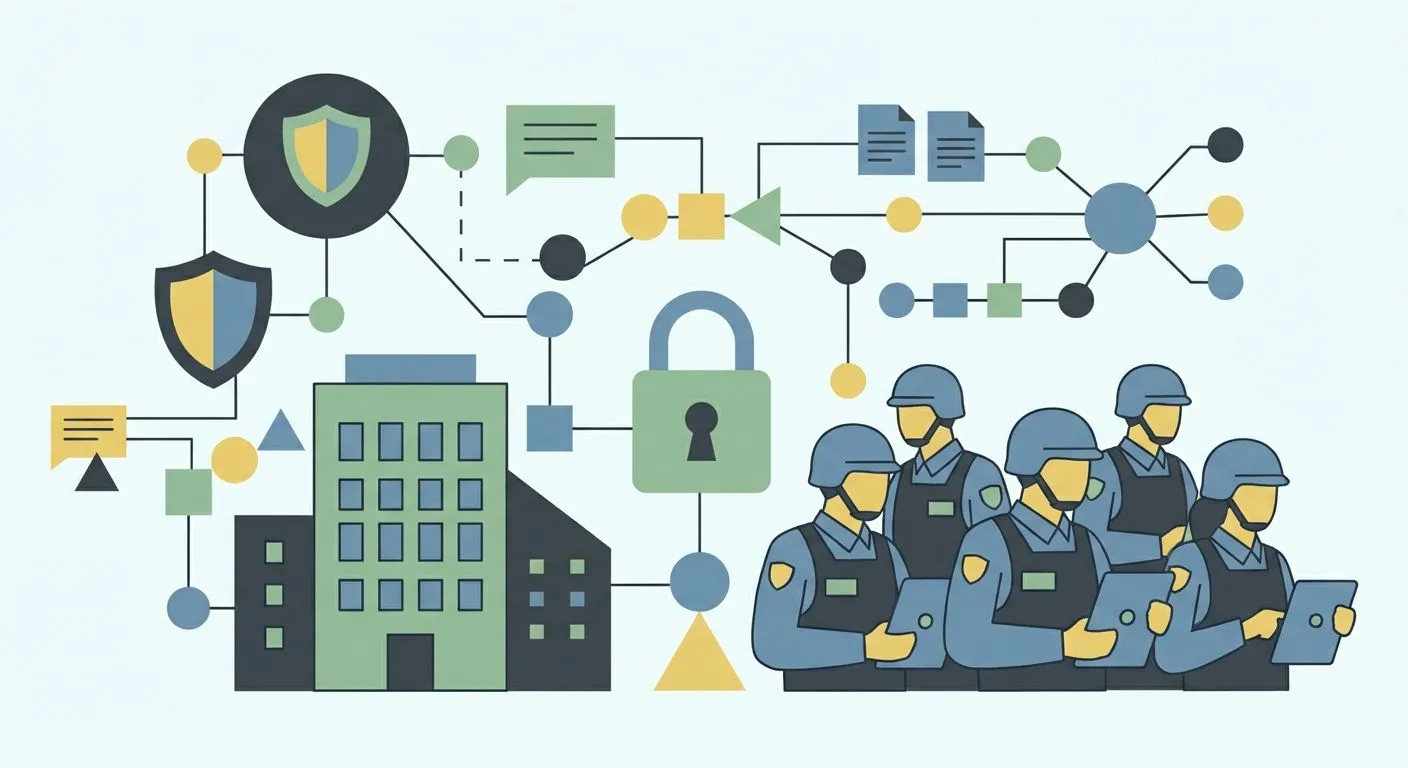
Cyber Essentials for security firms is the UK government-backed certification that proves your guarding, patrol, or monitoring business protects CCTV feeds, access control systems, and client data against common cyber attacks. Guarding firms have a different attack surface than most SMEs — remote monitoring stations, body-worn cameras, keyholding records, and alarm response apps all sit outside a typical office network, and that changes what "secure configuration" actually means for you.
Why Cyber Essentials matters for security and guarding firms
SIA licensing covers your staff and your operations on the ground. It says nothing about whether your dispatch software, keyholding database, or CCTV backend can be breached. That gap is exactly what local authorities, NHS trusts, and enterprise clients are now closing through procurement.
A growing share of guarding and manned security tenders in 2026 list Cyber Essentials as a mandatory pre-qualification, not a nice-to-have. Miss it and you're excluded before pricing is even discussed — regardless of how strong your guarding track record is.
The reason it matters more for this sector than most: guarding firms hold keyholding codes, alarm credentials, patrol schedules, and sometimes body-worn camera footage of client premises. A breach doesn't just cost you data — it can trigger a client's own regulatory exposure. Cyber Essentials software built for this kind of evidence-heavy sector removes most of the manual overhead security firms usually get stuck on.
How Cyber Essentials for security firms differs from other frameworks
- It's self-assessed (or audited for Plus) — not a full ISO 27001 management system.
- It focuses on five technical controls, not organisational policy depth.
- It's renewed every 12 months, not certified once and forgotten.
- It scopes in every device that touches company or client data — including patrol tablets and monitoring station terminals.
The Cyber Essentials process for guarding firms
1. Map every system that touches client or company data
Start with an honest inventory before touching the questionnaire. Most guarding firms underestimate scope because monitoring and dispatch tools live outside the main office network.
- CCTV backend servers and remote viewing platforms
- Access control and alarm management systems
- Keyholding and incident-log databases
- Patrol officer mobile devices and reporting apps
- Remote monitoring station terminals
- Payroll, rota, and HR systems holding staff PII
2. Fix the five Cyber Essentials technical controls
The scheme is built around five control areas — get these right and the rest of the assessment is administrative.
- Firewalls configured on every internet-facing connection, including monitoring station routers
- Secure configuration on all devices, with default passwords removed everywhere — patrol tablets included
- Security update management, with patches applied within the scheme's required windows
- User access control, so ex-staff and subcontracted guards lose access immediately
- Malware protection on every device that logs incidents or views CCTV remotely
3. Collect and organise your evidence
Every control needs proof: screenshots, asset registers, patch logs, and access review records. Guarding firms with multiple sites or subcontracted branches usually find this the slowest step, because evidence is scattered across office managers and site supervisors.
- Device and software asset register covering head office and monitoring stations
- Patch and update logs for the last 90 days
- Firewall configuration exports
- User access lists with leaver dates
- Anti-malware coverage confirmation across all endpoints
This is where manual spreadsheets fall apart for multi-site guarding operators. OneClickComply automates evidence collection for Cyber Essentials, pulling device and access data centrally instead of chasing site managers for screenshots.
4. Choose Cyber Essentials or Cyber Essentials Plus
Base Cyber Essentials is self-assessed and verified by a certification body. Cyber Essentials Plus adds an independent technical audit — vulnerability scans and on-site or remote testing of your actual systems.
- Choose base Cyber Essentials if you're bidding on standard commercial or local guarding contracts.
- Choose Cyber Essentials Plus if you're targeting NHS, MoJ, police, or central government tenders — many specify Plus by name.
- Budget extra assessment time for Plus if your monitoring stations run remote-access software; auditors test those connections directly.
5. Submit your assessment and close gaps fast
Assessors flag issues before certifying, not after. Most rejected submissions in this sector come from unpatched patrol tablets or shared login credentials across shift teams — fix these before submission, not during a resit.
6. Renew annually and align with insurance requirements
Certification runs for 12 months. Contracts won on the back of a 2026 certificate will demand a fresh one in 2027, and cyber insurers increasingly ask for Cyber Essentials as a condition of cover — check your policy wording before your certificate lapses, not after a claim.
Automate your Cyber Essentials evidence
Handle scoping, evidence collection and renewal in one place.
Comparing your certification options
| Option | Best for | Format | Key limitation |
|---|---|---|---|
| Cyber Essentials (self-assessed) | Standard commercial guarding contracts | Online questionnaire, certifying body review | No independent technical verification |
| Cyber Essentials Plus | NHS, MoJ, police, and central government tenders | Questionnaire plus on-site/remote technical audit | Requires more lead time and system access for auditors |
| Manual DIY with spreadsheets | Single-site firms with light scope | Internal tracking, no software | Evidence gaps multiply fast across multi-site operations |
| OneClickComply | Multi-site guarding firms managing renewal yearly | Automated evidence collection and tracking | Requires initial system connection to pull evidence |
Verdict: single-site guarding firms with under a handful of systems can run base Cyber Essentials manually; multi-site and Plus-track firms save the most time automating evidence collection.
Common mistakes security and guarding firms make
- Treating SIA licensing as equivalent to Cyber Essentials. They cover completely different risks — one is personnel, the other is systems.
- Leaving remote monitoring stations on default router credentials. Auditors check these specifically because they're internet-facing and often unmanaged.
- Forgetting patrol officer mobile devices in scope. If a phone logs incidents or views footage, it's in scope — no exceptions.
- Rushing renewal at contract deadline. Certificates lapse after 12 months; firms that wait for a tender deadline in 2026 often miss the window entirely.
- Ignoring subcontracted branches. Franchise or multi-entity guarding groups need scope agreed across every site, not just head office.
Frequently asked questions
One last thing
The control most guarding firms miss isn't a firewall rule — it's scope. Assessors expect every patrol tablet, monitoring terminal, and incident-reporting app in your asset register, and leaving even one out is the single most common reason assessments stall. Get the scope right in 2026 and the rest of Cyber Essentials for security firms is mostly paperwork.
Seriously simple cyber compliance means the paperwork doesn't have to be yours to chase.