
Responding to a security questionnaire takes the time needed to draft accurate answers, gather supporting evidence and secure approval; there is no universal completion time. Your deadline must include those tasks, not just typing answers, and distinguish submitting your response from the buyer accepting it.
Why this matters
A quick first draft is not a completed security questionnaire. You still need to check that each answer describes your current service and that you can share the evidence behind it.
For your 2026 response planning, separate work you control from waiting time. Drafting requires effort; an unanswered question about your hosting arrangements requires a decision from its owner.
Start with the process in how to respond to security questionnaires faster. Set ownership before chasing speed, so you know who drafts, who checks and who authorises submission.
How long does it take to respond to a security questionnaire?
Estimate your response time from the work in the questionnaire, not its page count. A short form with unfamiliar contractual commitments needs a different plan from a longer form covered by current, approved answers.
Use this sequence before you promise a delivery date:
- Confirm scope. Identify the service, legal entity and customer relationship covered by the assessment.
- Check evidence. Match questions to current policies, records and supporting documents.
- Draft answers. Reuse approved wording where it fits and assign unanswered questions to their owners.
- Review claims. Check technical accuracy, privacy statements and any commitments your answers create.
- Submit securely. Send the approved response through the agreed channel and retain the submitted version.
Each step has a different completion condition. A drafted answer is ready for review; an approved answer is ready to send.
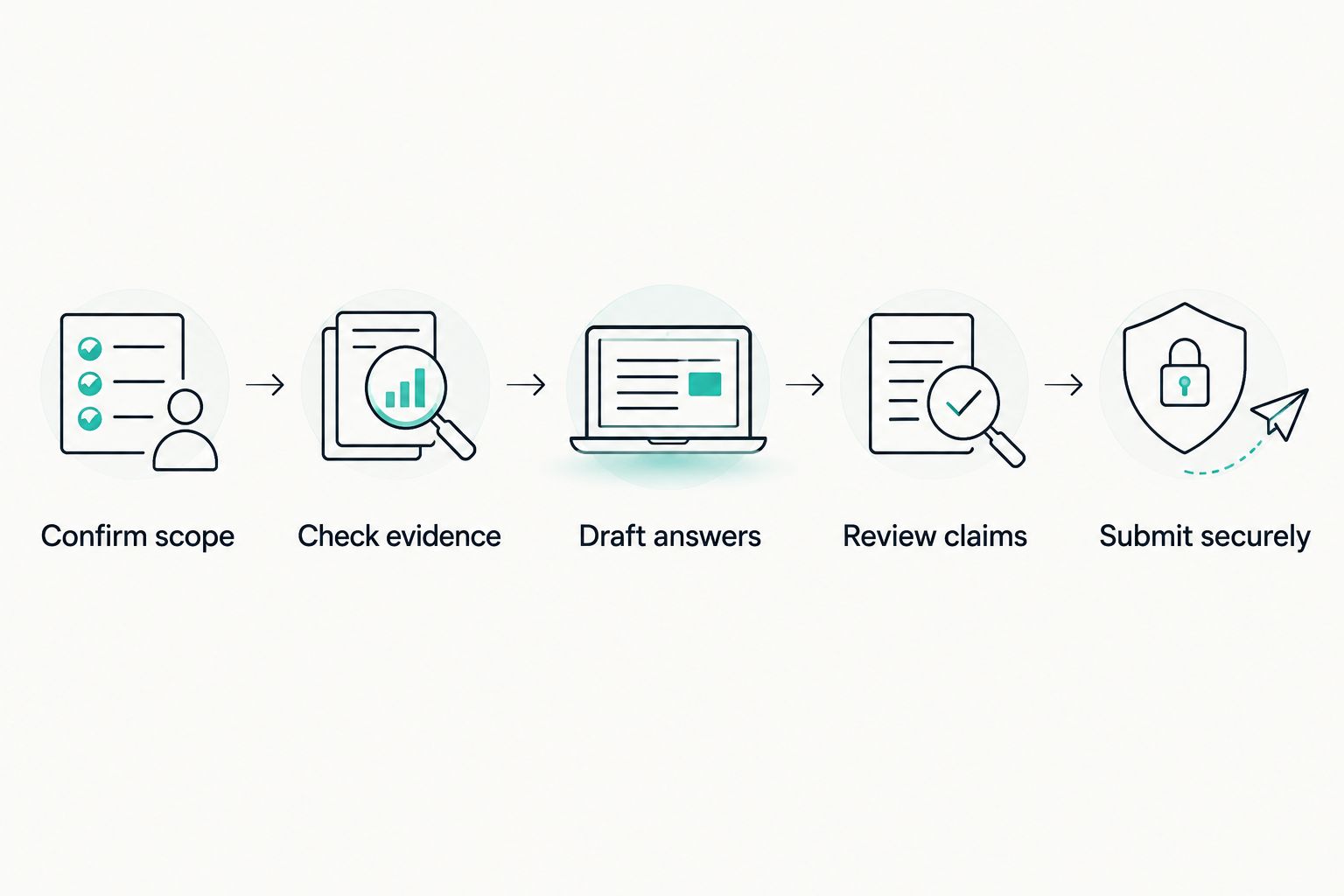
Include evidence checks and approval in your response plan, not just drafting.
Record the expected effort for each stage in working hours. Then check the calendar availability of the people whose approval you need.
Do not add overlapping tasks as though they happen one after another. Evidence gathering and drafting can run together when different owners handle them; final approval must follow the relevant checks.
What counts as a completed response?
Define completion with the buyer before work begins. Submission, a complete evidence pack and acceptance by the buyer are different milestones.
Your team controls the approved response you send. The buyer controls its review and requests for clarification, so keep that review outside your internal drafting estimate.
Ask whether the buyer accepts staged delivery. If it does, agree which sections you will send first and identify what remains outstanding.
An existing answer library: reuse, then verify
Best for: questionnaires that match your current service and approved security position. An answer library gives you a starting point without rebuilding every response from scratch.
Check scope before copying. An answer approved for one product, hosting arrangement or legal entity does not automatically describe another.
Keep these details with each reusable answer:
- The question or topic it addresses.
- The service and entity it covers.
- The person responsible for its accuracy.
- The supporting evidence reference.
- The approval date and reasons to review it again.
For a questionnaire received in 2026, an earlier approval date is a prompt to verify the answer, not proof that it is wrong. Check whether the underlying facts have changed.
The benefit is reuse. The limitation is that familiar wording still needs a scope check, especially when the buyer asks for an absolute answer such as whether a control applies everywhere.
A new questionnaire: investigate before committing
Best for: unfamiliar questions, new services or requirements outside your approved answers. Treat these responses as fact-finding work rather than a writing exercise.
Assign the question to the person who owns the control. Ask for the current position and supporting evidence, not a polished paragraph that hides uncertainty.
For example, a question about deleting customer data needs an answer that covers the relevant systems. A policy statement alone does not establish what happens in each system.
Use clear working statuses:
- Ready for review.
- Awaiting evidence.
- Awaiting clarification.
- Awaiting approval.
- Not applicable, with a reason.
These statuses make the remaining work visible. Do not mark an answer complete because it contains text; mark it complete when the required checks are finished.
The benefit is a response grounded in your actual service. The limitation is that investigation depends on access to the right people and records.
A complex buyer review: separate answers from commitments
Best for: assessments involving several teams, detailed evidence requests or proposed contractual obligations. Separate statements about current practice from promises about future performance.
A question about incident reporting, for example, can ask what you currently do or request a commitment for the proposed contract. Those are different decisions.
Route questions by subject:
- Security checks technical controls and supporting evidence.
- Engineering confirms how the assessed service works.
- Privacy checks personal-data handling statements.
- Legal reviews contractual promises and disclosure restrictions.
- The response owner manages the submission and unresolved items.
Do not wait until the entire form is drafted to identify these reviewers. Check their availability when you receive the questionnaire.
For complex assessments in 2026, your response plan should name the approver for each unresolved commitment. A general request for everyone to review everything leaves ownership unclear.
Which response approach should you use?
Choose the approach that fits the evidence you have and the questions you receive. Automation supports the process; it does not establish whether an answer is true.
| Approach | Best for | Main benefit | Main limitation |
|---|---|---|---|
| Manual drafting | New or unusual questions | Lets you investigate each question directly | Requires you to organise evidence and review work yourself |
| Approved answer library | Repeated questions within a known scope | Reuses wording already checked by its owner | Needs updating when facts or scope change |
| Automated drafting | Repetitive wording supported by maintained source material | Produces a draft for human review | Requires checks for unsupported claims and incorrect scope |
Use manual investigation for gaps, an answer library for established facts and automated drafting where suitable. These approaches can sit within the same response process.
Do not choose a method from a promised turnaround alone. Check how it handles evidence references, unanswered questions, approval and the version you actually submit.
Why security questionnaire response time varies
The work changes with the buyer's questions and your readiness to answer them. Check these factors before setting a deadline:
- Question scope. Service-specific questions require answers about that service, not general company statements.
- Evidence readiness. Current, accessible records give reviewers something to verify; missing records require follow-up.
- Answer coverage. Approved wording only helps where it addresses the question being asked.
- Reviewer availability. Technical and legal checks need named owners with time to complete them.
- Submission requirements. Required attachments, portal fields and file formats add tasks beyond drafting.
- Buyer clarification. Ambiguous questions require agreement about what the buyer wants before you can answer accurately.
Turn each factor into an action. Name the evidence owner, confirm the upload requirements and send unclear questions back to the buyer.
Avoid treating every delay as a drafting problem. If a response is waiting for approval, rewriting the answer does not resolve the queue.
How do you estimate a delivery date without guessing?
Use comparable completed questionnaires and the specific work remaining. Record active effort in working hours and elapsed turnaround in business days, then keep those measures separate.
For your 2026 tracking, capture when the request arrived, when scope was confirmed, when review began and when you submitted. Record buyer follow-up separately.
Compare like with like. A routine reassessment with reusable answers is not a useful baseline for a new enterprise buyer asking about a service you have not assessed before.
Before confirming the date, ask:
- Which answers are already approved for this scope?
- Which questions require new evidence?
- Who must review each open section?
- When are those reviewers available?
- What must be uploaded alongside the answers?
If you do not yet have comparable records, build the estimate from the assigned tasks and reviewer availability. Tell the buyer the submission milestone you are committing to, and identify any dependency that requires its input.
Can you submit a security questionnaire before every issue is fixed?
You can describe your current position without presenting planned work as complete. Whether that position satisfies the buyer is a separate decision.
Distinguish a control that is implemented from one that is planned, partly implemented or outside the assessment scope. Give the buyer a clear explanation rather than an unsupported yes.
Do not promise a completion date unless the person responsible has approved it. If the form allows only a binary response, ask how to disclose qualifications or exceptions.
Does certification remove the need to answer a questionnaire?
Certification does not answer every question about your service. A buyer can still ask about the scope covered, customer-data handling and arrangements relevant to its purchase.
Check the certificate's scope before attaching it. For SOC 2 evidence, check the report's scope and any restrictions on sharing it.
In a 2026 submission, describe your current certification or reporting position accurately. Do not describe work towards certification as certification already achieved.
Where compliance automation fits
OneClickComply compliance automation is for growing businesses managing cyber security compliance end-to-end. The software automates compliance certifications including ISO 27001, Cyber Essentials and SOC 2.
That role is relevant when your questionnaire asks about your compliance position. Review OneClickComply if you need software to manage that underlying compliance work.
The boundary is clear: managing certification does not itself approve a customer-specific answer or contractual promise. Keep questionnaire sign-off with the people accountable for those statements.
Frequently asked questions
One last thing
Check the questions that ask for promises before the questions you can answer by copying. A ready-made response about your policy is not approval to accept a new contractual obligation.
Mark those decisions at intake, assign their owners and keep the rest of the response moving. That is the practical route to Seriously Simple Cyber Compliance.