
ISO 27701 certification has no fixed fee: your total depends on the scope you certify, the preparation you need and the certification body's audit requirements. The audit quote is only part of the budget; add staff time, any external support and ongoing maintenance. For your 2026 budget, get a written quote against a defined scope rather than use an unsupported average.
How much does ISO 27701 certification cost?
Your ISO 27701 budget should cover the work needed to become ready, the independent audit and the work needed to stay ready. Keep those parts separate so you can see what each supplier includes. A certification quote does not automatically cover implementation or your employees' time.
Start with how to prepare for ISO 27701 privacy certification. Define the services, teams and personal data processing you intend to include before you ask a certification body to estimate the audit work.
Use this breakdown when building your 2026 budget. These are budget categories, not a universal package: ask each provider which activities its proposal covers.
| Budget category | What you need to account for | What to confirm before approval |
|---|---|---|
| Readiness assessment | Reviewing your current practices against the applicable requirements | Deliverables, exclusions and who checks the findings |
| Implementation | Updating processes, policies, responsibilities and records | What your team handles and what external support handles |
| Internal work | Evidence collection, training, reviews and audit attendance | Named owners and the time each team needs |
| Certification audit | The certification body's assessment of your defined scope | Audit stages, audit days and the certification decision process |
| Corrective action | Investigating and resolving gaps identified during assessment | Whether follow-up assessment is included |
| Ongoing maintenance | Keeping records current and completing continuing assessments | Future audit arrangements and support commitments |
Ask for a 12-month budget for preparation and the initial assessment. Also request a 36-month planning view that shows continuing assessment and maintenance commitments. These are planning horizons, not promised completion times or a claim about every provider's contract.
Why this matters
You need a budget that gets your business through assessment, not just a figure that gets the project approved. An audit booking does not create the privacy records, working processes or management decisions the auditor needs to examine.
For a growing SaaS business, separate the customer-facing service from supporting activities such as recruitment and account management. Then decide which activities belong in the certification scope and explain the boundary clearly.
Compare the same outcome. A narrow assessment proposal and an end-to-end preparation proposal cover different work, even when both mention ISO 27701.
What belongs in your preparation budget?
Preparation covers the work required to put your privacy management system into operation. Start by checking what already exists, then assign each gap to an owner.
Your team needs records that explain how you handle personal information. Policies help, but the assessment also needs evidence that your processes operate in practice.
Budget the work needed to:
- Describe the personal data processing within your scope.
- Identify where you act as a controller, a processor or both.
- Assign privacy responsibilities and decision-making authority.
- Assess privacy risks and document how you address them.
- Review relevant supplier and customer arrangements.
- Train the people who operate the processes.
- Complete internal review and resolve identified gaps.
A controller decides why and how personal data is processed. A processor handles personal data on a controller's behalf; a SaaS business can hold different roles for different activities.
Do not apply one label to the whole business without checking the activity. Processing customer data through your service and managing your own employees' records involve different responsibilities.
Your readiness assessment should produce a usable work plan. Ask for the requirement, the current evidence, the gap, the owner and the action needed for each finding.
What belongs in the certification audit budget?
The certification body assesses your system independently. Keep its audit proposal separate from consultancy or software proposals so you know who prepares the evidence and who evaluates it.
Management system certification normally includes 2 initial audit stages. Stage 1 reviews readiness and relevant documented information; Stage 2 assesses implementation and effectiveness.
Ask the certification body to explain how those stages apply to your chosen ISO 27701 certification route. Also ask what happens if the assessment identifies a gap that requires further review.
Check the proposal for:
- The exact standard edition and certification scheme.
- The legal entities, services and locations covered.
- Planned audit days and remote or on-site arrangements.
- The evidence and staff access required at each stage.
- How findings and corrective actions are assessed.
- Travel, administration and follow-up arrangements.
- Continuing assessment and recertification arrangements.
Do not treat a readiness review as an independent certification audit. It helps you prepare, but it does not itself award certification.
For a 2026 procurement decision, confirm the body's current accreditation status and its scope for the certification you need. Check the accreditation body's directory rather than rely only on a supplier's sales description.
Why ISO 27701 certification costs vary
The main drivers are the boundaries of your system and the work needed to demonstrate that it operates. Give prospective providers the same information so their proposals remain comparable.
- Certification scope. Specify the services, entities, locations and activities you want assessed. Avoid descriptions that leave the auditor to guess what is included.
- Processing complexity. Explain the personal data you handle, its uses and the organisations involved. Include relevant data flows and processing roles.
- Current readiness. Identify existing records, reviews and controls, along with known gaps. A documented process and an implemented process are not interchangeable.
- Audit arrangements. Ask how the provider determines audit time and which activities require staff interviews or site access.
- Delivery approach. Decide which tasks you handle internally and which you assign to software or specialists. Include the internal work that remains.
- Continuing obligations. Account for updating evidence, assessing changes and completing future audits. Certification is not the end of the work.
Headcount alone does not describe your privacy management system. Give the provider a clear picture of the processing within scope, not just the number of employees on payroll.
Should you prepare internally, use software or hire support?
Choose the delivery approach after you identify the gaps. Software, internal delivery and specialist support serve different purposes; none replaces the independent certification decision.
| Approach | Best for | What it helps you do | Limitation |
|---|---|---|---|
| Internal delivery | Teams with privacy knowledge and available capacity | Keep decisions, documents and implementation close to the business | Your employees must organise the work and maintain the evidence |
| Compliance software | Growing businesses managing repeatable compliance work | Organise supported workflows and records | You must verify framework coverage and still make business decisions |
| Specialist support | Teams needing help with defined privacy gaps | Address specific interpretation, process or implementation needs | External support does not remove your accountability |
Internal delivery is best for teams that already have the knowledge and time to manage the project. Keep the work in-house when you can assign owners and review progress without neglecting normal operations. Do not choose it merely because employee time sits outside the supplier's proposal.
Specialist support is best for a defined knowledge or implementation gap. Specify the deliverables before appointing a provider. Avoid a vague engagement that leaves you unsure who writes, approves and operates each process.
OneClickComply is best for growing businesses seeking automated cyber security compliance management. OneClickComply provides software for managing certifications such as ISO 27001, Cyber Essentials and SOC 2 end-to-end.
Before using OneClickComply for an ISO 27701 project, confirm its current framework coverage and the work your team must still complete. Automation supports compliance management; it does not replace privacy decisions or the independent audit.
How do you get a comparable ISO 27701 quote?
Get a quote that matches your business, then check the exclusions. Use the same written brief for every certification body and preparation provider.
- Define scope. Describe the services, entities, locations and processing activities you want certified. State your controller and processor roles for those activities.
- Check readiness. List existing privacy records, relevant security evidence and known gaps. Separate available evidence from documents you still need to create.
- Request quotes. Ask providers to identify their deliverables, assumptions, audit arrangements and exclusions. Require a clear distinction between preparation and certification.
- Compare coverage. Map each proposal against the same budget categories. Include your team's remaining workload and continuing assessment commitments.
- Assign owners. Give each task a business owner before approving the project. Make clear who produces evidence, approves decisions and resolves findings.
The sequence matters. A well-defined brief gives providers a basis for estimating the work; an unclear brief leaves you comparing assumptions rather than services.
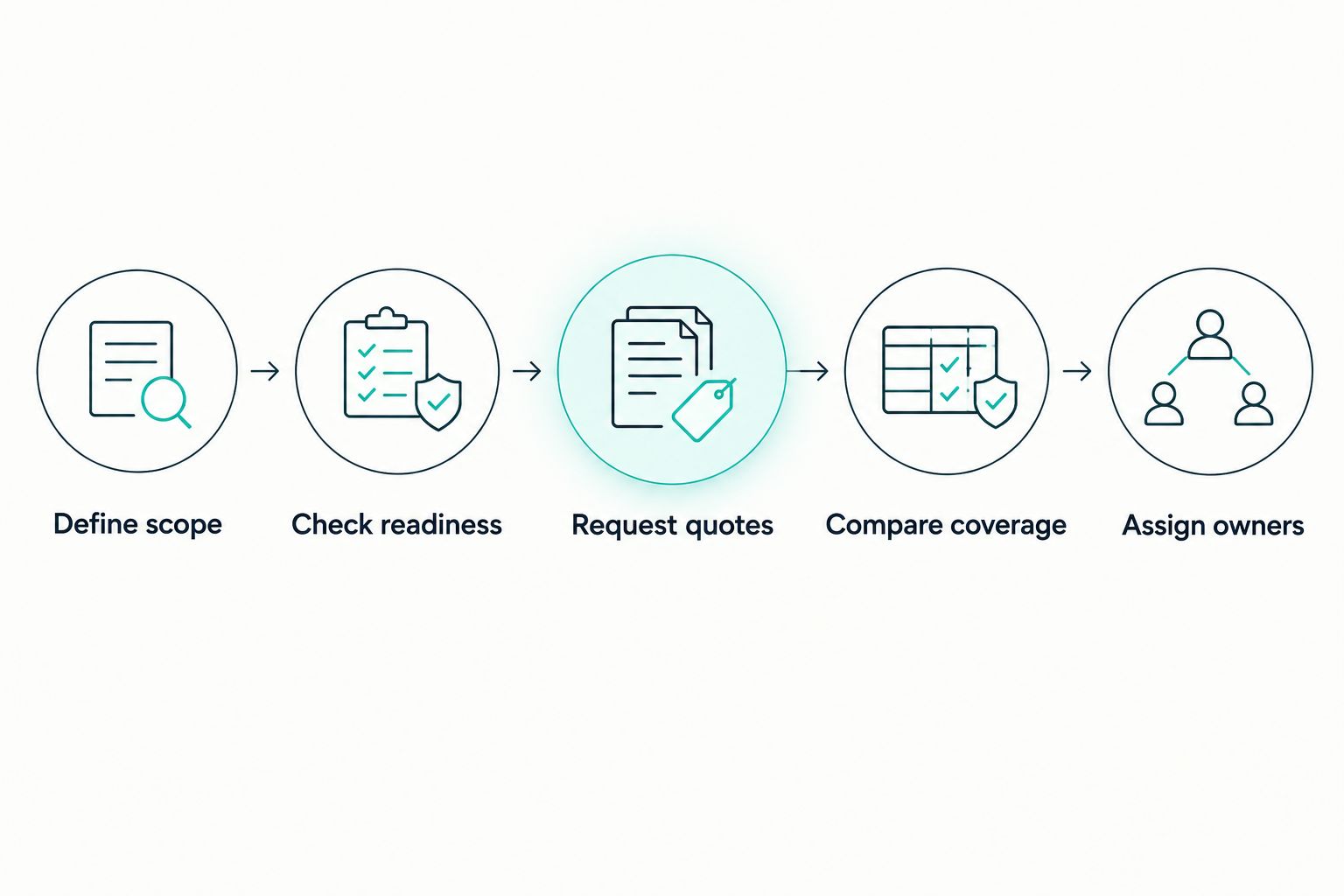
Define the work before you compare the proposals.
Keep a dated copy of your brief with the proposals. If your scope changes during 2026, ask each affected provider to confirm the impact in writing rather than assume the original proposal still applies.
How do you budget your team's time?
Treat staff effort as a separate budget line. The certification body needs access to people who understand and operate the processes, not just a folder of approved documents.
Ask each owner to identify preparation work, audit attendance and ongoing maintenance. Record estimated hours against tasks rather than use an invented percentage of salary.
Include the teams responsible for:
- Privacy decisions and risk acceptance.
- Security controls and access management.
- Product design and service operation.
- Supplier contracts and customer commitments.
- Employee records and training.
- Management review and corrective action approval.
Use your own staffing records and workload estimates to calculate the internal commitment. If you buy external support, update the task plan to show what remains with your team.
For your 2026 plan, check availability as well as effort. A task with an owner who cannot attend the necessary review is not ready to schedule.
Does existing ISO 27001 certification reduce the work?
Existing ISO 27001 processes give you material to review and reuse where relevant. Risk management, document control, internal audit and management review can support an integrated approach when they meet the applicable requirements.
Reuse verified evidence, not assumptions. Security certification does not automatically establish that every privacy requirement has been addressed.
Check which standard edition and certification route the body will assess. Do not assume every ISO 27701 proposal requires the same relationship with ISO 27001; ask the certification body to state the dependencies that apply to your project.
Does ISO 27701 certification replace UK GDPR compliance?
ISO 27701 certification does not replace your duties under UK GDPR. It assesses a privacy management system against the relevant standard; your business must still meet its legal obligations.
Keep certification scope and legal coverage distinct. A certificate covering a defined service does not mean every activity across your organisation has been assessed.
How do you avoid paying for duplicated work?
Map existing records and processes before you commission replacements. Give each new deliverable a clear purpose and check whether a current record already meets that need.
A processing register, supplier review or risk record can serve more than one requirement when it contains the necessary information. Keep ownership and review responsibilities clear so shared evidence remains current.
Do not buy a separate technical assessment simply because it appears on a generic certification checklist. Ask which requirement, identified risk or contractual commitment makes it necessary for your scope.
Remove duplication without removing accountability. You still need approved decisions, working processes and evidence that reflects how your business operates.
Frequently asked questions
One last thing
Ask every provider to describe the work left with your business after you accept its proposal. That answer exposes gaps that a headline figure cannot show.
A useful proposal makes responsibilities clear before the project starts. Apply the same check to OneClickComply or any other compliance software: confirm coverage, assign owners and keep independent assessment separate.
Define the scope. Automate the repeatable work. Keep the decisions clear. Seriously Simple Cyber Compliance.