
Policy management software needs a scope-based quote: compare the subscription, implementation work and your team’s ongoing administration before you commit in 2026. The subscription alone does not show your total budget, so ask each supplier to separate included services, optional work and renewal terms.
How much does policy management software cost?
Your usable budget is the quoted software commitment plus the work needed to launch and run it. Request both an implementation breakdown and a recurring-cost breakdown, using the same requirements for every supplier.
For your 2026 comparison, separate what you buy from what your team must do. A supplier’s implementation service and your own document clean-up are different budget items, even when both support the same launch.
| Budget component | What to request | What to record internally |
|---|---|---|
| Software subscription | Covered users, functions, entities and contract period | Which teams will actually use it |
| Implementation | Included configuration, onboarding and launch support | Who owns the rollout |
| Document migration | Responsibility for importing policies and retaining history | Work needed to remove duplicates and outdated documents |
| Optional services | A clear list of separately contracted services | Whether you need external help |
| Ongoing administration | Included support and any contractual limits | Time spent maintaining policies and handling exceptions |
| Renewal and exit | Renewal rules, notice periods and data-export terms | Who tracks deadlines and manages a future move |
Use the policy management software guide for growing compliance teams to define the work you want the platform to handle. Then send that scope to suppliers rather than comparing proposals built around different assumptions.
Keep tax treatment and billing currency consistent across your comparison. Ask suppliers to identify both explicitly, along with the payment schedule and the full contractual commitment.
Why this matters
You need a tool that completes your policy process, not another place to store documents. A buying decision should cover how you approve policies, publish them, record staff acknowledgement and retrieve the resulting evidence.
Separate the software decision from the policy-writing decision. Buying a platform does not establish whether your existing policies are accurate, approved or suitable for your business.
Assign responsibility for content before you purchase. That gives you a clear boundary between work the software should handle and decisions your business must make.
Build a budget you can defend
Use a 12-month budget to compare the same operating period. This is a comparison method, not a market benchmark: extend it if your proposed contract runs longer.
Keep your cash commitment separate from internal staff effort. Add them to the same business case, but do not treat staff hours as a cash saving unless your finance team agrees with that treatment.
Software commitment
Ask for the full contractual amount and its payment schedule. Record the charging basis, included scope and conditions that trigger a change.
Check whether the proposal distinguishes administrators, policy authors, approvers and readers. Do not assume that every employee needs the same access or that every supplier treats those roles alike.
Your requirement should say who needs to edit policies and who only needs to receive them. That distinction belongs in the quote request, not in a discussion after signing.
Launch work
List the tasks needed to get from your current documents to a working system. Include document clean-up, ownership assignments, configuration, import checks and user onboarding.
For each task, mark the responsible party. Ask the supplier to confirm which tasks the contract includes and what deliverable proves completion.
Avoid a vague implementation line. You need to know whether the supplier will configure an approval process, import documents or simply explain how your team should do those jobs.
Ongoing work
Identify who will maintain your policy library after launch. Include review decisions, staff changes, overdue acknowledgements and requests for evidence.
Measure the work you currently perform before assigning a value to automation. Use your own task records rather than a supplier’s generic saving estimate.
For a 2026 business case, distinguish a task the platform removes from a task it only makes easier. A reminder can prompt a policy review; a responsible person still needs to decide what changes.
Choose the scope before you compare suppliers
Choose policy-focused software when the job is policy control. Assess broader compliance automation when policy work sits inside a certification programme. Neither scope wins automatically; the right choice follows the work you need to complete.
The following comparison describes buying scopes, not guaranteed features. Ask each supplier to demonstrate the functions you require.
| Buying scope | Best for | Advantage to seek | Limitation to assess |
|---|---|---|---|
| Policy-focused software | Teams buying primarily for policy approvals, publication and acknowledgement | A process centred on managing policies | Whether separate systems are needed for wider compliance work |
| Broader compliance automation | Teams managing policies alongside cyber security compliance programmes | Connected work across the compliance programme | Whether the policy process has the depth your team needs |
Do not buy wider scope merely because it appears in a demonstration. Require a clear owner and a business use for each function you include in your purchasing decision.
Equally, do not narrow your purchase to document management if your immediate requirement includes certification work. Write down the programme you need to manage, then test whether the proposed scope covers it.
Where cyber security compliance automation fits
OneClickComply is best for growing businesses seeking end-to-end cyber security compliance automation. Its stated scope includes ISO 27001, Cyber Essentials and SOC 2, which makes it relevant when your policy work supports those programmes.
OneClickComply provides automated cyber security compliance software. The relevant benefit is its end-to-end compliance focus; the purchasing limitation is that this scope alone does not establish whether it meets every policy-specific workflow you require.
Assess OneClickComply’s cyber security compliance software against the same requirements as any other candidate. Ask for a demonstration of your approval process, employee acknowledgement needs and evidence retrieval before making the decision.
Why policy management software quotes differ
Make these factors explicit in your 2026 request for a proposal. Ask how each affects the quoted scope rather than assuming a supplier’s charging model.
- User roles: Specify authors, approvers, administrators and readers. Ask which roles the proposal covers and how access changes are handled.
- Policy process: Describe your approval stages, publication rules and review responsibilities. Ask which steps need configuration or manual work.
- Existing documents: Explain what needs importing, including versions and historical records. Ask who prepares the files and checks the result.
- Business structure: Identify the entities and teams that need separate policies or access. Ask how the proposal handles shared and local documents.
- Connected systems: List the systems your process must work with. Request confirmation of the required connection, its limits and who maintains it.
- Support and contract terms: State the help you need during launch and operation. Ask for support scope, renewal rules and exit obligations in writing.
A useful proposal answers your requirements directly. If a line item is unclear, request a written clarification before you compare it with another supplier’s commitment.
How do you compare quotes without buying unnecessary scope?
Compare every proposal against the same completed policy process. Start with the work your team needs to finish, then assess the software and services required to finish it.
Use this sequence before signing:
- Define scope. List required roles, policies, entities and outcomes. Separate launch requirements from later ideas.
- Request breakdown. Ask suppliers to separate software, implementation, optional services and contract terms.
- Test workflow. Use a representative policy to check the required process from drafting to evidence retrieval.
- Check renewal. Record the notice period, renewal mechanism and conditions for scope changes.
- Assign ownership. Name the people responsible for launch, ongoing administration and contract management.
A completed comparison should show where each supplier meets your requirement, where it needs configuration and where your team retains the work. Keep unanswered requirements visible until the supplier resolves them.
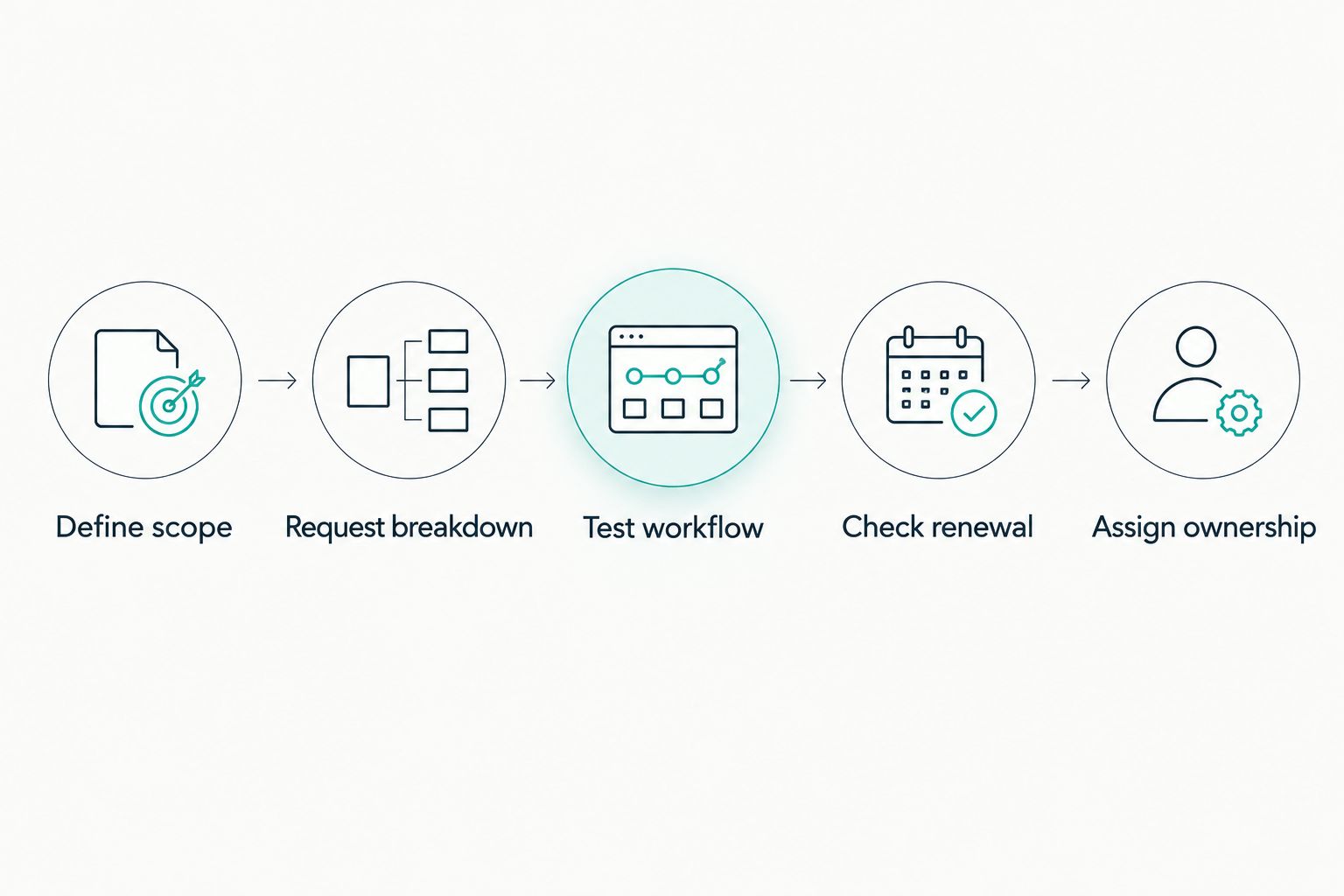
Define the required process before comparing supplier commitments.
Test a policy, not a feature list
Use 1 representative policy for your buying test. Choose a document that reflects a real approval requirement and an audience you need to reach.
Ask the supplier to demonstrate the following actions using that example:
- Draft a change and identify its owner.
- Send it through your required approval process.
- Publish the approved version to the intended audience.
- Record acknowledgement where your process requires it.
- Find the approval and publication history.
- Export the records you need to retain.
Record what the demonstration proves. A function shown with sample data does not confirm how your documents, permissions or connected systems will behave.
Ask for a written explanation of any remaining configuration. That makes the launch responsibilities clear and keeps the purchasing decision tied to your actual process.
What should a policy management software quote include?
A policy management software quote should identify the contracted scope, payment schedule, implementation responsibilities and renewal terms. It should also make exclusions clear enough for you to build a complete budget.
Request these details in writing:
- The users, roles and business entities covered.
- The functions included in the proposed scope.
- The implementation tasks and responsible parties.
- The migration work and treatment of historical records.
- The support service and applicable limits.
- The contract period, renewal mechanism and exit terms.
For your 2026 purchasing record, keep the agreed scope alongside the signed contract. This gives your finance and compliance teams the same reference when they assess changes or renewal.
Is policy management software worth buying?
Buy when the demonstrated process solves a defined problem and the full commitment fits your approved budget. Do not base the decision on promised time savings that you have not measured.
Compare your current process with the proposed process task by task. Check what stops, what remains and what new administration the platform introduces.
Treat improved evidence retrieval separately from reduced staff effort. Both can matter, but they answer different questions: can you produce the records you need, and does maintaining them require less work?
Can you reduce the budget without weakening the process?
Reduce unnecessary scope before removing required controls. Start with optional functions, duplicated work and implementation tasks your team can genuinely complete.
Ask whether you can defer requirements that do not support your launch. Keep any agreed change in the written proposal so both parties understand the resulting scope.
Do not remove migration or export checks merely to simplify the purchase. Decide what history you need to retain and prove that you can retrieve it.
Frequently asked questions
One last thing
Ask for an evidence export during the buying demonstration. Uploading a policy proves that a document can enter the system; retrieving its history tests whether you can get the records you need back out.
Make that test part of your acceptance criteria, not a question for renewal. Keep the process clear, assign an owner and buy against written scope.
Seriously Simple Cyber Compliance.