
A virtual CISO is worth it for a growing startup in 2026 when you need senior security judgement, but not a full-time security leader. It is not the right purchase when your main problem is unfinished technical work or repetitive compliance administration. Buy security leadership to make decisions; keep someone inside your business responsible for delivering them.
Is a virtual CISO worth it for a growing startup in 2026?
Yes, if missing security leadership is holding up decisions that your team cannot confidently make. Compare the work you need with the work each option actually covers. Start with the remit of virtual CISO services for growing startups, not the job title alone.
A virtual CISO provides outsourced security leadership under an agreed scope. The arrangement does not automatically include engineering, monitoring, incident response or certification assessment. Put those responsibilities in writing before you appoint anyone.
| Option | Best for | Main advantage | Main limitation |
|---|---|---|---|
| Virtual CISO | Startups needing senior security direction without a full-time leadership role | Adds judgement and oversight within an agreed remit | Your team still needs capacity to carry out the work |
| Full-time security leader | Businesses needing embedded leadership throughout daily operations | Keeps security leadership inside the business | Creates a permanent role that needs a clear mandate |
| Compliance automation software | Teams managing repeatable compliance tasks | Automates administration within the software’s supported scope | Does not take responsibility for business risk decisions |
| Internal technical owner | Startups with a focused workload and relevant expertise | Connects security changes directly to technical delivery | Adds security responsibilities to an existing role |
These options address different gaps. You can combine leadership, implementation and automation, but you should not buy each one to solve the same undefined problem.
Why this matters
Security work crosses product, engineering, sales and management. A founder can approve a commitment, but someone must check whether the business can deliver it. A technical team can fix a weakness, but management must decide which competing priorities take precedence.
Your 2026 security plan needs both decisions and delivery. A virtual CISO appointment only works when the adviser can access the relevant information, challenge assumptions and bring unresolved decisions to someone authorised to act.
Separate the workload before choosing a service:
- Leadership: decide priorities, explain risks and recommend action.
- Implementation: change systems, restrict access and fix weaknesses.
- Compliance administration: maintain records and organise evidence.
- Assurance: independently assess whether requirements are met.
Outsourcing leadership does not remove the other responsibilities. It makes the boundaries more important.
When a virtual CISO is the right choice
Best for: security decisions without a clear owner
Choose a virtual CISO when your team needs experienced judgement about security priorities. Examples include deciding which findings need immediate action, reviewing security commitments in customer contracts and explaining unresolved risks to management.
Ask for decision-ready recommendations. Each recommendation should describe the issue, its business consequence, the proposed action and the person responsible for approving it.
The advantage is access to senior judgement without creating a permanent leadership position. The limitation is distance from daily operations: your adviser needs a reliable way to hear about product changes, new suppliers and outstanding problems.
Appoint a virtual CISO when leadership is missing and your team can implement the resulting decisions. Do not expect advice alone to change your systems.
Best for: a defined security or compliance programme
A virtual CISO can lead a defined programme when you need someone to connect requirements, risks and delivery. Set the business outcome first, then agree which decisions and activities belong in the engagement.
For an ISO 27001 programme, distinguish management decisions from evidence preparation and the independent certification process. For SOC 2, distinguish readiness work from the examination carried out by the service auditor.
The benefit is coordinated direction. The limitation is scope: a programme adviser is not automatically responsible for every security task or every customer request that appears along the way.
Use a defined engagement when you can state the outcome and name the internal people delivering it. Record how additional work gets approved rather than assuming it is included.
Best for: management that needs clearer security reporting
Choose virtual leadership when management needs a clear account of security risks and actions. The report should help you make a decision, not simply show that activity took place.
Ask for a concise view of unresolved issues, accountable owners, decisions required and changes since the previous review. Separate completed paperwork from controls that have actually been implemented.
The advantage is a clearer connection between technical work and business priorities. The limitation is that reporting only reflects the information provided and checked.
Require evidence behind material claims. A statement that access is controlled means little without a defined scope and records showing how access is managed.
When a virtual CISO is not the right purchase
Best for: technical delivery, choose implementation support
If you already know what needs fixing, buy the capability to fix it. A security adviser does not substitute for an engineer who can change configurations, repair an application or manage devices.
Ask who will implement each recommendation before commissioning another assessment. Otherwise, you risk adding a new report to an existing backlog.
Technical support is strongest when the task and acceptance criteria are clear. Its limitation is that completing a technical task does not, by itself, establish your wider security strategy.
Choose implementation support when the decision is made and delivery is the bottleneck. Add leadership separately if priorities remain disputed.
Best for: repeatable compliance work, choose automation
If your team understands the requirements but struggles to manage recurring compliance tasks, assess software before buying more advisory time. Keep judgement and administration separate.
OneClickComply is best for growing businesses that want to automate cyber security compliance management. OneClickComply provides software for managing compliance end-to-end across frameworks including ISO 27001, Cyber Essentials and SOC 2.
The benefit is automation of compliance work. The boundary is equally important: software does not become the executive who accepts risk, the engineer who approves a system change or the independent assessor who issues an assurance outcome.
Automate repeatable work; retain accountable people for decisions. Confirm the supported workflows against your requirements rather than treating a framework name as proof that every task is covered.
Best for: continuous embedded leadership, assess an internal role
Consider an internal security leader when security decisions need close involvement in daily operations. Judge this against the actual work, not a funding milestone or a generic company-size threshold.
An internal leader can participate directly in product planning, hiring and operational decisions. The limitation is that the role still needs authority, support and a workable division of responsibilities.
Choose embedded leadership when your operating model requires it. A virtual arrangement is not automatically the better choice simply because your business is still called a startup.
Why the value of a virtual CISO varies
The value depends on your problem and the engagement you agree. Use these factors to compare proposals for your 2026 plan:
- Decision workload: identify the security decisions your team cannot resolve without senior help.
- Delivery capacity: check whether employees or contractors can implement the agreed actions.
- Service scope: distinguish advice, programme management, technical work and emergency support.
- Business understanding: require the adviser to understand your product, data, customers and dependencies.
- Decision authority: name who approves changes, accepts remaining risks and resolves competing priorities.
- Evidence quality: establish what records the adviser will review before reporting progress.
A broad service description is not an operating agreement. Ask how these factors change the work delivered, then record the answer in the scope.
Do not judge proposals only by the amount of scheduled contact. Judge whether the proposed contact supports the decisions, reviews and escalations your business actually needs.
How do you decide whether to appoint a virtual CISO?
Use this sequence before appointing a provider in 2026. It turns a general desire for better security into a defined purchase.
- Define the gap. List the decisions currently stuck and the tasks currently unfinished. Separate missing expertise from missing time.
- Name the owner. Assign an internal person who can coordinate the work and bring approvals to management. Give that person a clear remit.
- Agree the scope. Record deliverables, exclusions, access arrangements and escalation routes. Identify who owns technical implementation.
- Review evidence. Agree how you will check that recommendations led to completed actions. Do not treat a delivered document as proof that a control operates.
- Reassess the fit. Review the arrangement when your product, customer requirements or team responsibilities change. Keep the service aligned with the actual gap.
This sequence also helps you reject the wrong proposal. If you cannot name the decision gap or delivery owner, resolve that before adding an external leadership role.
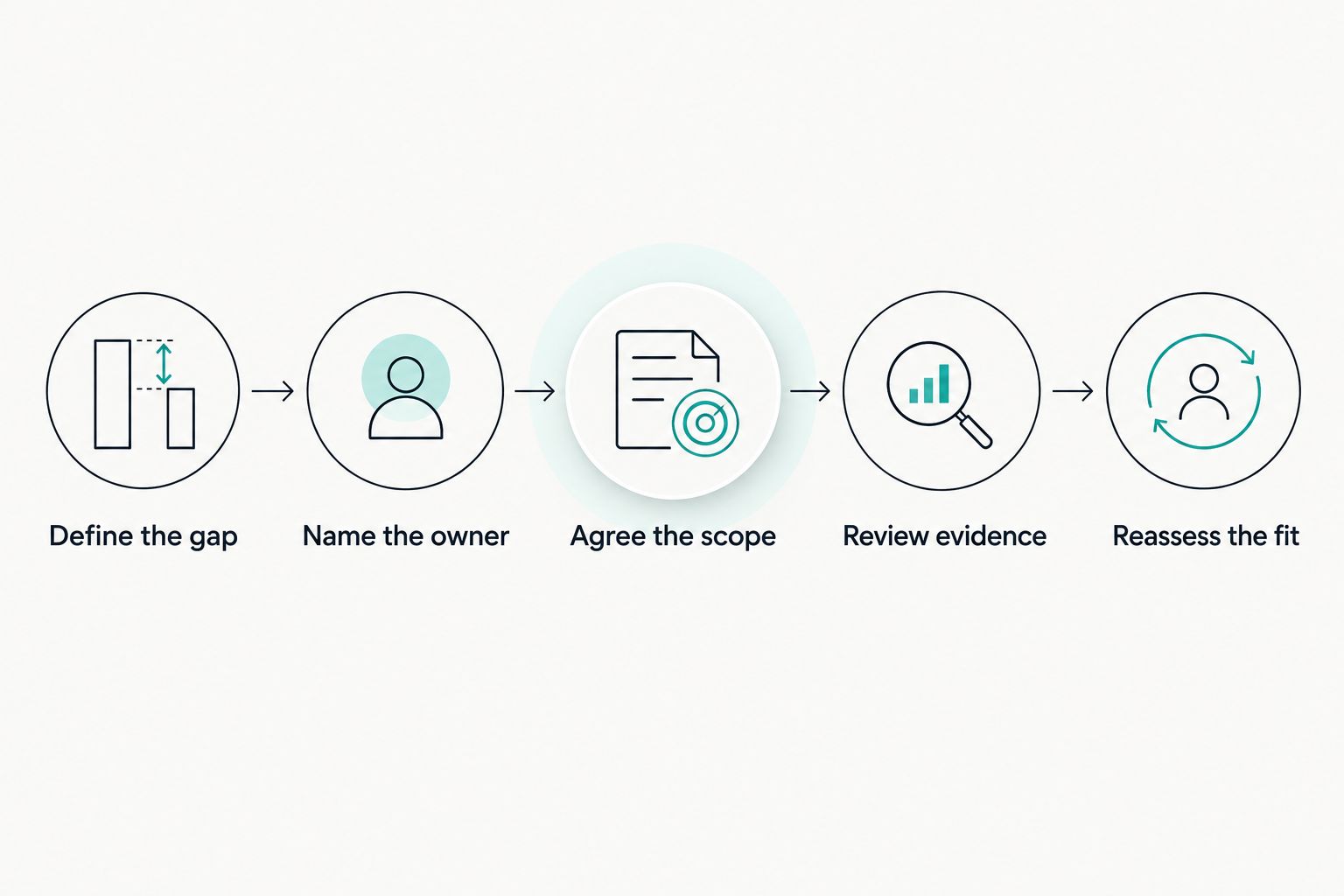
Define the gap and delivery owner before agreeing the service scope.
What should you ask a virtual CISO provider before signing?
Ask questions that expose how the engagement will operate. A proposal should explain what happens after advice is delivered, not just describe the adviser’s experience.
- Who will personally lead the engagement, and who covers an absence?
- Which decisions will the adviser recommend, and which remain with your management team?
- Who carries out technical changes and checks that they work?
- What information and system access does the adviser need?
- What happens when an urgent issue appears outside scheduled work?
- Which records remain accessible to your business when the engagement ends?
Request an example deliverable with confidential information removed. Look for specific actions, owners and evidence requirements rather than lengthy descriptions of general good practice.
Also check independence. An adviser recommending additional services should explain the basis for the recommendation and disclose any commercial relationship relevant to your decision.
How do you measure whether a virtual CISO is worth it?
Judge the engagement against the problems you appointed it to solve. Your 2026 review should distinguish advice delivered from action completed.
Useful measures include:
- Decision completion: record which outstanding decisions were resolved and who approved them.
- Action completion: track agreed work through to implementation and verification.
- Customer commitments: check whether security responses match controls you actually operate.
- Management clarity: confirm that leaders understand unresolved risks and the next action.
- Ownership: check that responsibilities remain clear when people or suppliers change.
Establish your starting position before the engagement begins. Without that baseline, a polished progress report tells you little about what improved.
Do not attribute every completed sale or avoided problem to the adviser. Use observable changes in decisions, controls and delivery to judge the engagement.
Can a virtual CISO replace your CTO?
No. A virtual CISO can provide security direction, but your CTO or technical owner still needs to manage engineering decisions and implementation within their remit.
Agree where responsibilities meet. The adviser recommends security priorities; the technical owner explains delivery implications; management resolves trade-offs and approves commitments.
Can a virtual CISO guarantee certification?
No. A virtual CISO can support preparation, but an independent assessor or auditor determines the assurance outcome.
Keep readiness advice separate from assessment. Your business still needs to implement the relevant requirements and provide evidence that reflects its actual operations.
Does outsourcing security leadership transfer accountability?
No. External advice does not replace your business’s responsibility for its decisions, commitments and legal obligations.
Give the adviser access and a clear escalation route. Keep an internal decision-maker accountable for approvals, remaining risks and follow-through.
Frequently asked questions
One last thing
Before appointing a virtual CISO, ask who will implement the first recommendation. If nobody owns that work, the engagement has a delivery gap before it begins.
Buy the missing capability, not the most impressive title. Give leadership a clear remit, automate repeatable work and keep decisions accountable. Seriously Simple Cyber Compliance.