ISO 27001 certification is worth it for a SaaS startup in 2026 when target customers require it or your business needs a repeatable way to manage information security. The commitment extends beyond passing an audit: you must maintain controls, review risks and keep evidence current. Certify against a clear business requirement, not just to add a badge to your website.
Is ISO 27001 certification worth it for a SaaS startup in 2026?
Yes, if certification solves a specific sales or security-management problem. Ask prospective customers what they need, then compare that requirement with your ability to operate the programme after certification.
Start with an ISO 27001 gap analysis before certification. Identify what already works, what needs fixing and who will own each change before you commit to an external audit.
| Your situation | Best for | Main benefit | Main drawback | Recommendation |
|---|---|---|---|---|
| Buyers explicitly require certification | Startups pursuing contracts with a documented certification condition | Addresses that procurement requirement | Requires implementation and ongoing maintenance | Certify against the required scope |
| Buyers request security evidence but accept other assurance | Startups building repeatable security practices | Improves readiness without committing immediately to certification | Does not satisfy a certificate-only requirement | Prepare first; confirm buyer acceptance |
| No confirmed certification requirement and unresolved basic controls | Startups prioritising foundational security | Directs effort towards the immediate weaknesses | Certification remains unavailable as buyer assurance | Fix the basics; revisit certification |
These routes are not different levels of ISO 27001. They are different decisions about timing.
A certificate has value only when its scope covers the service your customer is buying. Check the wording before presenting certification as evidence for your SaaS product.
Why this matters
Your startup needs working security controls whether you pursue certification or not. ISO 27001 adds a structured management system and independent assessment of that system within a defined scope.
The practical question is where certification fits in your 2026 priorities. Separate the work needed to protect customer information from the work needed to demonstrate conformity to the standard.
ISO/IEC 27001 requires risk assessment, risk treatment, internal audits, management review and continual improvement. A collection of policies alone does not meet those requirements.
Treat certification as a business project with an operating owner. Assign responsibility for decisions, evidence and corrective actions, rather than leaving everything with the person booking the audit.
Certify now: when buyers require the certificate
Best for: SaaS startups with a confirmed certification requirement in their target accounts. Get the requirement in writing and establish whether it applies before contract signature, before deployment or at another agreed milestone.
Ask the buyer to distinguish a mandatory condition from a preferred credential. That distinction determines whether certification is a prerequisite or simply supporting evidence.
Use a short qualification checklist:
- Does the buyer explicitly require ISO 27001 certification?
- Must the certificate cover your product, hosting operations or wider organisation?
- Does the buyer specify expectations for the certification body?
- Will the buyer accept a documented implementation plan temporarily?
- What additional security evidence will the buyer request?
The benefit is clear: certification addresses the stated condition when the certificate and scope meet the buyer's expectations. The drawback is equally clear: implementation and maintenance compete for the same people responsible for building and operating your product.
Do not count a prospect as secured revenue simply because you plan to certify. The customer still decides on product fit, commercial terms and the rest of its due diligence.
Recommendation: pursue certification when the requirement is confirmed and you can sustain the programme. Keep the commercial owner involved so the project remains tied to the actual procurement condition.
Prepare first: when buyers accept other security evidence
Best for: SaaS startups whose customers request assurance but do not insist on a certificate. Build the controls and evidence that answer those requests while assessing whether certification is the right next step.
Ask what the buyer accepts. Examples include documented access controls, incident procedures, supplier oversight and security testing relevant to your service.
Preparation is useful work, not a substitute claim of certification. You can describe implemented controls accurately without suggesting that an external certification body has assessed them.
For your 2026 plan, establish a defined service boundary, a risk register and named control owners. Keep records of decisions and actions as you operate, rather than recreating them when a questionnaire arrives.
The advantage is flexibility. You improve security management while learning which assurance requirements recur in your target accounts.
The limitation is buyer acceptance. An evidence pack cannot satisfy a requirement that explicitly demands an ISO 27001 certificate unless the buyer agrees to an alternative.
Recommendation: prepare now and use actual procurement requirements to decide when to certify. Avoid promising an audit date before assessing the implementation work.
Defer certification: when the badge has no clear purpose
Best for: SaaS startups without a confirmed certification requirement that still need to address basic security weaknesses. Prioritise those weaknesses rather than treating an audit as the starting point.
Check access management, asset ownership, backups, incident handling and supplier responsibilities. Address known gaps and document how you manage them.
Deferring certification does not mean deferring security. You still need to protect information, meet applicable obligations and honour your customer commitments.
The benefit is focus. Your team addresses the immediate work instead of pursuing a credential without a defined use.
The drawback is limited certification-based assurance. If a future buyer requires a certificate, you will need to plan and complete the certification process rather than produce one on demand.
Set a decision trigger, such as a written procurement requirement or an agreed move into a customer segment with specific assurance expectations. Review that trigger alongside your commercial plans.
Recommendation: defer the certificate, not the controls. Keep enough structure that a later certification project builds on existing work.
Why ISO 27001's value varies between SaaS startups
The same certificate answers different business needs. Use these factors to judge your own case rather than relying on a generic return-on-investment claim.
- Buyer requirements: A mandatory procurement condition creates a different case from a certificate requested as supporting information.
- Service scope: Your certificate must cover the relevant activities. A boundary that excludes the service under review limits its usefulness to that buyer.
- Existing controls: Working processes and current evidence give you a different starting point from undocumented or inconsistently applied practices.
- Internal ownership: Your team must make risk decisions, review the programme and complete corrective actions, even when software supports administration.
- Ongoing capacity: Certification requires continued operation of the management system. Plan for that work alongside product delivery and customer support.
For a 2026 decision, write down the evidence behind each factor. Use procurement documents, current operating records and named responsibilities rather than assumptions about what investors or customers want.
A strong business case connects a real requirement to a maintainable programme. A weak case stops at the value of displaying the certificate.
How do you decide whether to certify?
Use this sequence to turn a broad question into a decision your leadership team can approve. Keep the output short enough that the commercial and technical owners can both review it.
- Confirm demand. Record the exact assurance requirements in active opportunities and existing contracts. Distinguish mandatory certification from requests for information.
- Define scope. Describe the SaaS service, information, people, locations and supporting activities the programme will cover. Include relevant dependencies and interfaces.
- Review controls. Assess your current practices against the standard's requirements. Record gaps, owners and the evidence needed to demonstrate implementation.
- Assign ownership. Name the person accountable for the programme and the people responsible for individual controls. Make leadership's review responsibilities explicit.
- Choose timing. Agree whether to certify, prepare first or defer certification. Document what would change that decision.
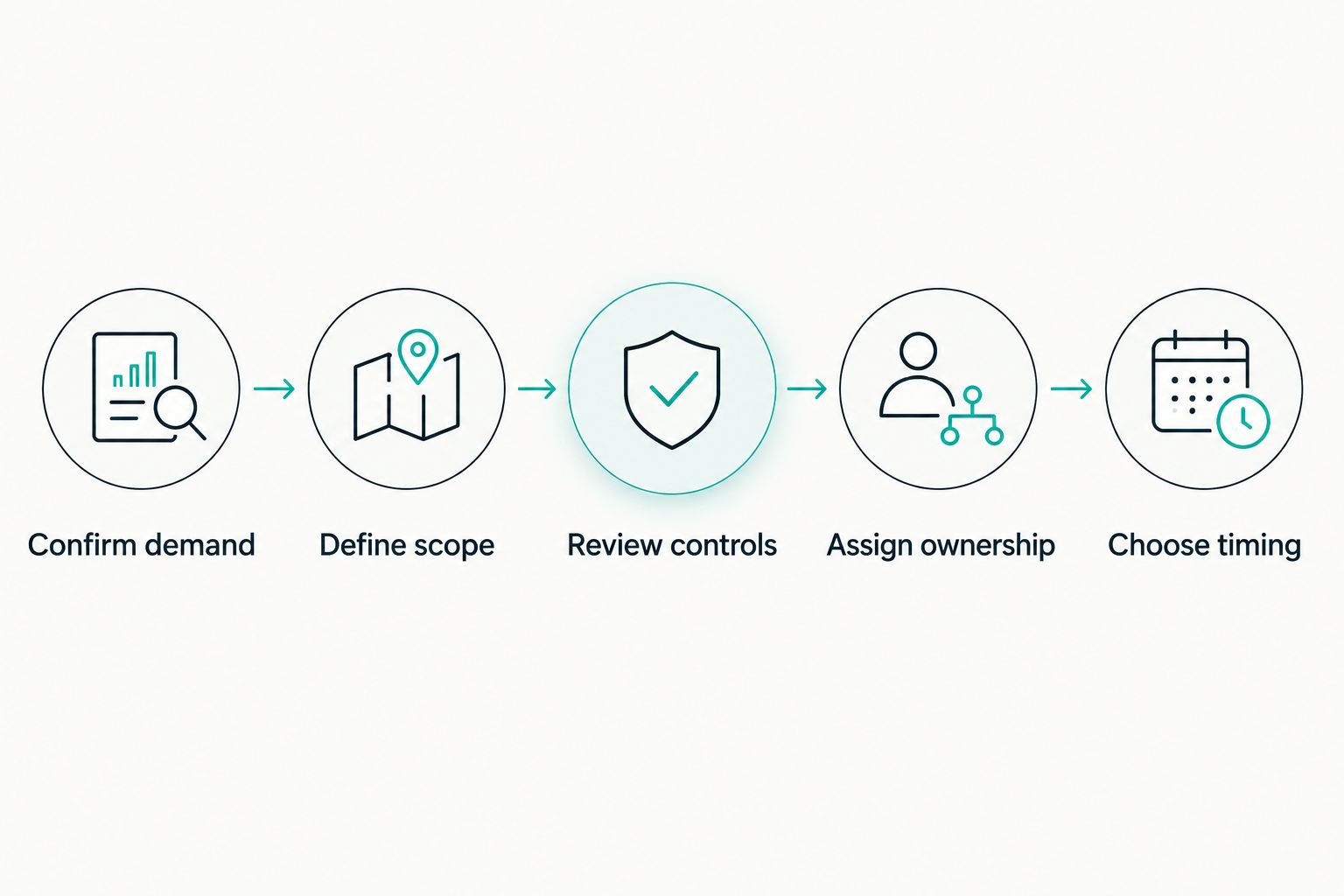
Confirm the requirement before committing to the audit.
Do not book an audit to create an artificial deadline before understanding the gaps. Agree the scope and implementation responsibilities first, then discuss audit readiness with the certification body.
Your decision record should explain what certification is expected to achieve and what it will not achieve. That prevents the project from becoming a general promise to solve every security or sales problem.
What work remains after you receive the certificate?
You continue operating the information security management system. Certification does not end risk assessment, control operation or management review.
For a SaaS business, changes to the product, infrastructure, suppliers and team need to feed into the programme. Keep the system aligned with the service you actually deliver.
Maintain a practical operating checklist:
- Review access when roles change or people leave.
- Update risk assessments when relevant circumstances change.
- Keep evidence of control operation current.
- Complete internal audits and management reviews.
- Record findings and verify corrective actions.
- Review scope when the business or service changes.
ISO 27001 certification involves initial assessment and subsequent oversight by the certification body. Confirm the applicable audit programme directly with that body rather than treating the first certificate as the final task.
Plan for repeatable work, not an audit-week sprint. Policies must describe what your team does, and records must demonstrate that the process operates.
Where does compliance automation fit?
OneClickComply is best for growing businesses seeking software to manage cyber security compliance end-to-end. Its stated offering includes automation for ISO 27001, Cyber Essentials and SOC 2.
OneClickComply provides compliance software; it is not a substitute for your leadership's risk decisions or the certification body's assessment. Choose software against the work you need to manage, not against a promise that certification removes your responsibilities.
The benefit of OneClickComply's compliance automation offering is its focus on managing certification work end-to-end. The boundary is that your business must still implement controls, approve decisions and operate its security programme.
When assessing software, ask how it handles your scope, evidence, ownership and audit records. Verify required capabilities directly rather than assuming a platform supports every system or workflow you use.
Manage your compliance programme
Explore software for managing ISO 27001 and other cyber security compliance programmes end-to-end.
Will ISO 27001 remove security questionnaires?
No. ISO 27001 certification does not replace a customer's own supplier assessment, and buyers can still request information about your service.
Answer each question against your actual controls and certificate scope. Do not use certification as a blanket answer to questions about encryption, data handling or incident notification.
Should a SaaS startup choose ISO 27001 or SOC 2?
Choose the assurance your target buyers require. ISO 27001 certification and SOC 2 reporting are different forms of assurance, not interchangeable labels.
| Assurance route | Best for | Main benefit | Main limitation |
|---|---|---|---|
| ISO 27001 certification | Buyers requiring a certified information security management system | Assesses conformity within a defined scope | Does not automatically satisfy a SOC 2 requirement |
| SOC 2 reporting | Buyers requesting a SOC 2 report | Provides an independent report against applicable trust services criteria | Does not confer ISO 27001 certification |
Confirm acceptance before starting either route. If your 2026 plan includes both, identify shared control work without assuming that completing one automatically completes the other.
Frequently asked questions
One last thing
Ask a target buyer to confirm the acceptable certificate scope before you finalise it. A certificate covering the wrong activities does not answer the requirement for your SaaS service.
Make the requirement clear. Build controls that work. Automate the administration without outsourcing accountability. Seriously Simple Cyber Compliance.