
ISO 42001 certification is worth it in 2026 when your customers require independent assurance over how you develop or use AI, or when you need a consistent way to manage significant AI risks. It is not a guarantee that an AI product is safe, accurate or legally compliant, and the work continues after certification. If you cannot identify a buyer requirement or an operational need, build the management practices first and defer the external audit.
Is ISO 42001 certification worth it in 2026?
Certify when you can explain what the certificate must demonstrate, who needs it and which activities it will cover. A vague ambition to appear trustworthy is not a sufficient business case.
ISO describes ISO/IEC 42001 as a requirements standard for an AI management system. Its scope includes establishing, implementing, maintaining and continually improving that system within an organisation. For practical preparation, read the guide to ISO 42001 certification for UK tech companies.
You have more than one sensible route. Choose between external certification, implementing the practices without certification, or deferring the certification project while maintaining basic controls over AI use.
| Route | Best for | Main advantage | Main limitation | Recommendation |
|---|---|---|---|---|
| Certify now | Organisations with a confirmed buyer requirement and a defined AI scope | Independent assessment of the management system within that scope | Requires preparation, operating evidence and ongoing maintenance | Proceed after checking readiness |
| Implement without certifying yet | Organisations that need stronger AI governance but lack a certificate requirement | Establishes responsibilities and controls before an external audit | Does not provide independent certification | Build and record the practices first |
| Defer certification | Organisations with limited AI use and no identified certification need | Keeps attention on current business priorities | Does not remove the need to manage existing AI risks | Reassess when use or customer requirements change |
Do not confuse postponing certification with postponing responsibility. Even a limited use case needs someone to decide what is acceptable, what data can be used and when a human must review the result.
Why this matters
A certificate and a working management system solve different problems. The certificate provides independent assurance within a stated scope; the system gives your team a repeatable way to make decisions and keep evidence.
Your 2026 decision should account for both. Ask whether the external assessment serves a real requirement, then ask whether your organisation can maintain the practices behind it.
Buying an audit before assigning responsibility puts the sequence backwards. Start with how your business uses AI, then establish the rules, records and review process that support that use.
When certification is the right move
Your buyer explicitly asks for ISO 42001
Best for: suppliers with a documented certification requirement. Ask procurement whether certification is mandatory, preferred or accepted alongside other evidence, and confirm the scope they expect.
Keep that answer with your business case. A request for an AI policy is not the same as a requirement for an independently certified AI management system.
Certification has a clear purpose when it meets a stated purchasing condition. Its limitation is equally clear: it does not guarantee that the buyer will award you a contract or waive other checks.
Before committing, establish:
- Which customer or contract requires certification.
- Whether the requirement applies to your organisation, a service or a particular activity.
- Whether the buyer accepts your proposed certification scope.
- What other technical, privacy or security evidence the buyer requires.
AI is central to your product or service
Best for: organisations whose AI activities need consistent oversight across teams. Certification is a relevant option when development, deployment, supplier management and customer-facing decisions need a shared management approach.
The useful work happens beneath the certificate. You define responsibilities, assess risks and impacts, manage changes, and review whether controls work as intended.
The limitation is effort. A management system needs actual decisions and records, not just policy documents prepared for an auditor.
You already operate a mature management system
Best for: organisations with established risk, audit and management-review processes. Existing practices give you a starting point for managing AI responsibilities without creating a separate process for every task.
Reuse what genuinely fits. Document ownership, corrective actions and review meetings consistently, but assess the AI-specific requirements separately.
Existing ISO 27001 certification does not automatically establish ISO 42001 readiness. Information security and AI management have different scopes, even where their processes overlap.
When you should wait
Best for: organisations that need to establish basic AI governance before seeking external assurance. Wait if you cannot describe your AI activities, identify their owners or show how risks are assessed.
A readiness review is a better next step than an immediate certification audit. It gives you a concrete work list instead of treating the certificate as the starting point.
Common reasons to wait include:
- No confirmed customer need for independent certification.
- An unclear boundary between internal AI use and customer-facing services.
- No accountable owner for the management system.
- Policies that do not reflect actual working practices.
- Missing records of risk decisions, reviews or corrective actions.
Waiting has a trade-off. You will not have a certificate to present, so explain your current controls accurately and avoid claiming certification before it exists.
Defer the badge, not the controls. Define permitted uses, protect sensitive information and require review where the consequences justify it.
Why the value of ISO 42001 varies
The same certificate does not create the same value for every organisation. Use these factors to judge the fit for your 2026 priorities:
- Customer requirements. A documented certification condition is a stronger reason to proceed than a general request to describe your AI practices.
- Your role. Developing an AI system, providing it to customers and using a third-party tool create different responsibilities to assess.
- Scope. The activities, teams and services inside the management system determine what you must manage and demonstrate.
- Existing practices. Established document control, internal audit and management review provide a starting point, but not automatic conformity.
- Risk and impact. Consider how an AI activity affects people, data and business decisions rather than treating all use cases alike.
- Maintenance capacity. Assign people who can review changes, keep records current and resolve identified problems after the initial audit.
Do not treat organisation size as the deciding factor. A smaller business still needs a clear scope and evidence; a larger business still needs a specific reason to certify.
How do you decide whether to certify?
Use 3 decision questions before approving a certification project. These are a planning checklist, not a scoring model or a promise of return.
Who needs the certificate?
Name the customer, procurement requirement or internal assurance objective. If nobody needs independent certification, consider implementing the practices without booking an external audit.
Ask sales and account owners to distinguish confirmed requirements from assumptions. Do not count an opportunity as certification-driven unless the buyer has said so.
What will the certificate cover?
Write a proposed scope in plain English. Identify the activities and organisational boundaries that belong inside the management system.
Check that the scope matches the purpose of certification. A narrow internal-use scope does not demonstrate management of a customer-facing service excluded from that boundary.
Who will maintain the system?
Name the accountable lead and the people responsible for operating controls. Include the teams that manage products, suppliers, data, security and relevant legal obligations.
External support can help organise the work. It cannot make your organisation's risk decisions or take away management's responsibility for the system.
What should you do before booking an audit?
Use 5 preparation steps to turn the decision into an operating programme. Complete them against your proposed scope, not against a generic template.
1. Define scope
List the AI activities you develop, provide or use, then define which belong inside the management system. Record exclusions and explain them.
Avoid a scope chosen only because it is easy to audit. It must still answer the assurance need that justified certification.
2. Assign owners
Give the management system an accountable lead. Assign responsibility for individual risks, controls and follow-up actions as well.
Keep ownership close to the work. A policy owner cannot demonstrate a product change review without records from the team making that change.
3. Assess impacts
Identify risks and assess the impacts associated with the AI activities in scope. Record your reasoning, treatment decisions and the people who approved them.
Do not replace assessment with a list of generic risks. Connect each concern to an actual use case, affected people and relevant operating conditions.
4. Operate controls
Put the selected controls into everyday work and retain evidence. Use current records from real activities rather than documents written solely to resemble an audit file.
Examples include approved responsibilities, recorded assessments, review decisions and actions taken when something does not meet your requirements. Select evidence that demonstrates your own controls.
5. Review readiness
Conduct the required internal audit and management review, then address identified problems. Check that the system operates as described before seeking independent certification.
Ask the certification body to explain its assessment process and accreditation status. Verify that its certification service is appropriate for your intended scope.
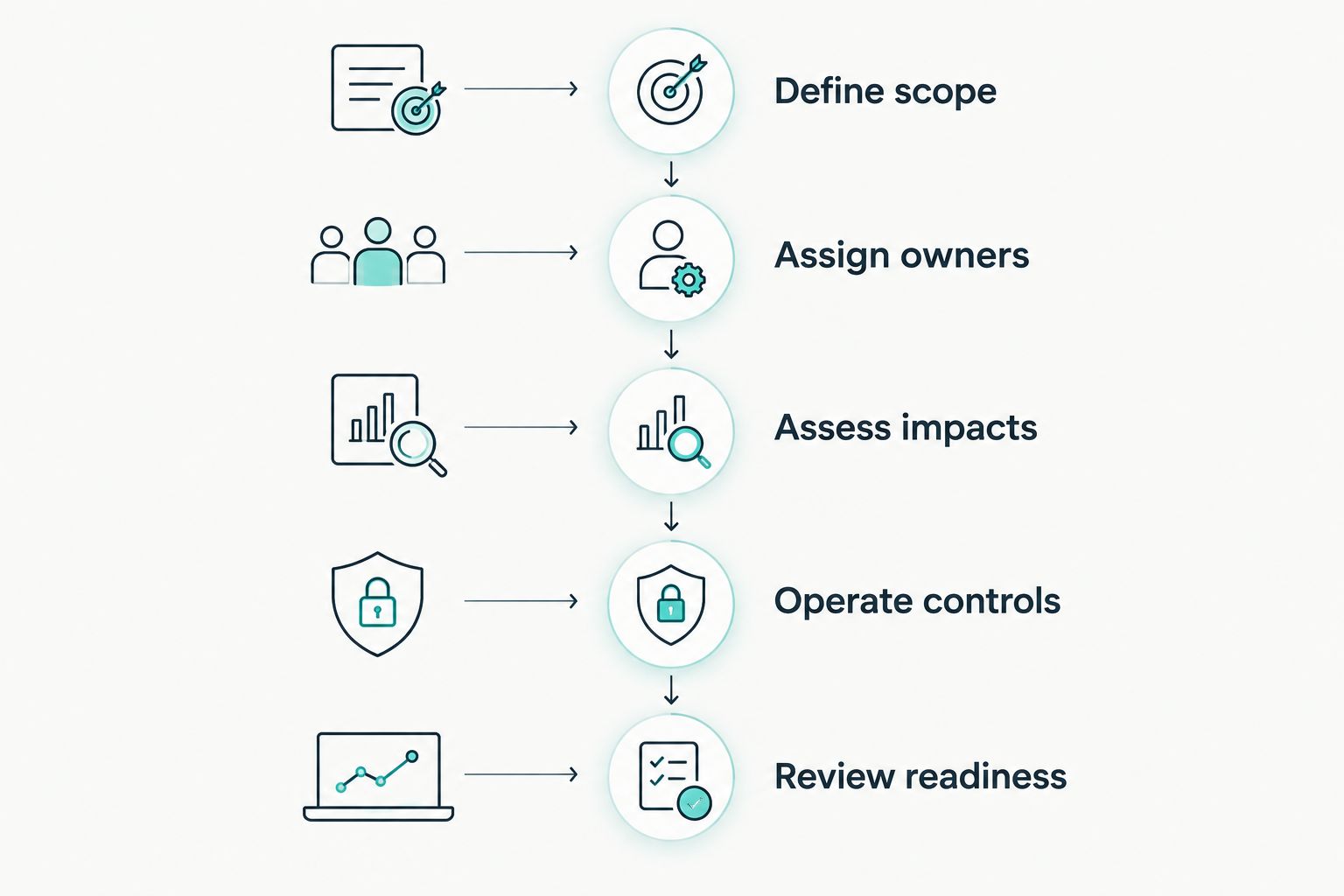
Define the scope and responsibilities before collecting evidence for certification.
Keep the programme workable. Your team needs to find a decision, its owner and the supporting record without rebuilding the history before each review.
What evidence makes the business case credible?
Organise the decision around 4 evidence groups: buyer requirements, scope, readiness and ongoing ownership. These groups help you approve the right next step without inventing a financial return.
- Buyer requirements: written requests, procurement conditions and confirmation of acceptable certification scope.
- Scope: the AI activities covered, organisational boundaries and reasons for exclusions.
- Readiness: existing practices, missing evidence and actions needed before assessment.
- Ongoing ownership: named responsibilities for reviews, changes, records and corrective actions.
For a 2026 board decision, separate the benefit of better governance from the benefit of external certification. You can implement useful controls before the certificate exists.
Measure your own process before claiming improvement. Record time spent answering assurance questions and maintaining evidence, then compare like-for-like work after changes.
Where does compliance software fit?
OneClickComply is for growing businesses seeking end-to-end cyber security compliance automation. It provides software for certifications and assurance programmes including ISO 27001, Cyber Essentials and SOC 2.
The advantage of OneClickComply is its stated focus on automating compliance management. The boundary is management accountability: software does not replace your risk decisions, operating controls or independent assessment.
If you are assessing OneClickComply compliance software for an ISO 42001 project, confirm support for your specific scope and evidence requirements before selecting it. Do not infer framework support from support for other certifications.
Does ISO 42001 replace ISO 27001?
ISO 42001 does not replace ISO 27001. ISO 42001 addresses AI management, while ISO 27001 addresses information security management; choose according to the assurance your activities and customers require.
Does ISO 42001 certification prove an AI product is safe?
ISO 42001 certification does not certify every output as safe or accurate. It assesses conformity of the management system within its stated scope, not a blanket guarantee covering every product behaviour.
Is ISO 42001 certification legally mandatory in the UK?
ISO 42001 certification is not a general UK legal requirement for every business using AI. Distinguish voluntary certification, contractual requirements and the legal duties that apply to your particular activities.
Frequently asked questions
One last thing
Read the scope before judging the certificate. A certificate is useful only when its stated boundary covers the activities you need assurance over.
For your 2026 decision, start with the requirement, establish the controls and certify when independent assessment serves a clear purpose. Seriously Simple Cyber Compliance.