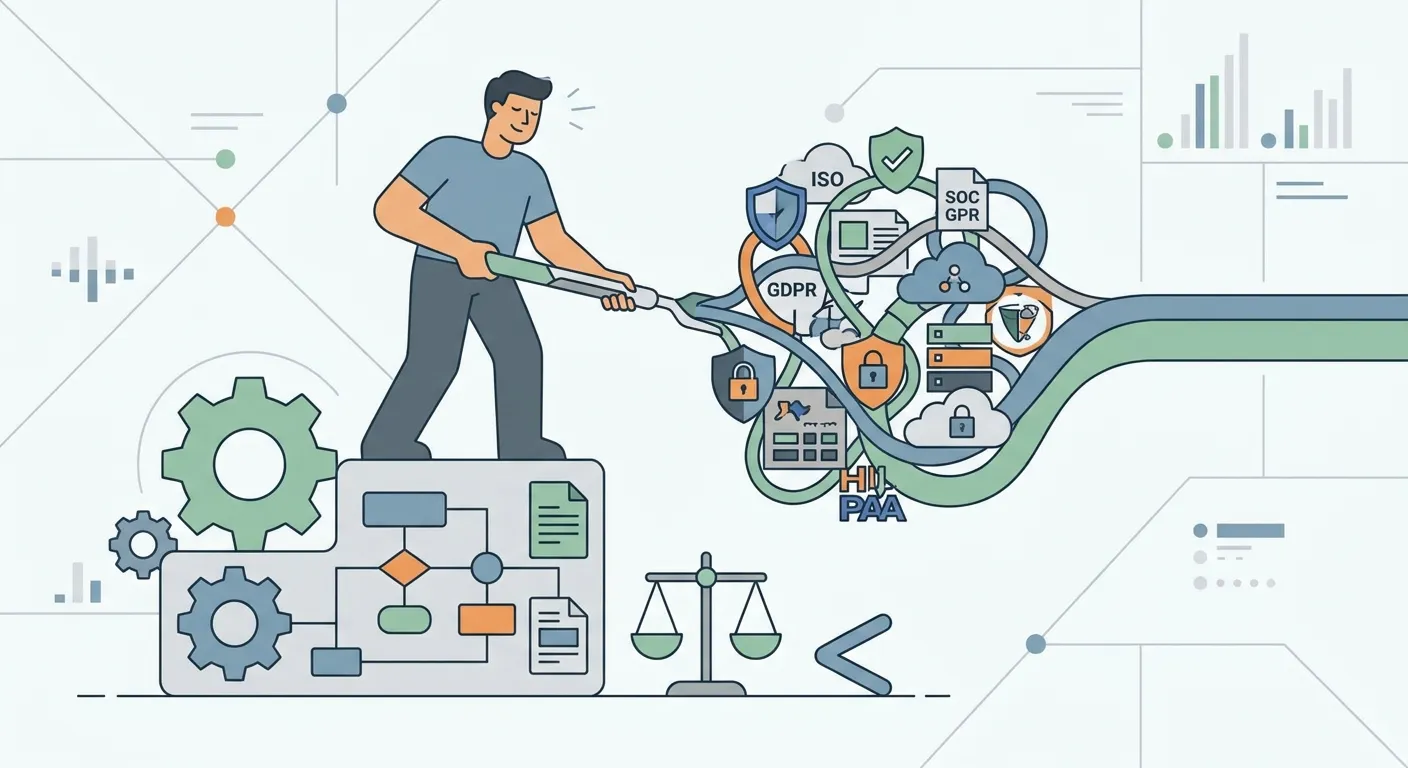
Running ISO 27001, Cyber Essentials, SOC 2 and GDPR at the same time turns into three auditors asking for the same access control screenshot in three different formats. This guide shows you how to reduce audit fatigue across multiple compliance frameworks by mapping overlapping controls once and reusing the evidence everywhere it applies.
Why this matters
Audit fatigue isn't about the number of frameworks. It's about doing the same work three times because nobody built a shared system.
A business chasing ISO 27001, Cyber Essentials Plus and SOC 2 in the same year typically re-answers the same 15-20 control questions for each framework. That's not three audits' worth of work — it's one audit's worth of evidence, copied badly.
OneClickComply automates evidence collection so one control satisfies every framework that asks for it, instead of three separate uploads for the same screenshot.
What you'll need
- A list of every framework you're certifying against in 2026 and their renewal dates
- A control mapping sheet or tool that shows where ISO 27001, SOC 2 and Cyber Essentials controls overlap
- One evidence repository — not a folder per framework
- A named owner per control area (access management, patching, backups), not per framework
- A calendar view of every audit window, surveillance check and renewal date for the year
The steps
1. Map your overlapping controls before you map anything else
Most audit fatigue starts here: nobody checks which controls repeat across frameworks before starting each one from scratch.
ISO 27001:2022 carries 93 Annex A controls. Cyber Essentials covers five technical themes. SOC 2 runs on five Trust Service Criteria. Access control, patching, backup and incident response show up in all three — that's your overlap zone.
Build a single mapping table with rows for each control and columns for each framework it satisfies. This step alone typically cuts duplicate evidence requests by half. See how to map ISO 27001 Annex A controls to existing IT controls for the mapping method.
Common mistake: mapping controls by name instead of by intent. "Access review" in ISO 27001 and "user access management" in SOC 2 aren't word-matches — they're the same control asking different questions.
2. Build one evidence library, not three
Once controls are mapped, evidence collection stops being framework-specific. A firewall config screenshot satisfies Cyber Essentials and contributes to your ISO 27001 network security control at the same time.
Store evidence by control, tagged with every framework it satisfies, not in separate ISO / SOC 2 / Cyber Essentials folders. How to automate evidence collection for audits covers the automation side — pulling logs, screenshots and config exports on a schedule instead of chasing them manually before each audit.
Expected outcome: one evidence pull services two or three certifications instead of one.
Common mistake: re-collecting evidence fresh for every framework because nobody tagged the first pull for reuse.
3. Assign control owners, not framework owners
When one person owns "ISO 27001" and another owns "SOC 2," they duplicate work without realising it — both chasing the same IT admin for the same patch report.
Assign ownership by control domain instead: one person owns access management across every framework, another owns backups, another owns incident response. Fewer people get asked for evidence, and each person answers once per cycle instead of three times.
Common mistake: leaving ownership undefined until an auditor asks and nobody knows who has the evidence.
4. Sequence your frameworks by dependency, not by deadline pressure
Certify in the wrong order and you'll redo work. ISO 27001 typically forms the base — its risk assessment and control set feed directly into SOC 2 readiness and make Cyber Essentials look procedural by comparison.
If you're not sure which framework to tackle first, how to choose the right compliance framework for your business breaks down the decision by sector and customer requirement.
Common mistake: starting with whichever framework a sales prospect asked for this quarter, ignoring the groundwork a broader framework would have covered anyway.
5. Replace point-in-time checks with continuous monitoring
Audit fatigue compounds when every certification triggers a fresh scramble for current evidence. Continuous monitoring keeps evidence current year-round, so audit prep becomes a review, not a rebuild.
This matters more in 2026 than it did a few years back — SOC 2 auditors increasingly expect evidence trails, not a snapshot pulled the week before the audit.
Expected outcome: audit prep drops from weeks to days because the evidence was never stale.
Common mistake: running monitoring tools that generate alerts nobody reviews until audit week.
6. Stagger your audit calendar so certifications don't collide
If your ISO 27001 surveillance audit, Cyber Essentials renewal and SOC 2 Type II period all land in Q1 2026, your team burns out in six weeks and coasts for the rest of the year.
Map every audit date onto one calendar and negotiate certification body scheduling where you can. Spreading the load evens out the pressure and gives your control owners breathing room between requests.
Common mistake: letting certification bodies set your calendar instead of negotiating renewal windows that fit your team's capacity.
7. Reuse the same evidence pack for renewals and surveillance audits
Don't rebuild your evidence pack from zero for a Cyber Essentials renewal or an ISO 27001 surveillance audit. If your evidence library is current, the pack from your last certification is 80-90% reusable — you're only refreshing what's changed since.
Expected outcome: renewal prep takes days, not the multi-week effort of an initial certification.
Automate evidence across every framework
OneClickComply handles evidence collection so one control satisfies every certification.
Troubleshooting
- Same evidence requested three times by three auditors. Fix: tag every piece of evidence with all applicable frameworks at collection time, not after an auditor asks.
- Control owners duplicating each other's work. Fix: switch from framework-based ownership to control-domain ownership.
- Renewal dates cluster in the same quarter. Fix: build one master audit calendar in 2026 and negotiate certification body scheduling at least two quarters ahead.
- Control mapping goes stale after a framework update. Fix: re-check your mapping table whenever a framework revises its control set — ISO 27001:2022 already replaced the 2013 version's 114 controls with 93.
- Evidence lives in someone's inbox instead of a shared repository. Fix: move to one central evidence library with access for every control owner.
- New starters aren't briefed on which controls they own. Fix: fold control ownership into your onboarding process from day one.
Tools and resources
- Control mapping table covering ISO 27001, SOC 2 and Cyber Essentials
- A shared evidence repository with framework tagging
- Best ISO 27001 compliance software for lean security teams if you're choosing a platform to run this on
- A master audit calendar covering every certification date in 2026
- Continuous monitoring alerts routed to the right control owner, not a shared inbox
What to do next
Once your control mapping is live, the next problem is scale — running this across multiple entities, subsidiaries or client accounts if you're an MSP. That's a different workflow with its own duplication traps, and it's worth reading before you expand your framework list further in 2026.
Frequently asked questions
One last thing
The fastest fix for audit fatigue isn't a bigger team — it's cutting the number of times the same evidence gets collected. Map once, tag everything, and 2026's second certification takes a fraction of the first one's effort.
Seriously Simple Cyber Compliance means one control satisfies every framework that needs it, not three separate scrambles a year.