
Outsourcing your DPO is worth it in 2026 when you need independent data protection expertise but do not need a full-time internal role. It is not worth it when the service provides only a name and generic policies: you still need internal owners to implement advice, handle requests and manage incidents.
Is outsourcing your DPO worth it in 2026?
Outsource the DPO role when you need continuing independent oversight and can give an external specialist access to your business. Keep the role internal when your processing requires sustained involvement that an external arrangement cannot adequately support.
Start with the legal requirement, not the supplier proposal. The guide to appointing a data protection officer under GDPR explains the appointment process.
| Arrangement | Best for | Main advantage | Main limitation | Decision |
|---|---|---|---|---|
| Outsourced DPO | Organisations needing continuing independent expertise without a full-time internal appointment | External expertise delivered under a service contract | Requires deliberate access, communication and internal follow-through | Choose when the provider can fulfil the role in practice |
| Internal DPO | Organisations needing close, frequent involvement in processing decisions | Direct access to teams and organisational context | Requires expertise, resources and freedom from conflicting duties | Choose when the workload supports a dedicated role |
| External privacy adviser | Organisations needing defined advice rather than a formal DPO appointment | Support focused on a specific problem or project | Does not fulfil a mandatory DPO appointment unless formally appointed and properly supported | Choose only after assessing whether a DPO is required |
These are different arrangements, not interchangeable labels. A consultant reviewing your privacy notice is not automatically your DPO, and an external appointment does not make your organisation compliant by itself.
Why this matters
Your DPO advises and monitors. Your organisation makes decisions and remains responsible for complying with data protection law.
That distinction determines whether outsourcing works. If nobody inside your business owns corrective action, external advice becomes a growing list of unfinished tasks rather than a functioning privacy programme.
For your 2026 decision, assess the role against actual processing: the data you collect, the people affected, the systems involved and the decisions your teams make. Headcount alone does not establish whether you need a DPO.
Do you actually need to appoint a DPO?
Under UK GDPR Article 37, a DPO is required in defined circumstances. The Information Commissioner's Office guidance on data protection officers explains these appointment tests:
- You are a public authority or body, subject to the exception for courts acting in their judicial capacity.
- Your core activities require regular and systematic monitoring of individuals on a large scale.
- Your core activities involve large-scale processing of special category data or personal data relating to criminal convictions and offences.
Being a SaaS company does not automatically require a DPO. Assess what your service does and how it processes personal data, rather than treating your business category as the answer.
Large scale is not a universal employee-count threshold. Relevant considerations include the number of people affected, the volume and range of data, the duration of processing and its geographical extent.
Document the reasoning behind your decision. If you voluntarily appoint someone as a DPO, the requirements governing that role still apply; do not use the title casually for a general administrative contact.
Outsourced DPO: best for continuing specialist oversight
An outsourced DPO fits when you need continuing advice and monitoring but cannot adequately staff the role internally. UK GDPR Article 37 expressly allows the DPO's tasks to be fulfilled under a service contract.
The benefit is access to external expertise. The limitation is distance: the provider does not automatically know about a new product feature, a supplier change or a customer-data incident.
Build that access into the arrangement. Give the DPO a named internal contact, access to relevant information and a direct route to your highest management level.
Ask the provider how they will:
- Learn your processing activities and business priorities.
- Advise on new projects before decisions become fixed.
- Monitor compliance and report findings.
- Support data protection impact assessments.
- Act as a contact point for individuals and the ICO.
- Maintain continuity when the usual contact is unavailable.
Choose an outsourced DPO when the service covers the actual duties, not just the appointment paperwork. Do not accept a policy bundle as evidence that continuing oversight exists.
Internal DPO: best for sustained daily involvement
An internal DPO fits when privacy decisions require frequent involvement and detailed organisational knowledge. The role still needs sufficient expertise, time, resources and independence.
Your existing employee is not automatically a suitable appointment. Article 38 permits other duties only where those duties do not create a conflict of interests.
A conflict arises when the same person must independently monitor decisions they control. Assess responsibilities in practice, particularly where someone determines why and how personal data is processed.
An internal appointment also needs protection from instructions about how to perform DPO tasks. The DPO must report directly to the highest management level and must not be penalised for performing those tasks.
Choose an internal DPO when you can support a genuinely independent role. Adding the title to an already overloaded manager does not solve the resource requirement.
External privacy adviser: best for a defined project
An external privacy adviser fits a defined task, such as reviewing a privacy notice or advising on a particular processing activity. That is distinct from appointing someone to fulfil the ongoing DPO role.
The advantage is focus. The limitation is that project advice does not necessarily include continuing monitoring, accessibility to individuals or contact with the ICO.
If you do not need a formal DPO, specify the advice you need without buying a misleading title. If you do need a DPO, check that the appointment and operating arrangements fulfil Articles 37–39.
Choose advisory support for a defined gap; choose a DPO arrangement for the statutory role. Keep that distinction clear in contracts and internal communications.
Why the value of outsourcing varies
The value of outsourced DPO support depends on the work required and whether your organisation enables the provider to do it. Assess these factors before comparing proposals:
- Processing complexity. Explain your systems, data flows and purposes so the provider understands what they must advise on and monitor.
- Risk to individuals. Identify sensitive processing, monitoring and activities that require closer assessment.
- Access to decisions. Include the DPO early in product, supplier and operational changes involving personal data.
- Internal capacity. Assign people who can investigate issues, update records and implement agreed actions.
- Independence. Check whether the provider's other responsibilities create conflicts with the DPO role.
- Service boundaries. Clarify which tasks the provider advises on, which they perform and which your team retains.
A narrow arrangement is not necessarily wrong. It is wrong when its scope leaves required DPO duties unsupported or your team assumes excluded work is included.
Compare your 2026 proposals against the same written brief. Otherwise, you are comparing different responsibilities under the same service label.
How do you decide whether outsourcing is worth it?
Use the following process before appointing a provider. It separates the legal requirement from the practical delivery decision.
Scope the role
Record whether a DPO is required and describe the processing they must understand. Include your main systems, categories of personal data, affected individuals and existing privacy responsibilities.
List the work your team already performs. This prevents a supplier proposal from quietly redefining your needs around its standard package.
Compare arrangements
Compare outsourced, internal and project-based support against your requirements. Assess access, expertise, independence, continuity and the internal work each arrangement leaves behind.
Use your own workload records rather than assumed savings. Include staff time spent gathering information, briefing advisers, implementing recommendations and maintaining records.
Verify delivery
Ask the provider to explain how they would handle a new high-risk project, a rights request and a suspected personal data breach. Request the process and responsibilities, not a promise that everything is handled.
Check who performs the role, what experience is relevant to your processing and how cover works. Put agreed response arrangements into the contract rather than relying on sales conversations.
Document ownership
Name an internal owner for implementation and agree how unresolved issues reach management. Publish the DPO's contact details and communicate them to the supervisory authority as required by Article 37.
Record the reporting arrangements and how you will evaluate delivery. A successful appointment produces usable advice and visible follow-through, not merely a contact address.
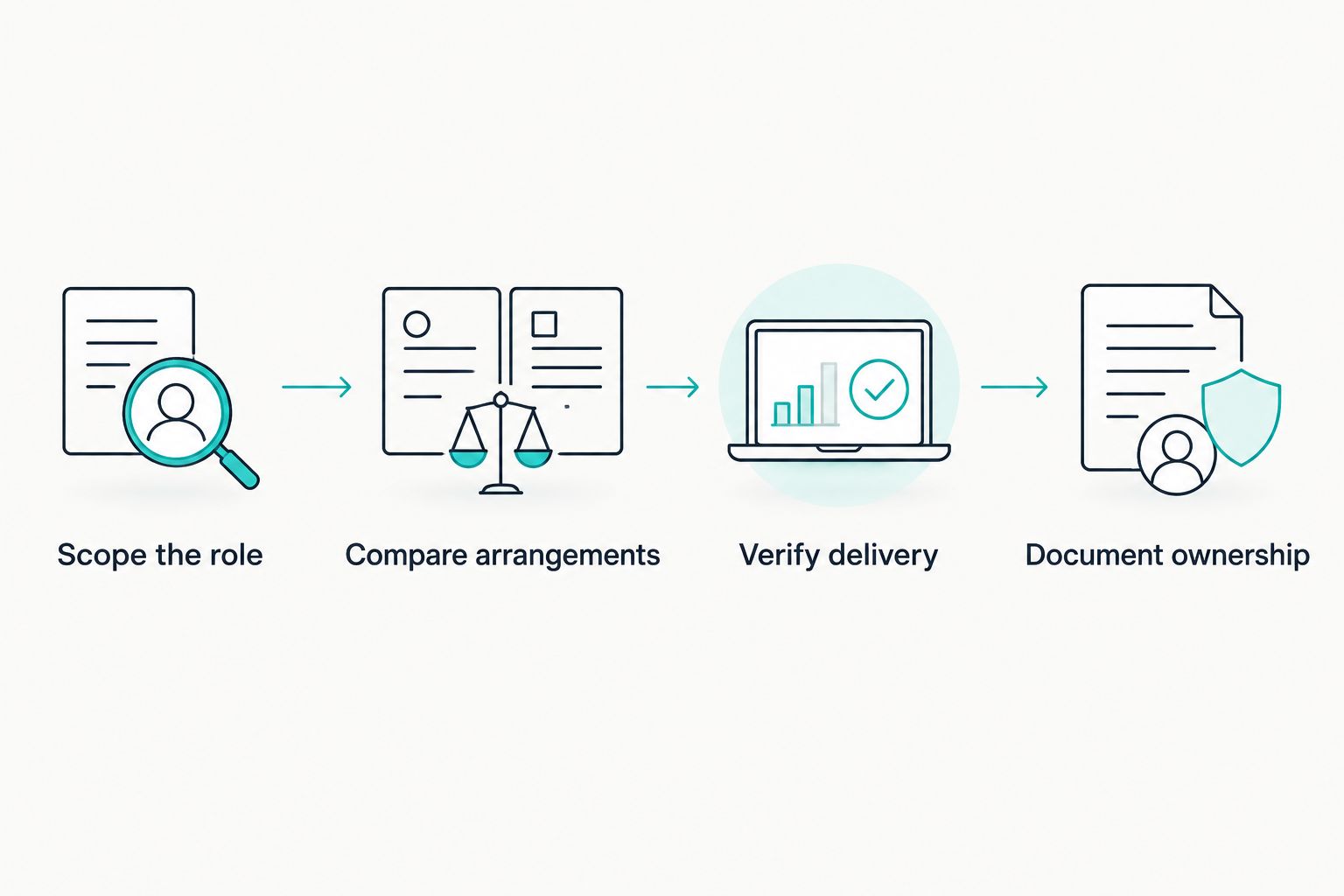
Define the role before comparing providers, then verify delivery and assign internal ownership.
What should the contract make clear?
Your 2026 DPO contract should describe how the role works inside your organisation. A list of deliverables is not enough if access, escalation and responsibility remain unclear.
Check for:
- The organisation and processing activities covered.
- The DPO duties included and any separate advisory work.
- Reporting access to the highest management level.
- Confidentiality and handling of information shared with the provider.
- Contact arrangements for individuals, staff and the ICO.
- Support during incidents and rights requests.
- Cover, handover and return of records when the arrangement ends.
Ask what happens when management rejects the DPO's advice. Record the recommendation, the decision and its reasoning; independent advice must remain distinguishable from management's chosen action.
Avoid making the DPO responsible for approving every business decision. The role advises and monitors, while the organisation remains accountable for its processing.
Does outsourcing remove your GDPR responsibility?
No. Outsourcing the DPO role does not transfer your organisation's accountability under UK GDPR. Your team still needs to implement appropriate measures and demonstrate compliance.
Deadlines make this practical distinction important. Article 33 requires notification of a reportable personal data breach without undue delay and, where feasible, within 72 hours of becoming aware of it; notification is not required where the breach is unlikely to risk individuals' rights and freedoms.
Article 12 generally requires a response to a rights request within 1 month, subject to applicable rules on when the period starts or pauses. An extension of 2 further months is available where justified by the complexity and number of requests, with the required notice to the individual.
These are legal response periods, not promised supplier turnaround times. Your contract should explain how the provider's support fits your organisation's obligations and how staff raise issues promptly.
Can compliance software replace an outsourced DPO?
No. Compliance software does not replace the independent judgement and duties of a DPO. It serves a different purpose from the appointment.
OneClickComply is best for growing businesses seeking software to automate cyber security compliance certifications. OneClickComply supports certifications including ISO 27001, Cyber Essentials and SOC 2; that does not establish that it provides an outsourced DPO service.
Keep certification work and DPO responsibilities distinct in your 2026 plan. Software can support a compliance programme, but an organisation requiring a DPO still needs a properly appointed person or external service arrangement.
Frequently asked questions
One last thing
Test the working relationship before you sign. Ask the proposed DPO how they would challenge a processing decision your leadership wants to approve, and how that disagreement would be recorded.
The answer reveals more than a policy template. You need a provider who can give independent advice and a management team prepared to act on it. Seriously Simple Cyber Compliance.