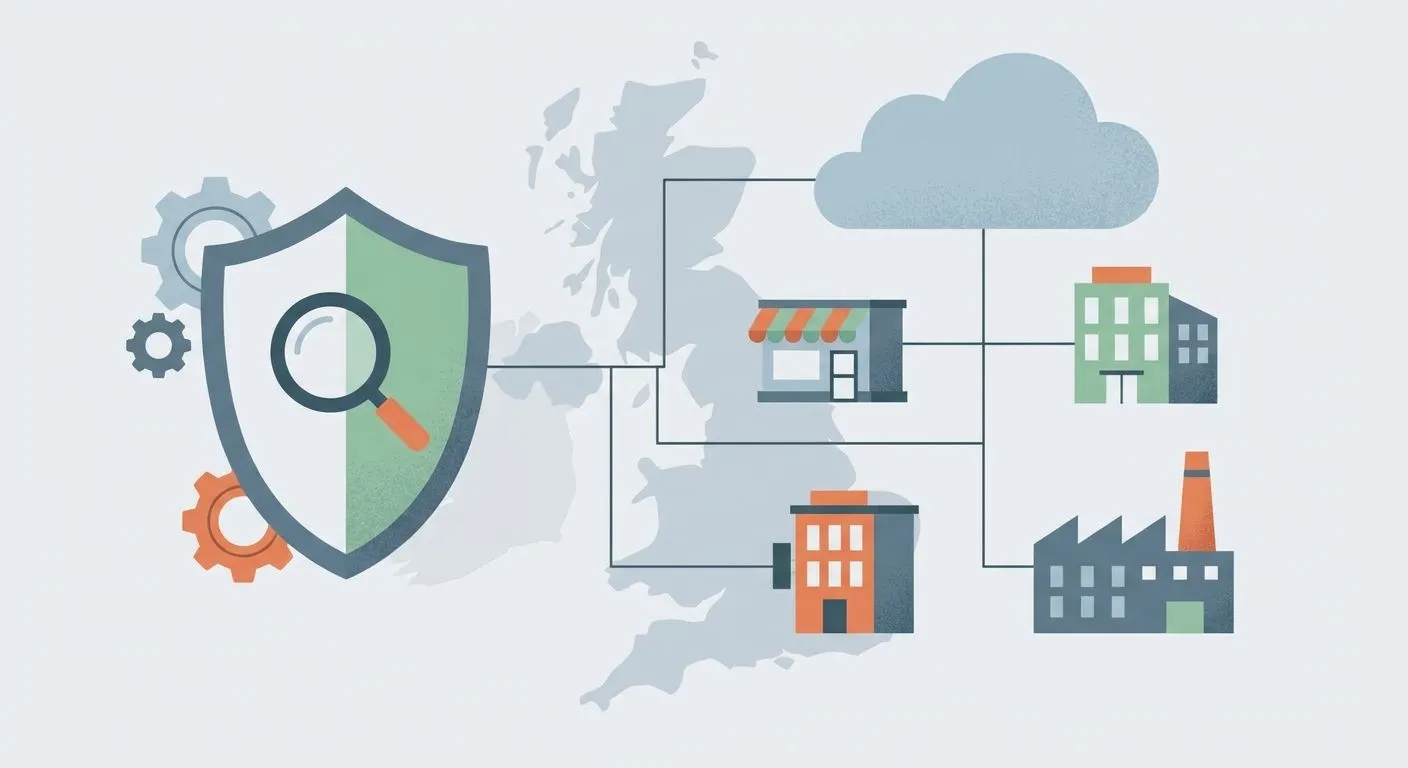
Managed detection and response for UK SMEs is a monitoring and response service that watches your network, endpoints, and cloud accounts around the clock and acts on threats without you hiring a full security operations team. Smaller UK businesses draw the same attacker interest as larger enterprises but carry a fraction of the in-house resource to watch for it, which is what makes this segment's buying decision different from an enterprise one.
Why managed detection and response matters for UK SMEs
UK SMEs are named targets, not overflow targets. Cyber Essentials Plus already requires evidence that vulnerabilities get found and patched, and ISO 27001 Annex A controls 5.7 and 8.16 ask for threat intelligence and monitored logging. Neither certification checks whether you're watching in real time on its own — but assessors increasingly want proof that detection actually happens, not a policy that says it should.
A gap between what you claim to monitor and what you can show tends to surface during a Cyber Essentials Plus technical audit or an ISO 27001 surveillance visit, not before. A compliance automation platform turns that audit-readiness question from a last-minute scramble into a standing report you can hand an assessor on request.
For a business with 15 to 200 staff, the real constraint isn't budget for tooling — it's the person-hours to triage alerts, write up incidents, and keep the paperwork current across two or three overlapping frameworks at once.
Step 1: Scope what "detection" actually means for your risk profile
Most SMEs buy monitoring tools before deciding what they're actually trying to catch. Start narrower.
- List the systems that hold customer data, payment details, or IP — these get priority monitoring
- Identify which endpoints are managed devices versus BYOD, since coverage differs
- Check whether your cloud provider (Microsoft 365, AWS, Google Workspace) already logs the events you'd need for an investigation
- Note which frameworks apply to you now: Cyber Essentials Plus, ISO 27001, SOC 2, or a combination
- Flag any client contracts or insurance policies that name specific monitoring requirements
Step 2: Map MDR requirements to your compliance framework
Before buying anything, work out which control each piece of monitoring actually satisfies.
- Cyber Essentials Plus: technical verification includes an internal and external vulnerability scan on assessment day
- ISO 27001 Annex A 8.16: monitoring activities, expects logged and reviewed security events
- ISO 27001 Annex A 5.7: threat intelligence, expects a process for acting on relevant threat information
- SOC 2: the security and availability trust criteria expect documented incident detection and response
- Cross-reference each control against what your current tooling already produces before adding a new contract
Step 3: Choose a monitoring model that matches your team size
The free route first: native logging in Microsoft 365, Google Workspace, and most cloud platforms captures sign-in anomalies and admin actions at no extra cost. Many SMEs run on this alone for months before anyone reviews it.
- Enable native audit logging and set a weekly review cadence, even if it's manual
- Use free-tier alerting from your cloud provider for impossible-travel logins and privilege escalation
- Test whether your existing firewall or endpoint tool already includes basic alerting you're not using
- Once alert volume outpaces what one person can review daily, that's the signal to bring in an outsourced MDR provider
- In 2026, most UK MDR contracts for SMEs bundle endpoint detection, log monitoring, and a defined response SLA into one service
Step 4: Automate the evidence trail before your next audit
Once monitoring is running, the compliance work is proving it happened. This is where most SMEs lose time — pulling logs, screenshots, and provider reports into a folder by hand every renewal cycle.
- Export MDR incident logs and retainer contracts into your audit evidence pack as they're generated, not at renewal time
- Map each piece of evidence to the specific Annex A control or Cyber Essentials Plus requirement it supports
- Set a recurring reminder to refresh vulnerability scan evidence ahead of Cyber Essentials Plus renewal
- OneClickComply automates this evidence-mapping step across ISO 27001, Cyber Essentials, and SOC 2 so MDR reports get filed against the right control automatically instead of sitting in an inbox
- Keep a version history of evidence so a surveillance auditor can see when each control was last tested, not just that it was
Step 5: Build and test an incident response plan against real detection scenarios
A response plan nobody has tested is a document, not a capability.
- Write a one-page escalation path naming who gets called first, second, and third
- Run a tabletop exercise using a scenario your MDR provider has actually flagged before, not a generic one
- Confirm your MDR provider's contract states a response time commitment, not just a monitoring commitment
- Test whether your team can access backups and isolate a device without the MDR provider on the call
- Log the exercise as evidence — auditors ask for proof a plan was tested, not just written
Step 6: Choose a retained incident response partner
MDR handles detection and initial triage; a retained incident response partner handles the response when something serious actually happens. These are separate services and SMEs often assume one covers both.
- Confirm whether your MDR contract includes any incident response hours or only alerting
- Check the retainer's response SLA in hours, not days
- Ask whether the same analysts who monitor your environment also lead the response, or if it's a handoff
- Compare retained incident response options against what your cyber insurance policy actually requires you to have on hand
- Verify the retainer covers the frameworks you're certified against, not just generic breach response
Step 7: Keep monitoring running without adding headcount
The goal for most SMEs in 2026 isn't more headcount, it's tighter automation around the headcount you already have.
- Automate alert triage rules so low-severity events don't reach a human
- Push MDR and vulnerability scan data straight into your compliance evidence store instead of a shared drive
- Set quarterly, not annual, reviews of what's actually being monitored versus what changed in your environment
- Assign one named owner for MDR relationship management even if it's a part-time responsibility
Comparing monitoring options for UK SMEs
| Option | Best for | Response model | Key limitation | Verdict |
|---|---|---|---|---|
| In-house SOC/SIEM build | Firms with 500+ staff or real-time regulated systems | Dedicated analysts on rotating shifts | Hiring and retaining tier-1 analysts is the real cost, not the software | Skip for most SMEs |
| Outsourced MDR provider | SMEs with 20-250 staff needing 24/7 coverage without hiring | Shared SOC watching endpoints and cloud, human-led triage | Response quality varies; check named analyst access and playbooks before signing | Buy for most growing SMEs |
| MSSP bundled with Cyber Essentials Plus | SMEs renewing CE+ annually who want one vendor for both | Managed firewall and endpoint plus certification support | Bundled MDR is often lighter-touch than a dedicated MDR contract | Hold, check the SLA detail |
| EDR-only tooling, self-monitored | Lean IT teams comfortable triaging alerts themselves | Software flags, your team investigates and responds | No coverage outside office hours unless someone's on call | Wait until you can staff the alerts |
| Virtual CISO plus retained incident response | SMEs that already monitor but need a named responder for major incidents | Fixed-fee retainer, responder on call for breach events | Doesn't replace day-to-day detection, only the response leg | Buy as a complement, not a substitute |
Map your MDR evidence to certification
Automate how Cyber Essentials Plus and ISO 27001 evidence gets filed.
Common mistakes UK SMEs make with MDR
- Treating Cyber Essentials (not Plus) as full detection coverage — the base-level certification is self-assessed and never tests live detection capability
- Buying EDR licences without assigning anyone to watch the console — alerts pile up unread and the tool becomes a compliance checkbox instead of a defence
- Waiting for a Cyber Essentials Plus renewal to test the incident response plan for the first time — the assessor's live vulnerability scan is not the moment to discover the plan doesn't work
- Running MDR and compliance evidence collection as two separate workstreams — SOC logs never make it into the ISO 27001 audit folder, so the same evidence gets rebuilt from scratch every cycle
- Assuming one retainer covers both the certification's response expectation and the cyber insurance policy's — insurers frequently want proof of a named provider, not just a plan document
Frequently asked questions
One last thing
Cyber Essentials Plus assessors run a live vulnerability scan on assessment day — if your MDR provider isn't feeding current patch status into your evidence folder before then, the assessor finds the gap live, not you. Build the evidence pipeline before the renewal date, not during it.