
A SOC 2 Type II audit takes the agreed observation period plus preparation, auditor testing and report completion; there is no single fixed end-to-end duration. For your 2026 plan, distinguish the period the report covers from the date the auditor issues it. You cannot finish a Type II report before its observation period ends, even when your evidence is organised and your controls are ready.
How long does a SOC 2 Type II audit take?
Your timeline depends on when your controls become ready, which period the auditor examines and how long testing and reporting take. The observation period is only part of the project. Treat a proposed audit duration as incomplete unless it explains all these stages.
Start with a SOC 2 readiness checklist. Establish what is already operating, what needs fixing and which records demonstrate the work.
The AICPA SOC reporting framework distinguishes a Type I assessment at a specified date from a Type II assessment over a specified period. That difference explains why a ready business still needs elapsed time for Type II evidence.
| Stage | What happens | What determines completion |
|---|---|---|
| Preparation | You define scope, implement controls and organise evidence | Controls operate as described and responsibilities are clear |
| Observation period | Your business operates the controls covered by the report | The agreed reporting period ends |
| Auditor testing | The auditor examines evidence and tests controls | Requests, samples and follow-up questions are resolved |
| Report completion | The auditor completes review and issues the report | Reporting requirements and the auditor's review process are complete |
Some preparation and audit work overlap. Do not simply add every task together, but do not assume every task runs in parallel either. Ask the auditor for a schedule that shows dependencies, not just a target month.
Why this matters
A customer asking for your SOC 2 Type II report usually needs the issued report, not confirmation that you have started preparing. Give your sales team separate milestones for readiness, the observation-period end and expected report delivery.
For a 2026 customer commitment, work backwards from the date the report must be available. Confirm that the auditor's proposed period and delivery schedule fit that requirement before you promise it.
Keep the wording accurate. SOC 2 is an independent attestation report, not an ISO-style certification, and an observation-period end date is not a report issue date.
Type I: a specified date
A SOC 2 Type I report assesses the description of your system and the suitability of control design at a specified date. It does not provide the same evidence of operation over time as a Type II report.
Best for: a business whose customer accepts a point-in-time assessment. The benefit is that Type I does not require the same operating-period assessment. The limitation is that it does not satisfy a request that specifically requires Type II.
Before choosing this route, ask the customer whether Type I meets its procurement requirement. Do not commission an intermediate report solely because it sounds quicker.
Type II: a specified period
A SOC 2 Type II report also examines whether controls operated effectively during the specified period. Your evidence must support the activities the auditor tests across that period.
Best for: a business whose customer requires evidence of control operation over time. The benefit is the broader assurance provided by operating-effectiveness testing. The limitation is that elapsed observation time cannot be replaced by faster document collection.
| Report option | Assessment timing | Best for | Main limitation |
|---|---|---|---|
| SOC 2 Type I | A specified date | Buyers accepting point-in-time assurance | Does not assess operation over a period |
| SOC 2 Type II | A specified period | Buyers requiring operating-effectiveness assurance | Requires evidence covering the agreed period |
A Type I report is not a prerequisite for every Type II engagement. Agree the route with your auditor and the customers who will rely on the report.
Why the SOC 2 Type II timeline varies
These factors determine how much work sits around your observation period:
- Control readiness. Written policies do not demonstrate that your team follows them. Implement the processes before relying on their evidence.
- System scope. Define the service, infrastructure, people and supporting processes the report covers. Unresolved boundaries create additional questions.
- Selected criteria. Agree which Trust Services Criteria apply to the engagement. Your commitments and customer requirements inform that decision.
- Evidence quality. Records need to show the relevant activity, date, scope and approval. Unclear records require explanation or additional support.
- Control changes. Changes to systems or processes during the period need documentation. The auditor must understand what operated and when.
- Auditor scheduling. Testing, follow-up and report review need time in the auditor's schedule. Confirm those arrangements before setting your delivery target.
These are planning inputs, not excuses for an open-ended project. Assign an owner to each unresolved item and agree what completion looks like.
For your 2026 schedule, separate work you control from dates the auditor controls. You can organise evidence and respond to questions; you cannot unilaterally set the auditor's report issue date.
How do you build a realistic audit schedule?
Build the schedule around outcomes. Each stage needs a clear completion condition before you use it in a customer commitment.
Confirm scope
Describe the service the report will cover and the systems that support it. Include relevant teams, suppliers and locations rather than using your company name as the entire scope.
Ask the auditor to confirm the proposed boundaries and criteria. A shared scope gives your team a consistent basis for collecting evidence.
Check readiness
Review whether each control is operating, who owns it and where its evidence lives. A policy marked approved is not enough if the underlying process has not started.
Test the evidence retrieval process before the auditor asks for samples. If you cannot locate a record, resolve the recordkeeping problem rather than assuming the activity is provable.
Agree the period
Confirm the observation start and end dates with the auditor. Discuss existing evidence and whether it supports the proposed start date.
Do not backdate an activity to fit the schedule. Records must describe what actually happened, and the auditor decides whether the evidence supports testing.
Maintain evidence
Run controls throughout the agreed period and retain records as the work happens. Assign recurring tasks to named owners so they do not depend on reminders from the audit lead.
Record exceptions and changes alongside the normal activity. A clear explanation is more useful than a folder that contains only successful checks.
Complete reporting
Agree how the auditor will request evidence, how your team will respond and who will resolve questions. Include the auditor's report review process in the delivery schedule.
Check the factual accuracy of your system description and management statements. Report completion requires more than uploading the final requested file.
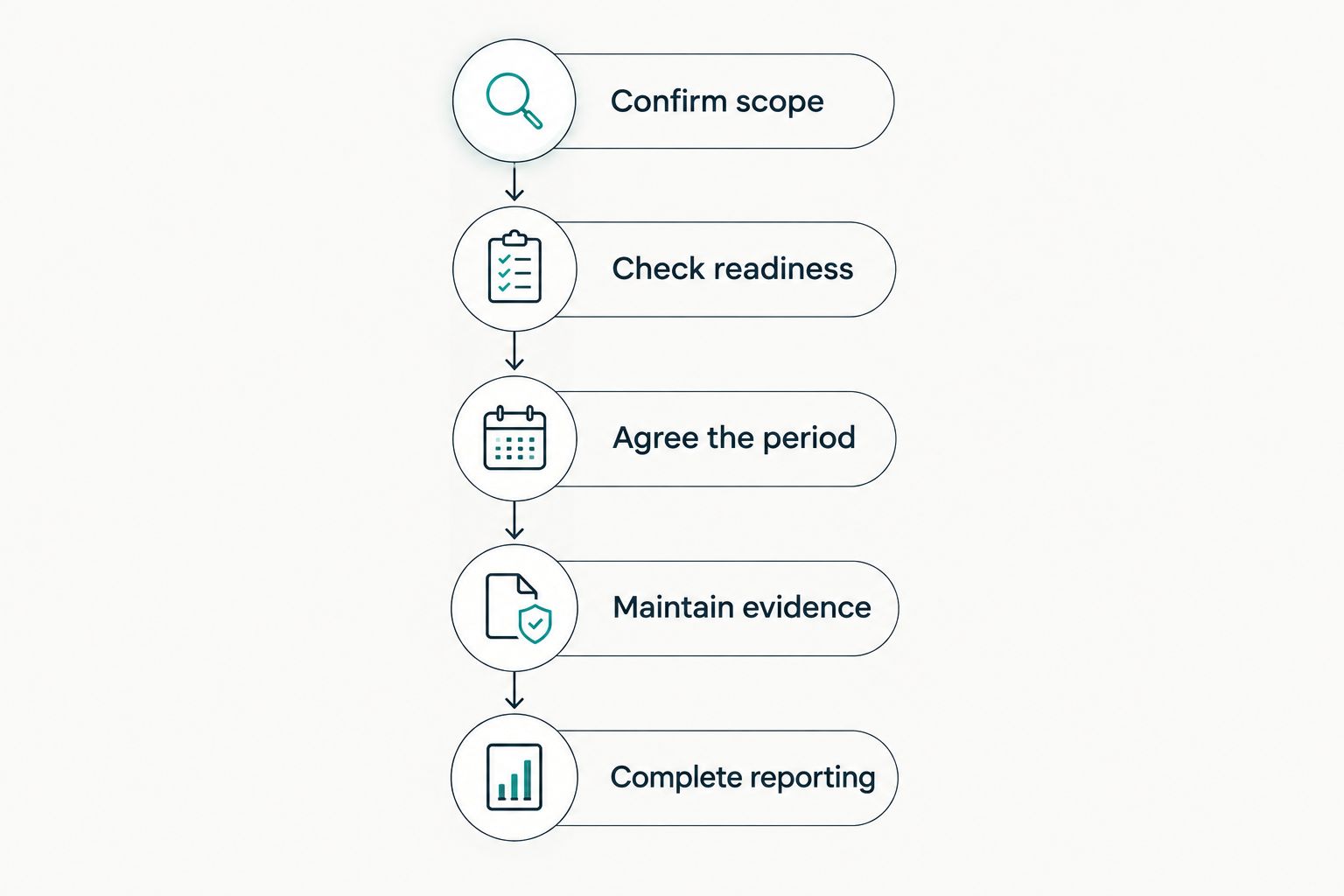
The report delivery plan includes work before and after the observation period.
Keep these stages in one shared schedule. Your engineering, people, security and sales teams need the same dates and the same definition of completion.
What evidence should you organise before testing?
Organise evidence around the control it supports, not just the application that produced it. The auditor needs to understand the activity, the relevant population and the period covered.
Examples include access approvals, employee onboarding records, change approvals, incident records and completed reviews. The exact evidence depends on your controls and the auditor's testing approach.
For each control, record:
- The person responsible for operating it.
- The systems and people it covers.
- The frequency stated in your process.
- The source of the evidence.
- The date and outcome of each relevant activity.
- Any exceptions and the action taken.
Keep original records and their context. A screenshot without a date or a clear system boundary does not explain whether it supports the requested period.
Your 2026 evidence library should distinguish current settings from historical activity. A secure configuration today does not, by itself, demonstrate how that configuration operated throughout the report period.
Can automation shorten a SOC 2 Type II audit?
Automation can reduce manual compliance administration. It does not compress the agreed observation period or replace the auditor's judgement.
OneClickComply is built for growing businesses that want to automate SOC 2 compliance management. OneClickComply provides software for managing cyber security compliance end-to-end, including SOC 2.
The practical boundary matters: software supports your compliance programme; your team still operates controls, explains exceptions and participates in the independent audit. Do not treat software adoption as proof that your report is ready.
Automate repeatable administration where it fits your process. Retain human ownership for decisions, approvals and follow-up, and confirm that the evidence you collect meets the auditor's needs.
What causes avoidable delays?
Avoidable delays come from unresolved decisions and incomplete records. Keep both visible before testing starts.
An unclear reporting boundary
A control owner supplies evidence from a system outside the agreed scope. The audit lead then has to establish whether the relevant system was covered.
Prevent this by attaching a scope description to each evidence request. Name the system and the activity, not just the control heading.
A missing recurring activity
A review described in your policy was not completed when expected. Completing it now does not create a historical record of the missed review.
Tell the auditor what happened and document the corrective action. Do not present a later activity as if it occurred earlier.
Unanswered auditor questions
The requested evidence exists, but nobody owns the response. Questions remain open while teams assume another person is handling them.
Assign a coordinator and a subject owner for each request. Escalate unresolved questions through the agreed audit process.
Can you start the observation period before buying software?
You can have relevant operating evidence before adopting compliance software. The auditor must assess whether that evidence supports the proposed reporting period and testing.
Preserve existing approvals, logs and review records. Moving them into a new evidence library does not change when the underlying activities occurred.
Does every control problem restart the audit?
A control problem does not automatically restart the entire audit. The auditor evaluates its nature, timing and effect on the testing and report.
Explain the issue promptly and provide accurate records. Ask whether additional testing, a scope decision or a change to the reporting plan is required.
What should you tell customers while the audit is underway?
State the stage you have reached and the milestone you expect next. Distinguish an intended delivery date from an issued report.
For a 2026 procurement discussion, confirm whether the buyer needs Type II specifically, which service must be covered and what reporting period it expects. These answers determine whether your planned report will meet the requirement.
Frequently asked questions
One last thing
A completed evidence checklist and an issued audit report are different milestones. Before you promise a delivery date, ask the auditor to confirm the observation-period end, outstanding testing and expected report issue date separately.
Manage the work you can control. Keep the reporting commitments precise. OneClickComply's approach is Seriously Simple Cyber Compliance.