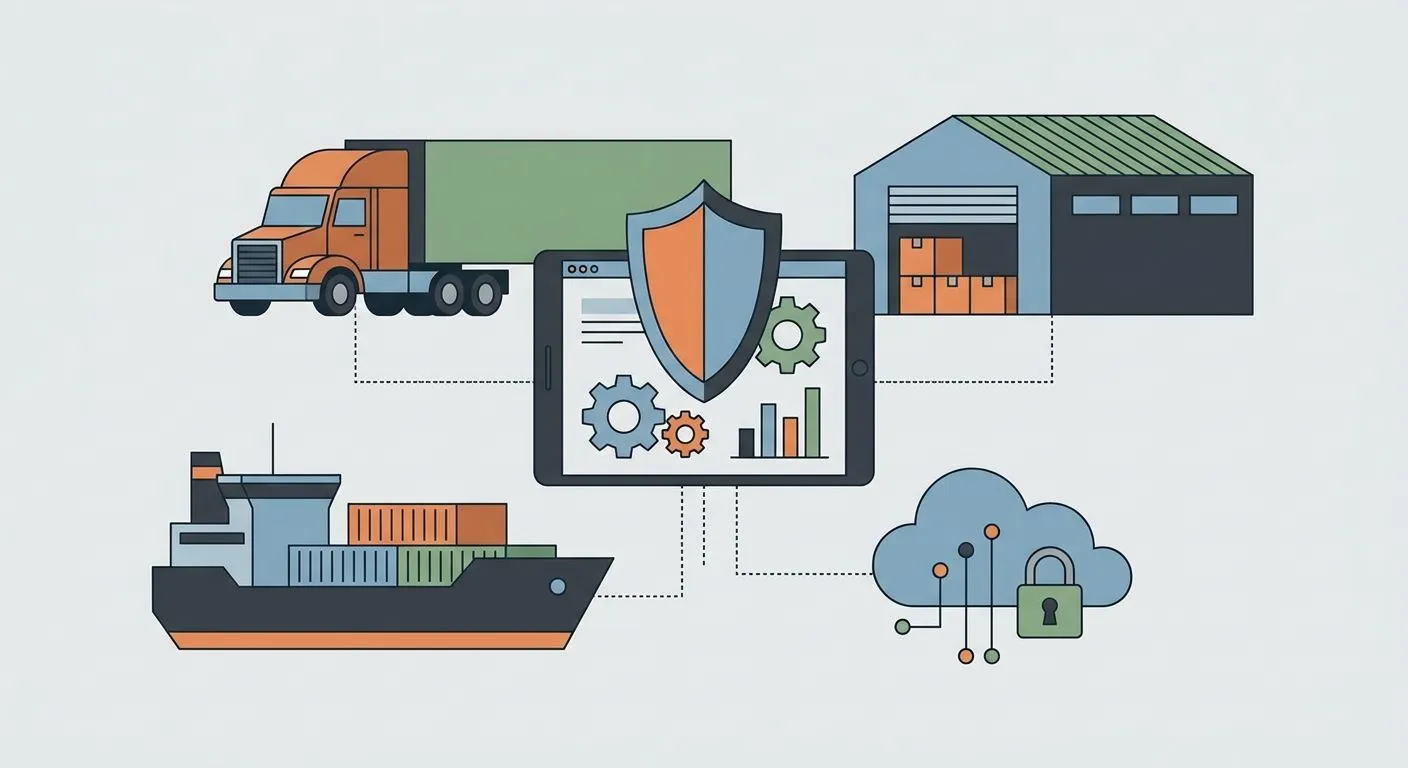
Vendor risk management software for logistics companies is a platform that scores, monitors, and documents the risk each carrier, freight broker, and haulage subcontractor poses to your operation, built to handle a subcontractor network that changes every quarter. Logistics fleets don't run one supply chain; they run a mesh of carriers, agency drivers, warehousing partners, and last-mile subcontractors, and a spreadsheet tracker breaks down somewhere around vendor 15.
Why vendor risk management matters for logistics companies
Logistics operators inherit risk from every link in the chain, not just their own systems. A freight broker who subcontracts to a haulier who subcontracts to an owner-driver creates three hops before you even know who's touching the cargo or the data tied to it. If your own customers demand Cyber Essentials as a condition of the contract, that requirement doesn't stop at your front door; it has to reach every subcontractor with access to load data, tracking systems, or depot access.
Most logistics vendor risk programmes fail for one reason: the vendor list grows faster than the review process. A 3PL onboarding five new regional hauliers a quarter can't run the same manual checklist it used at 20 vendors when it's managing 80. The fix is tiering vendors by exposure, not treating every subcontractor the same way.
Update your vendor inventory
Start by listing every entity that touches freight, data, or premises, not just the ones you invoice directly.
- Carriers and hauliers, including owner-drivers under agency arrangements
- Freight brokers and their known subcontracted fleets
- Warehousing and cross-dock partners
- Telematics and tracking software vendors
- IT and payroll vendors with access to driver or customer data
- Insurance brokers and claims handlers
Score subcontractors by risk tier
Group vendors by what they can access or disrupt, not by contract size alone. A small courier with depot access to customer data can carry more risk than a large haulier with none.
- Tier 1: direct data access, high cargo value, or hazmat handling
- Tier 2: physical access to depots or vehicles but limited data exposure
- Tier 3: indirect vendors with no data or premises access
- Reassess tier whenever a subcontractor's scope of work changes
Running this by hand in a spreadsheet works until your vendor count passes roughly a dozen. OneClickComply applies the tiering logic automatically and flags which vendors are overdue for review, so tier assignment stops being a quarterly scramble.
Run due diligence checks before onboarding
Before a new haulier or broker goes live, confirm who actually owns the business and whether they've had recent status changes.
- Pull company status and filing history from Companies House data
- Check for adverse insolvency filings or director disqualifications
- Confirm insurance certificates match the cargo type and value you're contracting for
- Request evidence of any existing security certification, even a self-assessment
- Verify subcontracting rights before assuming the vendor won't subcontract further
Set minimum security requirements per tier
Decide what each tier has to prove before it's allowed to touch your data or depots, then put it in the contract, not just the onboarding email.
- Tier 1 vendors: Cyber Essentials or equivalent, annual renewal proof
- Tier 2 vendors: basic access controls and incident reporting commitment
- Tier 3 vendors: signed data handling agreement, no certification required
- All tiers: a documented point of contact for security incidents
This is where compliance automation for logistics and supply chain companies earns its place: it turns tier requirements into automated checklists that chase the vendor for you instead of your compliance lead doing it by email.
Automate re-assessment and monitoring
A vendor that passed onboarding in January isn't automatically safe in December. Certifications lapse, ownership changes, and subcontracting chains grow without anyone telling you.
- Set renewal reminders tied to certification expiry dates, not calendar quarters
- Re-run Companies House checks on Tier 1 and Tier 2 vendors annually
- Flag any vendor that changes its own subcontractor list without notice
- Track incident history per vendor, not just per contract
Vendor risk doesn't stop at paperwork; visibility into physical operations matters just as much, and the logic is the same one applied by platforms built around tracking hazmat haulage subcontractors: continuous monitoring catches what an annual review misses.
Build an audit trail for tenders
When a major retailer or manufacturer runs a tender, they'll ask for evidence your vendor programme actually works, not just that one exists.
- Keep timestamped records of every risk assessment, not just the final score
- Store certification copies alongside the vendor record, not in a separate folder
- Log every remediation request and its close-out date
- Map your process against a vendor risk assessment framework so a new hire can run it without a handover meeting
Automate vendor risk for your fleet
See how OneClickComply handles tiering, evidence and renewals end-to-end.
Options compared for logistics vendor risk management
| Option | Best for | Key limitation |
|---|---|---|
| Spreadsheets and email | Fleets with under a dozen active vendors | No audit trail, breaks down fast past a dozen vendors |
| Generic GRC platform | Enterprises already running ISO 27001 or SOC 2 internally | Built for internal controls, slow for carrier onboarding speed |
| OneClickComply | Logistics operators managing dozens of hauliers, brokers and 3PLs against Cyber Essentials or ISO 27001 requirements | Best suited to teams ready to formalise tiering, not a one-off check |
| Consultant-run due diligence | A single push before signing a major contract | Recurring cost at every renewal cycle, slower turnaround |
Verdict: for a fleet running more than a handful of subcontractors, OneClickComply beats spreadsheets on speed and beats a generic GRC platform on onboarding turnaround for logistics-specific vendor churn.
Common mistakes logistics companies make
- Treating every subcontractor the same, regardless of whether they handle hazmat, high-value cargo, or nothing but a delivery run.
- Assuming the broker vetted their own subcontractors. Freight brokers frequently subcontract further down the chain without telling you.
- Skipping reassessment after driver or ownership turnover. A haulier that passed onboarding under one owner may look completely different a year later.
- Ignoring Cyber Essentials flow-down. If your customer requires it of you, your Tier 1 vendors likely need it too, even if nobody wrote that into the contract.
- Storing evidence in someone's inbox. When a tender asks for proof, an email thread isn't an audit trail.
Courier and last-mile operators face a version of this problem specific to their model: a large pool of owner-drivers and agency staff with high turnover and low individual contract value, which makes tiering by data access more useful than tiering by spend. The pattern in Cyber Essentials for courier and last-mile delivery firms applies directly to the vendor side of the same fleets.
Frequently asked questions
One last thing
The subcontractor you haven't reviewed since onboarding is statistically the one most likely to have changed. Ownership, subcontracting chains, and certification status shift constantly in freight, and 2026 tenders increasingly ask for proof of ongoing monitoring, not just a signed contract from three years ago. Vendor risk management software for logistics companies only earns its keep if reassessment runs on autopilot — that's the one habit spreadsheets can't replicate at scale.