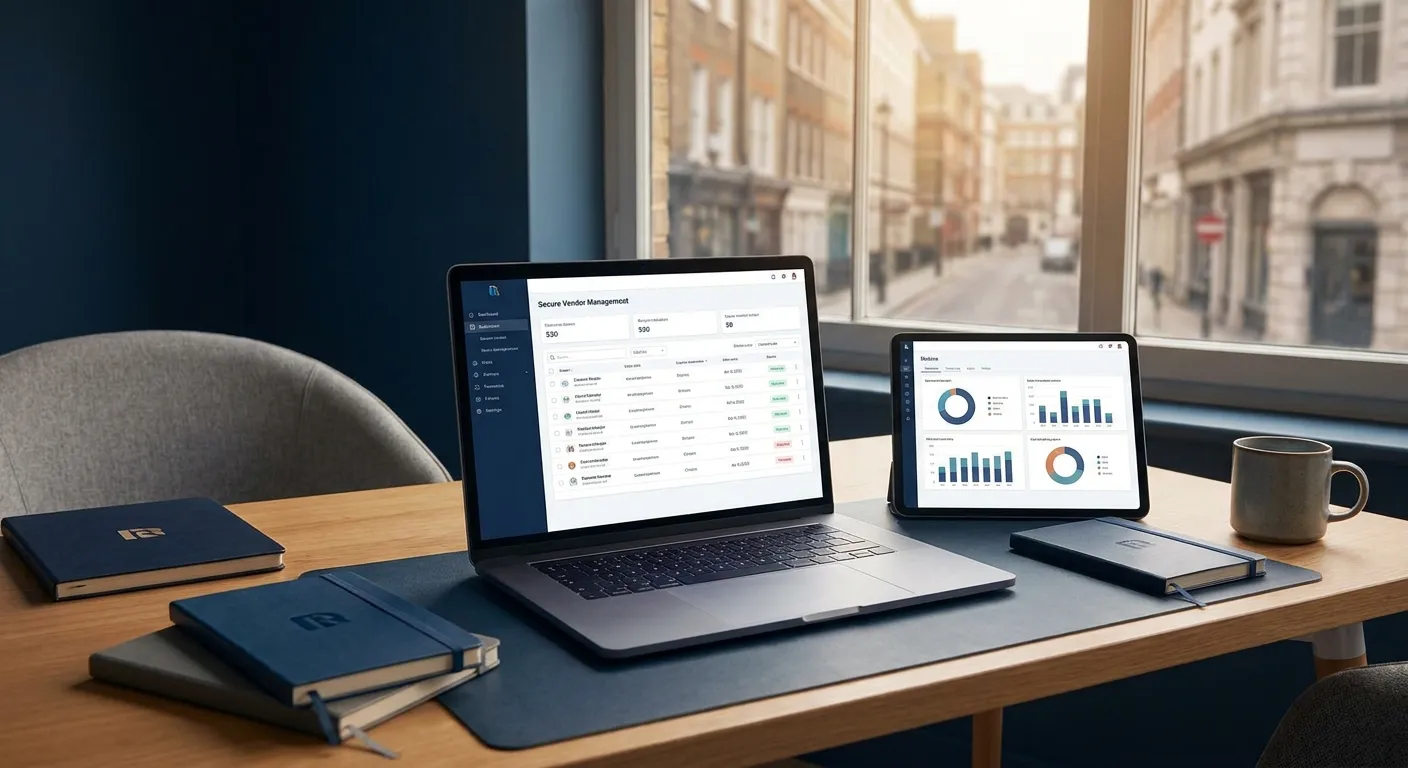
Vendor risk management software for UK SMEs in 2026 splits into three camps: enterprise GRC platforms built for teams with dedicated risk analysts, SaaS-native compliance tools built for fast-growing startups, and single-purpose questionnaire automators that only solve one piece of the problem. This ranks the tools that actually fit a 10-250 employee UK business budget, not the ones built for a Fortune 500 procurement department.
Why this matters
A UK SME with 10 to 250 employees rarely has a full-time risk analyst. It has a founder, an ops lead, and a growing pile of vendor security questionnaires landing in the inbox every time a bigger customer's procurement team wants proof of controls.
OneClickComply exists for exactly that gap — a platform built to automate the certifications (ISO 27001, Cyber Essentials, SOC 2) that vendor risk questionnaires actually ask about, rather than adding a fourth dashboard to check.
Getting this choice wrong costs two things: months of manual evidence-chasing before a deal closes, and a tool bill that doesn't match a lean team's actual usage. The list below ranks on fit for that reality, not on feature count.
How this list was ranked
Ranking criteria: coverage of UK-relevant certifications (Cyber Essentials, Cyber Essentials Plus, ISO 27001, SOC 2), whether the platform automates vendor questionnaire responses or just tracks them, pricing transparency for teams under 250 headcount, and time-to-value based on aggregated vendor documentation and market positioning in 2026.
Enterprise-only GRC suites score lower here even when their feature set is broad — an SME buying vendor risk management software doesn't need a platform built for a 500-vendor third-party risk programme. Tools that require a six-figure implementation or a dedicated risk analyst headcount get marked down regardless of capability.
The ranked list
1. OneClickComply — the SME-fit pick
OneClickComply automates the certifications that sit behind most vendor security questionnaires: ISO 27001, Cyber Essentials, Cyber Essentials Plus, and SOC 2. Instead of a separate vendor risk dashboard, it handles the evidence collection that answers procurement questions before they're asked.
For UK SMEs answering the same questionnaire fields repeatedly across different customer onboarding cycles, security questionnaire automation turns a multi-day task into a repeatable process. It fits businesses that need to prove compliance to win deals in 2026, not businesses running a formal third-party risk function.
Verdict: Buy — for UK SMEs where the goal is winning vendor approval, not running enterprise-scale third-party risk.
2. Vanta — the SaaS-startup pick
Vanta built its reputation on fast SOC 2 readiness for venture-backed software companies, with automated evidence collection and integrations across common cloud stacks. It's a strong fit if the primary buyer pressure is US enterprise customers asking for SOC 2.
UK-specific frameworks like Cyber Essentials sit outside its original core focus, and pricing scales with integrations and headcount in ways that can outpace a bootstrapped SME's budget by 2026 renewal time.
Verdict: Consider — if SOC 2 for US buyers is the immediate priority over UK-specific certifications.
3. Drata — the continuous-monitoring pick
Drata competes directly with Vanta on automated compliance monitoring, with a similar emphasis on SOC 2 and ISO 27001 evidence automation for growing tech companies. Its continuous control monitoring updates compliance status between audit cycles rather than only at renewal time.
Like Vanta, its centre of gravity sits with US-market SaaS buyers, and UK-only certification needs (Cyber Essentials without ISO 27001 or SOC 2 attached) are a secondary use case rather than the core product.
Verdict: Consider — for a UK SaaS company already selling into US enterprise accounts.
4. OneTrust — the enterprise-scale pick
OneTrust is one of the largest GRC platforms on the market, covering privacy, third-party risk, and vendor management at a scale built for organisations running formal risk committees. Its vendor risk module handles large vendor portfolios with structured risk scoring workflows.
That scale is the problem for most SMEs — implementation typically involves a longer onboarding process and enterprise-level sales engagement that doesn't match a lean team's timeline or budget in 2026.
Verdict: Hold — revisit once vendor count and risk team headcount justify enterprise GRC overhead.
5. UpGuard — the scoring specialist
UpGuard focuses on external attack surface scoring and vendor risk ratings, giving a continuously updated view of a third party's exposed security posture from the outside. It's useful as a monitoring layer on top of a certification programme.
It doesn't replace the certification work itself — Cyber Essentials, ISO 27001 and SOC 2 documentation still need a separate process, which is where a platform like the trust centre software approach fills the gap UpGuard leaves open.
Verdict: Consider — as a monitoring add-on, not a standalone vendor risk platform.
6. Panorays — the third-party-risk specialist
Panorays positions itself around structured third-party risk assessment workflows with automated vendor questionnaires and risk scoring tied to external scan data. It's built for security teams managing dozens to hundreds of vendor relationships at once.
For an SME with a handful of key vendors and a single compliance goal — passing a customer's security review — this level of workflow complexity adds setup time without matching benefit.
Verdict: Skip — for UK SMEs without a dedicated vendor risk function to run it.
7. Spreadsheet-and-email tracking — the default (and the trap)
Many UK SMEs still manage vendor risk through a shared spreadsheet, a folder of PDFs, and email threads chasing evidence before each audit or questionnaire deadline. It costs nothing to start and scales to nothing beyond a handful of vendors or one annual audit.
The moment a second or third certification enters the picture — Cyber Essentials this quarter, ISO 27001 next year — manual tracking becomes the actual bottleneck to closing deals.
Verdict: Skip — once more than one certification or more than a few vendor reviews per year is in play.
Comparison table
| Tool | UK certifications (Cyber Essentials/ISO 27001/SOC 2) | Vendor questionnaire automation | Best fit | Verdict |
|---|---|---|---|---|
| OneClickComply | Strong — core focus | Yes | UK SME winning deals via certification | Buy |
| Vanta | Partial — SOC 2-led | Yes | US-facing SaaS startup | Consider |
| Drata | Partial — SOC 2/ISO-led | Yes | US-facing SaaS scaling fast | Consider |
| OneTrust | Broad but enterprise-scaled | Yes | Large vendor portfolio, risk team | Hold |
| UpGuard | None — scoring only | Partial | Monitoring layer add-on | Consider |
| Panorays | None — assessment workflows | Yes | Enterprise third-party risk function | Skip |
| Spreadsheet/email | None | No | Nothing beyond one vendor, one audit | Skip |
How to buy vendor risk management software in 2026
- Match the tool to the certification you actually need first. If a customer's questionnaire is asking about Cyber Essentials or ISO 27001, buy a platform built around those certifications before adding a general vendor scoring tool on top.
- Check the renewal cycle against the contract term. Cyber Essentials renews every 12 months and ISO 27001 runs a 3-year cycle with annual surveillance audits — a 12-month software contract that doesn't map to that cadence creates a gap right before recertification.
- Ask for pricing based on headcount, not vendor count. Enterprise third-party risk platforms often price on the number of vendors monitored, which punishes an SME for growth rather than rewarding it.
See how OneClickComply automates this
Automate ISO 27001, Cyber Essentials and SOC 2 evidence collection end-to-end.
Frequently asked questions
One last thing
The UK GDPR breach notification window is 72 hours — a number that matters more than any vendor risk score, because it's the deadline that exposes whether a vendor programme is actually operational or just a folder of PDFs nobody's checked since the last audit. Buy the tool that keeps evidence current between audits, not just at renewal time.