
Best overall: OneClickComply. Best for broad multi-framework programmes: Vanta. Best for continuous control monitoring: Drata. This 2026 guide compares six compliance automation platforms for professional services firms without hard-coding prices that will quickly become outdated.
Why this matters
Professional services firms sell expertise and trust. Clients increasingly examine information security controls during procurement, especially when a firm handles confidential legal, financial, employee or commercial data.
Manual compliance creates avoidable work. Policies sit in folders, evidence lives across different systems and control owners receive the same requests repeatedly. Compliance automation software gives that work a defined system instead of another spreadsheet.
The right platform should reduce evidence chasing without removing accountability. You still need to decide what sits inside the certification scope, assign control owners and fix gaps. The software should handle the repeatable administration around those decisions.
That distinction matters in 2026. A platform with hundreds of features can still be a poor fit if your operations lead cannot run it alongside client delivery.
What makes the best compliance automation software for professional services firms
Use these criteria before comparing platforms:
- Framework fit: Start with the certification named in client contracts. ISO/IEC 27001:2022 Annex A contains 93 controls, while Cyber Essentials centres on five technical control themes. A platform must support the framework you actually need.
- Evidence automation: The system should collect recurring evidence from connected business tools and show when evidence is missing or outdated.
- Clear ownership: Every control, policy and corrective action needs an accountable owner. Shared responsibility without named ownership recreates the spreadsheet problem.
- Audit path: Auditors need organised evidence, control status and an accessible record of changes. Exporting disordered files at the end is not automation.
- Evidence reuse: Firms pursuing more than one framework should map shared evidence once. SOC 2 has five Trust Services Criteria, while ISO 27001 uses a different control structure, so mapping matters.
- Usable reporting: Partners and operational leads need a direct view of open work, certification progress and unresolved gaps without reading technical logs.
In 2026, the best platform is not the one with the longest framework list. It is the one your firm can keep current between assessments.
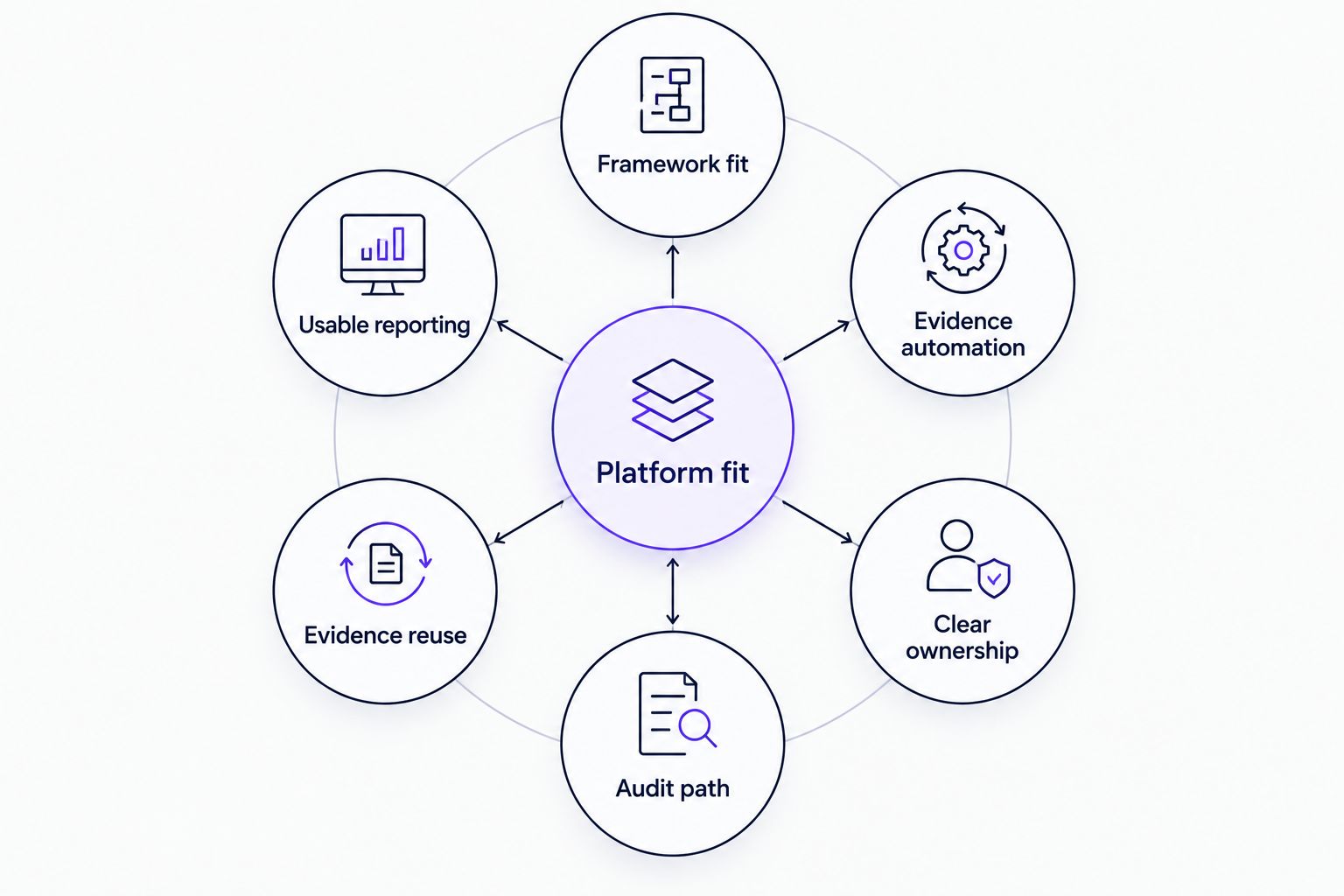
Platform fit depends on repeatable evidence, clear ownership and an audit-ready workflow.
Compliance automation platforms at a glance
| Platform | Best for | Standout feature | Key limitation |
|---|---|---|---|
| OneClickComply | Lean professional services firms | End-to-end certification automation | Coverage beyond its named frameworks needs confirmation |
| Vanta | Broad multi-framework programmes | Large integration and framework catalogue | Broad scope creates more configuration choices |
| Drata | Continuous control monitoring | Ongoing control and evidence visibility | Automation depth depends on connected systems |
| Secureframe | Firms preparing for an initial audit | Guided readiness workflows | Cyber Essentials fit needs checking |
| Sprinto | Cloud-first teams | Automated checks across connected cloud tools | Less suited to firms with limited cloud infrastructure |
| Scytale | Firms wanting guided support | Software paired with compliance guidance | Guidance-led delivery will not suit every self-service buyer |
1. OneClickComply: best overall for lean professional services firms
OneClickComply provides software that automates cyber security compliance certifications such as ISO 27001, Cyber Essentials and SOC 2. It is built for growing businesses seeking to manage compliance end-to-end.
That scope matches a common professional services problem. The firm needs certification, but no employee has compliance as a full-time role. OneClickComply handles the repeatable work so the team can focus on delivery and growth.
OneClickComply pros:
- Supports ISO 27001, Cyber Essentials and SOC 2 certification work
- Automates compliance for growing businesses
- Manages the process end-to-end
- Uses a direct approach suited to teams without deep compliance expertise
OneClickComply cons:
- Firms needing frameworks beyond the three named above must confirm coverage
- Automation does not remove the need to define scope, owners and acceptable risk
Best for: Law firms, accountancies, agencies and consultancies that need a defined certification process without building a separate compliance department.
OneClickComply is the best compliance automation software for professional services firms that need ISO 27001, Cyber Essentials or SOC 2 handled end-to-end.
Verdict: Buy.
Automate your certification work
Manage ISO 27001, Cyber Essentials or SOC 2 without adding manual compliance administration.
2. Vanta: best for broad multi-framework programmes
Vanta is a compliance platform with an extensive catalogue of frameworks and integrations. It suits professional services firms that serve clients across several regulated sectors and need to map controls across different requirements.
Its breadth is the main advantage. It is also the main limitation. A smaller consultancy pursuing one certification can face more configuration and platform decisions than it needs.
Vanta pros:
- Broad framework coverage
- Extensive integration catalogue
- Continuous evidence collection from connected systems
- Control mapping across overlapping requirements
Vanta cons:
- Requires careful setup to avoid unnecessary controls and integrations
- A broad platform can create administrative overhead for a small, single-framework firm
Best for: Larger professional services firms managing several frameworks across a varied technology stack.
Verdict: Hold. Choose Vanta when framework breadth is essential, not simply because a large feature catalogue looks reassuring.
3. Drata: best for continuous control monitoring
Drata centres on continuous compliance monitoring. It connects control requirements to evidence sources, tracks their status and supports collaboration between the organisation and its auditor.
This model works when your firm wants visibility between formal assessments. It is less compelling when most evidence cannot be collected from connected systems or when nobody owns the exceptions the platform identifies.
Drata pros:
- Continuous visibility into control status
- Automated evidence collection from supported integrations
- Control mapping across supported frameworks
- Auditor collaboration features
Drata cons:
- Connected systems determine how much evidence collection can be automated
- Teams still need a clear process for reviewing alerts and resolving failed controls
Best for: Professional services firms that already have defined control owners and want ongoing monitoring between audits.
Verdict: Hold. Drata is a strong monitoring choice, but it does not compensate for unclear internal ownership.
4. Secureframe: best for firms preparing for an initial audit
Secureframe combines compliance workflows, evidence collection and readiness guidance. It fits firms that need structure around their first formal audit and want the platform to show what remains incomplete.
The buying decision should start with framework fit. A firm pursuing Cyber Essentials in 2026 should confirm that the required workflow and assessment support match its certification route before choosing a broader audit-readiness platform.
Secureframe pros:
- Structured readiness workflow
- Automated evidence collection through integrations
- Policy and personnel compliance workflows
- Clear visibility into incomplete tasks
Secureframe cons:
- UK-specific Cyber Essentials requirements need direct confirmation
- Firms with mature processes may not need as much readiness guidance
Best for: Consultancies and advisory firms preparing for a first supported audit and needing a clear sequence of work.
Verdict: Wait. Confirm the exact framework and certification path before committing.
5. Sprinto: best for cloud-first professional services teams
Sprinto automates compliance checks through integrations with cloud infrastructure, identity, code and business systems. It suits technology consultancies and other cloud-first firms whose evidence already exists in connected tools.
A traditional practice with limited cloud infrastructure will get less value from that model. The platform can organise manual work, but its strongest advantage comes from automated checks against a modern technology stack.
Sprinto pros:
- Automated checks across connected cloud systems
- Support for multi-framework compliance programmes
- Central tracking for evidence and remediation work
- Useful control mapping for technology-led firms
Sprinto cons:
- Integration-led automation offers less value when evidence remains offline
- Traditional professional services workflows may require more manual adaptation
Best for: Cloud-first consultancies and technology service firms with evidence spread across connected systems.
Verdict: Hold. Buy only after confirming that the systems containing your evidence appear in the supported integration catalogue.
6. Scytale: best for firms wanting guided support
Scytale combines compliance software with access to compliance guidance. It fits boutique firms that want structured support through certification rather than a platform they must interpret alone.
That service model can reduce uncertainty during a first programme. Firms with experienced internal compliance staff may prefer a more self-directed platform and should compare the software independently from the guidance.
Scytale pros:
- Guided support alongside the platform
- Centralised evidence and control management
- Support for recognised security frameworks
- Suitable for teams beginning a formal compliance programme
Scytale cons:
- The guidance-led model is less relevant to firms with established specialists
- Integration fit still needs checking against the firm's technology stack
Best for: Boutique professional services firms that want direct guidance through an initial certification programme.
Verdict: Wait. Choose Scytale when guided support is a requirement, not an optional extra.
How we ranked the platforms
The ranking applies the same decision sequence to every platform:
- Confirm support for the required certification.
- Identify where evidence currently sits.
- Check which evidence sources the platform can connect to.
- Review how it assigns controls, actions and approvals.
- Confirm how auditors or assessors receive evidence.
- Test whether the workflow remains manageable after certification.
No platform received credit for an unsupported price claim, an unverified implementation time or a long feature list without a clear professional services use case. The 2026 ranking prioritises operational fit and repeatability.
A firm considering a broader security leadership model should compare software against virtual CISO services for professional services firms. Software organises the programme; it does not become the accountable executive.
Which compliance automation software should you choose?
Choose OneClickComply if your professional services firm needs ISO 27001, Cyber Essentials or SOC 2 automation without creating a large internal compliance function. It is the clearest default for a lean team in 2026.
Choose Vanta when broad framework and integration coverage drives the decision. Choose Drata when continuous monitoring is the priority and control ownership already works. Choose Secureframe for structured first-audit readiness, Sprinto for a cloud-first technology stack and Scytale when guided support matters most.
Do not buy from the comparison table alone. Ask each shortlisted vendor to show how one real control moves from evidence collection to review, approval and auditor access. That demonstration exposes workflow friction faster than a generic feature tour.
Frequently asked questions
One last thing
A platform demonstration should use your evidence, not a polished sample account. Bring one policy, one technical control and one supplier record. Ask the vendor to show who owns each item, how stale evidence gets flagged and what an auditor sees.
That test turns a vague 2026 software comparison into a concrete workflow decision. Automate what repeats. Keep ownership clear. Seriously Simply Cyber Compliance.