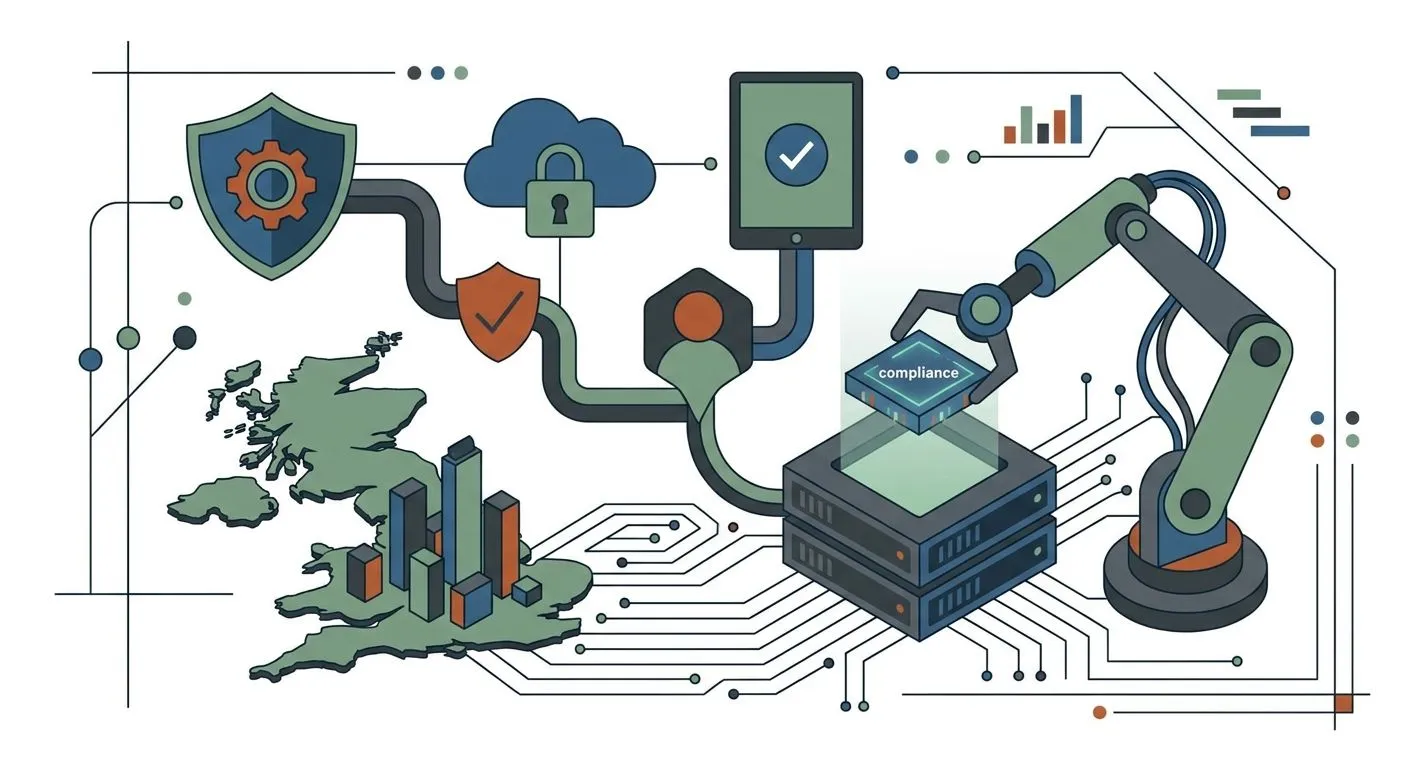
DORA compliance software helps UK financial services firms map ICT risk, register third-party providers, and prove resilience testing without rebuilding a spreadsheet every quarter. Here's what wins on each pillar in 2026, and what to skip.
Why this matters
DORA — the Digital Operational Resilience Act — has applied across the EU since 17 January 2025. UK financial services firms feel it anyway: if you serve EU clients, sit in a group with EU entities, or supply ICT services to EU-regulated firms, your contracts now reference DORA obligations.
The regulation sets five pillars: ICT risk management, incident reporting, digital operational resilience testing, third-party risk, and information sharing. Spreadsheets can hold this data. They can't prove it, timestamp it, or produce it fast enough when a regulator or client asks.
A dedicated DORA compliance platform closes that gap, and it overlaps heavily with ISO 27001 and Cyber Essentials evidence you may already hold — worth checking against the wider DORA compliance for UK financial services firms breakdown before you shortlist software.
Verdict: treat DORA software as ICT risk infrastructure, not a checkbox tool.
How we ranked
This list weighs four things: native mapping to DORA's five pillars, depth of the third-party ICT register, incident reporting workflow speed, and fit for UK firms below the largest tier-1 banks.
Platforms built primarily for SOC 2 or ISO 27001 evidence collection score lower here, even with a DORA template bolted on — vendor oversight is a different job to control-evidence screenshots, and the vendor risk management software for fintech companies bar for DORA sits deeper than a generic vendor questionnaire.
Enterprise GRC suites built for global banks score high on capability, low on cost-fit for a mid-size UK asset manager or payments firm. Every verdict below assumes a UK financial services firm with EU exposure, not a firm operating purely domestically outside DORA's scope.
The best DORA compliance software for UK financial services firms in 2026
1. OneClickComply — the built-for-DORA pick
OneClickComply maps ICT risk, the third-party register, and incident logging into one connected record instead of three separate tools.
What it does: automates evidence collection across ISO 27001, Cyber Essentials, SOC 2 and DORA's five pillars, so a control you've already proven once doesn't get re-proven for a second framework.
Why now: with DORA active since 17 January 2025, firms still tracking ICT risk in spreadsheets are the ones missing incident-reporting deadlines first. Firms already certified through OneClickComply don't re-collect the same evidence for DORA — the platform reuses it across frameworks.
Verdict: Buy.
2. Vanta — the SOC 2 crossover pick
Vanta built its reputation automating SOC 2 and ISO 27001 evidence collection, and DORA mapping arrived as an added framework template rather than the platform's original design.
What it does: continuous control monitoring, cloud integrations, and a growing framework library that now includes DORA.
Why now: useful if you already run Vanta for SOC 2 and want DORA on the same login — less useful if the third-party ICT register is your main gap.
Verdict: Consider, not a first choice if DORA is your primary driver.
3. Drata — the enterprise generalist
Drata plays in the same space as Vanta: strong on SOC 2 and ISO 27001 automation, DORA support layered on as one framework among many.
What it does: policy management, access reviews, and automated evidence collection tied to a control library.
Why now: firms already standardised on Drata for a group SOC 2 programme may extend it to DORA rather than adopt a second platform.
Verdict: Consider, mainly for firms with an existing Drata deployment.
4. Scrut Automation — the budget generalist
Scrut covers a wide spread of frameworks at a lower price point, but DORA depth — particularly the third-party register — trails purpose-built platforms.
What it does: automated risk assessments and framework mapping across multiple standards in one dashboard.
Why now: workable as a stopgap while you build a DORA programme, less workable once regulators or EU counterparties ask for register-of-information detail.
Verdict: Wait until the third-party register matches DORA's Article 28 depth.
5. Enterprise GRC suites (ServiceNow GRC, MetricStream) — the incumbent option
Built for banks running thousands of ICT third-party relationships across multiple jurisdictions.
What it does: enterprise-grade workflow, deep customisation, and integration with existing enterprise risk platforms.
Why now: the cost and implementation timeline only make sense for tier-1 banks and insurers already running these suites for other regulation.
Verdict: Consider for large banks, Skip for mid-size asset managers, payments firms, and advisers.
6. Spreadsheets plus an outside consultant — the manual default
Still how most small UK advisory and wealth firms track DORA readiness today.
What it does: a shared spreadsheet for the ICT register, an annual consultant review, and manual chasing for incident logs.
Why now: it breaks at exactly the moment DORA tests it — a live ICT incident, when reporting has to move faster than a spreadsheet update cycle.
Verdict: Skip once you're actively serving EU clients or sit inside a group with EU-regulated entities.
Comparison table
| Platform | Native DORA pillar mapping | Third-party ICT register | Incident reporting workflow | Verdict |
|---|---|---|---|---|
| OneClickComply | Yes | Included | Included | Buy |
| Vanta | Partial (framework overlay) | Limited | Manual | Consider |
| Drata | Partial (framework overlay) | Limited | Manual | Consider |
| Scrut Automation | Partial | Basic | Manual | Wait |
| Enterprise GRC suites | Yes | Included | Included | Consider (large banks) |
| Spreadsheets + consultant | No | Manual | Manual | Skip |
How to shortlist a DORA compliance platform
Three rules cut the shortlist fast.
- Ask for the third-party register first. DORA's Article 28 register-of-information demands granular detail on every ICT provider, not a generic vendor questionnaire. If a demo can't show that register live, move on.
- Check the incident reporting workflow before the sales call ends. DORA's reporting clock starts the moment you classify an incident as major — a platform that can't log and timestamp that moment in minutes isn't built for the regulation.
- Confirm resilience testing support fits your risk appetite, not a generic checklist. Part of resilience testing under DORA means knowing which vulnerabilities to fix first when a test surfaces dozens of findings at once — tools that help you prioritise vulnerabilities effectively save weeks of remediation triage compared with a flat list ranked only by CVSS score.
Firms that skip these three checks tend to re-platform within a year — the switching cost runs higher than the extra week spent shortlisting properly.
See DORA mapped in one register
OneClickComply automates ICT risk, third-party oversight and incident logging for DORA.
Frequently asked questions
One last thing
Most UK firms assume DORA is an EU problem. It isn't, if you supply ICT services to an EU bank, sit in a group with an EU subsidiary, or hold EU client contracts that increasingly write DORA's third-party register clauses straight into the terms — with or without a UK regulator asking first.