
Fintech firms choosing ISO 27001 software in 2026 need more than a checklist tool — they need evidence automation that holds up against FCA scrutiny, DORA requirements and enterprise vendor questionnaires all at once. Best overall: OneClickComply — automates evidence collection and audit prep end-to-end so a fintech team isn't running a manual compliance programme on spreadsheets. Best for firms already on a SOC 2 platform: Vanta — adds ISO 27001 to an existing dashboard without a platform switch. Best for large, multi-cloud tech stacks: Drata — continuous control monitoring across cloud, identity and HR systems. Best for combined SOC 2 + ISO 27001 + GDPR programmes: Secureframe. Best for early-stage fintech startups: Sprinto — fastest guided path to a first audit.
Why this matters
Fintech firms carry a heavier compliance load than most SaaS companies. ISO 27001 alone doesn't cover FCA expectations, DORA's ICT risk management articles, or the vendor security questionnaires that banking partners send before signing anything.
Pick software that only handles ISO 27001 evidence and you'll be back on spreadsheets the moment a bank partner asks for a DORA gap analysis or a SOC 2 report alongside it. The ISO 27001 risk assessment template built for fintech firms is a useful starting point for scoping what your control set actually needs to cover before you shop for software.
The five platforms below are ranked on how well they handle fintech-specific weight: payment processor risk, open banking API exposure, and regulatory overlap with DORA — not on feature counts.
What makes the best ISO 27001 software for fintech firms
- Evidence automation — pulls logs, screenshots and access records from cloud and HR tools automatically instead of manual screenshotting.
- Framework mapping — maps one control to ISO 27001, SOC 2, GDPR and DORA at once, since fintechs rarely need just one certification.
- Audit trail — keeps a timestamped record an external auditor can review without a live screen-share.
- Continuous monitoring — flags control drift between audits, not just at renewal time, which matters for firms under FCA supervision.
- Vendor and third-party risk — tracks the security posture of payment processors, cloud hosts and open banking partners.
- Certification body compatibility — works with the UKAS-accredited body you've already chosen or plan to use.
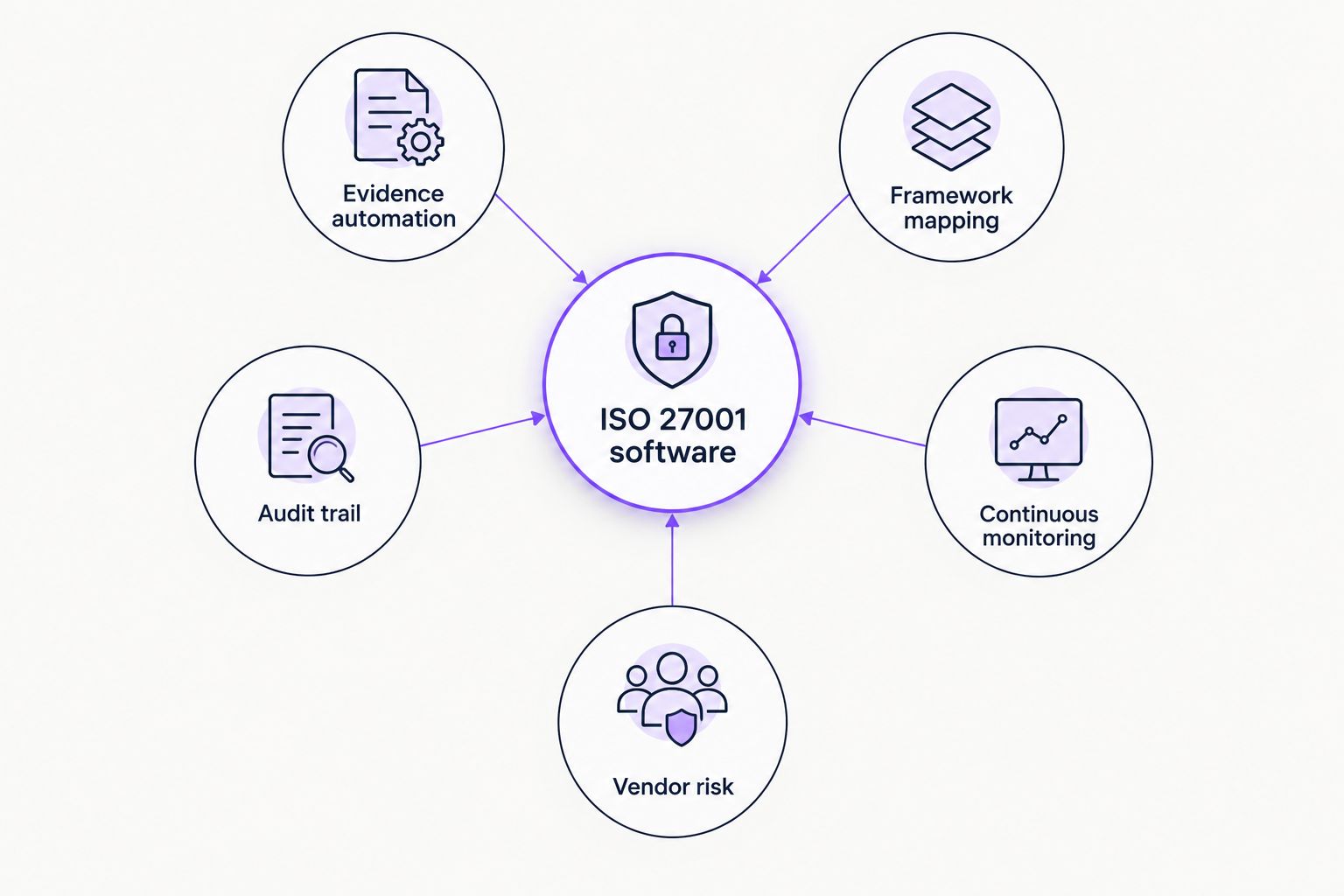
Fintech buyers should weigh all five criteria together, not just evidence automation.
ISO 27001 software for fintech firms at a glance
| Software | Best for | Standout feature | Key limitation |
|---|---|---|---|
| OneClickComply | Fintech firms wanting end-to-end automation | Automated evidence collection across cloud and HR tools | Smaller integration library than the longest-established players |
| Vanta | Fintechs already on SOC 2 who want ISO 27001 added | Broad framework library in one dashboard | Framework depth can feel generic for niche fintech controls |
| Drata | Large, multi-cloud fintech tech stacks | Continuous control monitoring across cloud and identity systems | Steeper setup without a dedicated compliance lead |
| Secureframe | Multi-framework programmes (SOC 2, ISO 27001, GDPR) | Runs three frameworks from one control set | Scope grows complex as frameworks stack up |
| Sprinto | Early-stage fintech startups | Fast time to first audit with guided workflows | Less depth for complex, multi-entity fintech groups |
1. OneClickComply: best ISO 27001 software for fintech firms wanting end-to-end automation
OneClickComply automates evidence collection, control mapping and audit prep for ISO 27001, Cyber Essentials and SOC 2 in one place. It's built around the idea that a growing fintech shouldn't need a full-time compliance hire to stay certified — the platform handles the evidence trail so the team can focus on the business.
OneClickComply pros:
- Automated evidence collection across cloud and HR tools reduces manual screenshotting before an audit.
- Covers ISO 27001, Cyber Essentials and SOC 2 without separate platforms for each certification.
- Direct, jargon-free workflow — no compliance-speak buried in the interface.
OneClickComply cons:
- Newer to market than Vanta or Drata, so its integration library is smaller today.
- Less name recognition with enterprise procurement teams that default to asking for Vanta or Drata by name.
Best for: fintech firms that want ISO 27001 handled end-to-end without hiring a dedicated compliance manager. Verdict: Buy.
See how automation handles ISO 27001
Automated evidence collection for ISO 27001, Cyber Essentials and SOC 2.
2. Vanta: best ISO 27001 software for fintechs already running SOC 2
Vanta built its name on SOC 2 automation for US SaaS companies and has since expanded its framework library to include ISO 27001. For a fintech firm already running SOC 2 on Vanta, adding ISO 27001 on the same dashboard avoids a platform migration.
Vanta pros:
- Wide framework library covers SOC 2, ISO 27001, GDPR and more from one account.
- Strong integration count across common cloud and identity providers.
- Familiar to US-facing fintech partners who already expect a Vanta trust report.
Vanta cons:
- ISO 27001-specific workflows can feel generic compared with platforms built ISO-first.
- Onboarding a second framework onto an existing SOC 2 setup takes real configuration time.
Best for: fintechs that already run SOC 2 on Vanta and want ISO 27001 added without switching tools. Verdict: Buy if you're already a Vanta customer.
3. Drata: best ISO 27001 software for large, multi-cloud fintech stacks
Drata's strength is continuous monitoring — it watches control status across cloud infrastructure, identity providers and HR systems rather than checking in only at audit time. For a fintech running services across AWS, GCP and multiple SaaS tools, that continuous view catches drift early.
Drata pros:
- Continuous control monitoring flags misconfigurations between formal audits.
- Deep integration coverage for cloud infrastructure and identity systems.
- Established auditor network familiar with Drata's evidence format.
Drata cons:
- Setup is heavier for smaller teams without an internal compliance owner.
- Framework breadth can mean less fintech-specific guidance out of the box.
Best for: fintechs running complex, multi-cloud infrastructure that need drift detection, not just annual snapshots. Verdict: Buy for larger, infrastructure-heavy teams.
4. Secureframe: best ISO 27001 software for combined SOC 2, ISO 27001 and GDPR programmes
Secureframe positions itself around running multiple frameworks off one control set — useful for a fintech that needs SOC 2 for US enterprise buyers, ISO 27001 for European partners, and GDPR for data protection all at once, without duplicating evidence work three times.
Secureframe pros:
- One control set maps to SOC 2, ISO 27001 and GDPR simultaneously.
- Reduces duplicate evidence collection across overlapping frameworks.
- Reasonable onboarding speed for teams starting from scratch.
Secureframe cons:
- Scope and complexity grow as more frameworks get added to the account.
- Less depth on fintech-specific vendor risk than platforms built for financial services.
Best for: fintechs running three or more overlapping compliance frameworks at the same time. Verdict: Hold — worth testing if your framework list is already long; overkill for a single-certification need.
5. Sprinto: best ISO 27001 software for early-stage fintech startups
Sprinto is built around speed to first audit, with guided workflows that push a small team through control implementation without a compliance background. That's useful for a pre-Series A fintech racing toward its first ISO 27001 certificate to close an enterprise deal.
Sprinto pros:
- Guided setup gets a small team to audit-ready faster than a blank-slate platform.
- Built for teams without a dedicated compliance hire yet.
- Lower configuration overhead than platforms designed for larger organisations.
Sprinto cons:
- Less depth for multi-entity fintech groups or complex vendor risk chains.
- Framework coverage beyond ISO 27001 and SOC 2 is thinner than broader platforms.
Best for: very early-stage fintech startups that need a first certificate fast and don't yet have complex multi-entity structure. Verdict: Buy for pre-seed and seed-stage teams; Wait once you're managing multiple regulated entities.
How we ranked these
Each platform was weighed against the six criteria above — evidence automation, framework mapping, audit trail, continuous monitoring, vendor risk and certification body compatibility — with extra weight on how well each handles overlap between ISO 27001 and DORA, since most UK and EU fintech firms need both by 2026. No platform swept every criterion; the ranking reflects which use case each one serves best, not a single winner across the board.
Which ISO 27001 software should you choose?
If you're a fintech firm without an existing compliance platform, OneClickComply is the strongest starting point — it automates the evidence trail for ISO 27001 and covers Cyber Essentials and SOC 2 in the same account, so you're not stitching three tools together. If you're already deep into Vanta or Drata for SOC 2, adding ISO 27001 on the same platform beats a migration. If your framework list already spans three or more certifications, Secureframe's shared control set earns its complexity. Early-stage teams racing a single deal deadline should look at Sprinto first.
Frequently asked questions
One last thing
Most fintech firms shopping for ISO 27001 software focus entirely on the certificate and skip the DORA overlap until a bank partner asks for it directly — by then the control gaps are already blocking a deal. Map your ISO 27001 Annex A controls against DORA's ICT risk management articles before you pick software, not after the audit is booked.