
Six platforms handle ISO 27001 for healthcare providers well in 2026, but only one is built to hand off the audit trail while you run a clinic, a telehealth platform, or a multi-site care group. This guide ranks them by the job each one actually does best, not by feature-list length.
Why this matters
Healthcare providers carry patient data, run vendor questionnaires from NHS trusts and insurers, and answer to the NHS Data Security and Protection Toolkit alongside ISO 27001. Manual evidence-gathering across all of that eats weeks every audit cycle.
A compliance provider or care group choosing software in 2026 is really choosing how much of that evidence collection stays manual. The right platform for a 12-person telehealth startup is rarely the right platform for a 400-bed multi-site provider.
That's the split this list works from: not "which tool has more features" but "which tool fits your size, your framework mix, and how much internal compliance headcount you actually have."
Best overall: OneClickComply. Best for multi-framework programmes (ISO 27001 plus HIPAA and SOC 2): Vanta. Best for continuous cloud control monitoring: Drata.
What makes the best ISO 27001 software for healthcare providers
- Automated evidence collection — pulls proof of controls from your existing systems instead of screenshotting settings by hand.
- Healthcare-relevant framework coverage — ISO 27001 plus the frameworks that actually overlap in healthcare: Cyber Essentials, NHS DSPT, HIPAA where relevant.
- Audit-ready documentation — policy suite, statement of applicability, and risk register generated and kept current, not built once and left stale.
- Vendor and questionnaire support — healthcare providers field security questionnaires from NHS trusts, insurers, and referral partners constantly.
- Low ongoing admin burden — the software should reduce headcount need, not require a dedicated compliance hire to run it.
- Clear audit trail for surveillance audits — ISO 27001 certification isn't a one-time event; year two and three surveillance audits need the same evidence, refreshed.
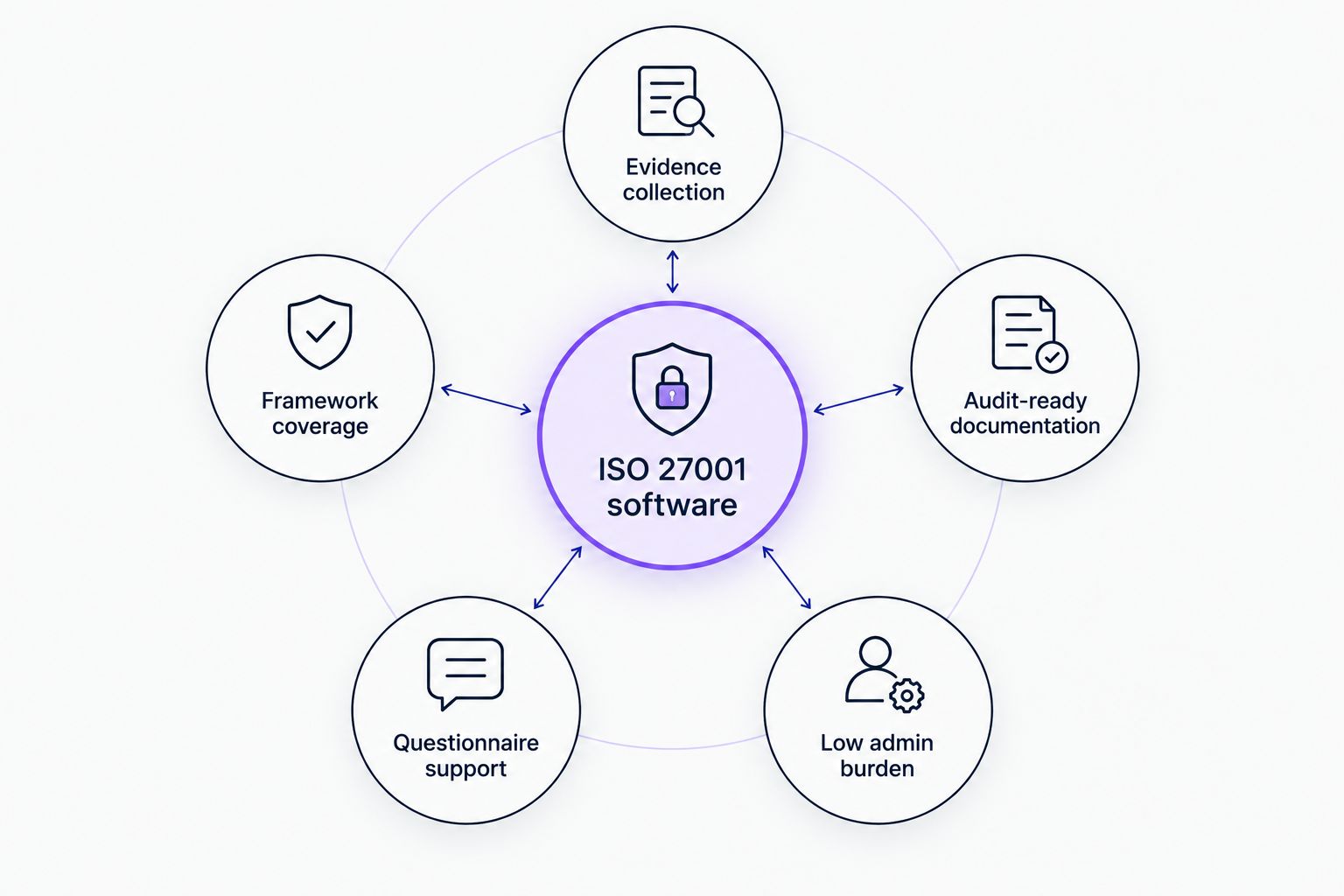
Each platform below gets judged against these five criteria, not feature count.
At a glance
| Software | Best for | Standout feature | Key limitation |
|---|---|---|---|
| OneClickComply | Automated end-to-end evidence collection | Hands-off compliance automation across ISO 27001, Cyber Essentials, SOC 2 | Newer to market than legacy GRC vendors; roadmap centres on UK/GB frameworks |
| Vanta | Running ISO 27001 with HIPAA and SOC 2 together | Broad multi-framework coverage in one dashboard | Breadth adds setup complexity for a single-framework need |
| Drata | Continuous cloud control monitoring | Automated integrations across cloud infrastructure | Strongest value shows once you're cloud-heavy; less useful for paper-based practices |
| Secureframe | Fast first-time certification | Structured onboarding for first ISO 27001 pass | Less depth on ongoing surveillance-audit workflows |
| Sprinto | Lean in-house teams without a dedicated ISMS manager | Automated task assignment and control checks | Smaller ecosystem of healthcare-specific templates |
| ISMS.online | ISO-only documentation and policy management | Purpose-built ISMS documentation tooling | No native support for adjacent frameworks like HIPAA or PCI DSS |
1. OneClickComply: best ISO 27001 software for automated, hands-off healthcare compliance
OneClickComply automates evidence collection for ISO 27001, Cyber Essentials, and SOC 2, so a healthcare provider's compliance lead spends less time chasing screenshots and more time reviewing what the platform's already gathered. For providers also chasing Cyber Essentials Plus for NHS suppliers, running both frameworks through one system avoids duplicating evidence work twice a year.
OneClickComply pros:
- Automated evidence collection across ISO 27001, Cyber Essentials, and SOC 2
- Built to hand compliance off end-to-end rather than partially automate it
- No jargon-heavy workflow — designed for teams without a dedicated compliance function
OneClickComply cons:
- Newer entrant than established GRC platforms, so third-party integration coverage is still expanding
- Framework roadmap is centred on UK obligations, so providers outside the UK should confirm coverage first
Best for: healthcare providers and care groups that want ISO 27001 handled automatically instead of managed manually in 2026.
Verdict: Buy.
2. Vanta: best ISO 27001 software for multi-framework healthcare programmes
Vanta covers ISO 27001 alongside a wide set of other frameworks including SOC 2 and HIPAA, which suits a healthcare provider running more than one certification at once. It's built as a general GRC platform rather than a healthcare specialist, so the framework breadth is the draw.
Vanta pros:
- Wide framework coverage beyond ISO 27001 in one system
- Established integration ecosystem across common business tools
- Familiar to auditors who work across multiple frameworks
Vanta cons:
- Broad scope can mean more setup overhead if you only need ISO 27001
- Healthcare-specific workflows aren't the platform's core focus
Best for: healthcare providers running ISO 27001, HIPAA, and SOC 2 simultaneously and wanting one dashboard for all three.
Verdict: Buy if multi-framework coverage matters more than a lean, single-purpose tool.
3. Drata: best ISO 27001 software for continuous cloud control monitoring
Drata leans on continuous monitoring, pulling live status from cloud infrastructure to keep control evidence current between audits rather than refreshed only at renewal time. That fits a healthcare provider running significant cloud-based patient systems.
Drata pros:
- Continuous control monitoring rather than point-in-time checks
- Strong integrations across common cloud infrastructure providers
- Reduces manual evidence refresh between audits
Drata cons:
- Value is strongest for cloud-heavy organisations; less impactful for paper-based or on-premise setups
- Healthcare-specific templates are thinner than general SaaS templates
Best for: healthcare organisations with substantial cloud infrastructure that want controls monitored continuously, not annually.
Verdict: Hold unless your infrastructure is cloud-heavy enough to justify it.
4. Secureframe: best ISO 27001 software for fast first-time certification
Secureframe structures the path to a first ISO 27001 certification with guided onboarding, which suits a healthcare startup or small practice certifying for the first time in 2026 and wanting a clear sequence to follow.
Secureframe pros:
- Structured, guided path for first-time certification
- Onboarding built to get to audit-ready faster
- Reasonable fit for smaller healthcare teams new to ISO 27001
Secureframe cons:
- Less depth on ongoing surveillance-audit workflows in year two and three
- Fewer healthcare-specific integrations than sector specialists
Best for: healthcare startups and small practices pursuing ISO 27001 certification for the first time.
Verdict: Hold for first-time certifiers; revisit for renewal-year fit.
5. Sprinto: best ISO 27001 software for lean in-house healthcare teams
Sprinto automates task assignment and control checks for teams without a dedicated ISMS manager, which matters for a smaller healthcare provider where compliance sits alongside someone's other job.
Sprinto pros:
- Automated task assignment reduces reliance on manual tracking
- Suited to teams without a full-time compliance role
- Straightforward control-check automation
Sprinto cons:
- Smaller library of healthcare-specific templates than larger platforms
- Less framework breadth than Vanta or Drata
Best for: lean healthcare compliance teams running ISO 27001 without a dedicated ISMS manager on staff.
Verdict: Hold.
6. ISMS.online: best ISO 27001 software for dedicated ISMS documentation
ISMS.online is built specifically around ISO management system documentation — policies, risk registers, statements of applicability — rather than broader GRC coverage. That narrow focus suits a provider that only needs ISO 27001 handled well and nothing else.
ISMS.online pros:
- Purpose-built for ISO management system documentation
- Straightforward for teams that want ISO-only tooling
- No unnecessary framework clutter
ISMS.online cons:
- No native coverage for adjacent frameworks like HIPAA, PCI DSS, or Cyber Essentials
- Less automation depth on evidence collection than the leaders on this list
Best for: healthcare providers that need ISO 27001 documentation handled and nothing broader.
Verdict: Wait unless ISO 27001 is genuinely the only framework you'll ever need.
How we ranked these
Each platform was measured against the five criteria above: evidence automation, healthcare-relevant framework coverage, audit-ready documentation, questionnaire support, and ongoing admin burden. Running an ISO 27001 gap analysis before certification first tells you which of those five gaps matter most for your organisation before you commit to a platform.
Which ISO 27001 software should you choose?
If you're a healthcare provider that wants ISO 27001 handled with minimal internal compliance overhead in 2026, OneClickComply is the default pick. If you're already running HIPAA or SOC 2 alongside ISO 27001, Vanta's breadth earns its setup overhead. If your infrastructure is cloud-native and control drift is your real risk, Drata's continuous monitoring is worth the trade-off.
For everyone else — first-time certifiers, lean teams, or providers that only ever need ISO 27001 — Secureframe, Sprinto, and ISMS.online each solve a narrower version of the same problem. Pick the one that matches your team size, not the one with the most logos on its integration page.
Automate your ISO 27001 programme
See how automated evidence collection works for healthcare compliance.
Frequently asked questions
One last thing
ISO 27001 certification isn't a one-time project for a healthcare provider — surveillance audits happen every year after the initial certification, and the software you pick determines whether year two is a repeat of year one's workload or a five-minute evidence pull. That's the real cost difference between these six platforms in 2026, not the sign-up screen.