
Best overall shortlist choice: NCC Group for a consultancy-led engagement. Best for repeat testing alongside releases: Cobalt. Best for a platform-led testing programme: NetSPI. Best for combining scoped testing with a bug bounty programme: HackerOne. This 2026 guide matches penetration testing companies to your e-commerce setup, then shows you what to require before you appoint one.
Why this matters
Your storefront is only part of the test. Customer accounts, discount rules, refunds, fulfilment connections and administrative access all belong in the scoping conversation.
A report about public pages does not establish whether one customer can retrieve another customer's order. You need explicit coverage of the actions that move money and expose data.
OneClickComply provides compliance automation, including policy generation, security-control remediation and risk management. It belongs alongside independent testing, not in a ranking of penetration testing companies.
What makes the best e-commerce penetration testing company?
For your 2026 shortlist, judge the proposed work against these criteria before comparing company names:
- Business-logic testing: Require manual checks of discounts, refunds, order changes and checkout steps. Ask which abuse cases the engagement covers.
- Authenticated coverage: Include customer, support and administrator permissions. Test access between accounts, not just access to the login page.
- API coverage: Name the services behind the storefront, mobile app and integrations. An API is not covered simply because its website is listed.
- Safe delivery: Agree test data, transaction handling, prohibited actions and an emergency contact. Obtain permission for every system in scope.
- Actionable reporting: Require reproducible findings, affected functions, business impact and remediation guidance. Agree how fixes will be retested.
Choose the proposal that names your buying journeys and access boundaries, not the proposal with the longest tool list.
E-commerce penetration testing companies at a glance
These are shortlist recommendations by engagement model, not a claim that one company finds more vulnerabilities than another. Confirm current service scope, delivery team and contractual terms directly.
| Company | Best for | Standout service model | Key limitation to resolve |
|---|---|---|---|
| NCC Group | Consultancy-led assessment | Penetration testing within a broader cyber security consultancy | Specify application logic rather than accepting a general infrastructure scope |
| Cobalt | Repeat testing alongside releases | Penetration testing as a service | Define manual checkout coverage and responsibility between engagements |
| NetSPI | Platform-led testing programmes | Penetration testing supported by a testing platform | Establish exactly which assets and workflows each engagement covers |
| HackerOne | Scoped testing plus bug bounty | Penetration testing and separate researcher-led programmes | Keep guaranteed test coverage distinct from voluntary vulnerability submissions |
1. NCC Group: best for consultancy-led e-commerce testing
NCC Group provides penetration testing as part of its cyber security consultancy services. Put NCC Group on your shortlist when you want a consultancy-led assessment with a defined scope and technical reporting.
For an e-commerce engagement, ask NCC Group to explain how the proposed work connects storefront testing with APIs, administrative functions and supporting infrastructure. Do not assume a broad consultancy brief automatically includes every connection.
NCC Group pros:
- Offers a consultancy-led route to penetration testing.
- Provides a starting point for discussing application and infrastructure testing together.
- Suits a procurement brief built around named systems and agreed deliverables.
NCC Group cons and buying checks:
- A company-wide service portfolio does not establish the experience of your assigned testers.
- Checkout abuse, refunds and account boundaries still need explicit inclusion in the statement of work.
Best for: Retailers seeking a consultancy-led engagement across a defined collection of systems.
Ask for a redacted report and a walkthrough of a relevant testing approach. Focus on how the assigned team would demonstrate an unauthorised order change without disrupting fulfilment.
Verdict: Buy only when the written scope includes your critical trading journeys and a clear retest process.
2. Cobalt: best for testing alongside e-commerce releases
Cobalt offers penetration testing as a service. Shortlist Cobalt when you want a platform-based way to organise testing around changes to your application.
That model fits a buying brief centred on repeated assessments rather than a report filed after a single engagement. You still need to define when a change triggers testing and which features each assessment covers.
Cobalt pros:
- Offers a service model designed around managing penetration testing through a platform.
- Gives release-focused teams an alternative to a standalone consultancy engagement.
- Supports a procurement conversation about repeated testing and finding management.
Cobalt cons and buying checks:
- A platform does not establish that every release receives manual testing.
- You must distinguish the agreed engagement from any work your developers perform between tests.
Best for: E-commerce development teams commissioning tests alongside material application changes.
Give Cobalt a concrete example: a new loyalty feature that changes basket totals and refund calculations. Ask what gets tested, what evidence you receive and how the engagement handles fixes deployed during testing.
Verdict: Buy when the proposed testing cycle matches your release process and names the manual business-logic checks.
3. NetSPI: best for a platform-led testing programme
NetSPI provides penetration testing services supported by its testing platform. Consider NetSPI when you want to organise testing as a programme across a defined asset estate.
For an online retailer, that means separating storefronts, APIs, cloud systems and internal services into explicit scopes. A programme view helps structure that discussion; it does not remove the need for a precise brief.
NetSPI pros:
- Combines penetration testing services with a platform-led delivery model.
- Offers an option for teams organising multiple testing engagements.
- Gives buyers a basis for discussing finding visibility and remediation workflows.
NetSPI cons and buying checks:
- A programme-level view does not prove coverage of individual checkout or account journeys.
- Asset counts alone do not describe the depth of testing required for a complex application.
Best for: Retailers coordinating a testing programme across several applications or environments.
Ask NetSPI to show how a finding moves from technical discovery to developer action and retest. Require a clear distinction between an asset being recorded, assessed and manually tested.
Verdict: Buy when the programme proposal preserves detailed application coverage rather than reducing testing to an asset inventory.
4. HackerOne: best for scoped testing plus bug bounty
HackerOne offers penetration testing and bug bounty programmes. These are different mechanisms: a penetration test follows an agreed scope, while a bug bounty programme invites researchers to submit eligible findings under published rules.
Shortlist HackerOne when you need a defined assessment and also want to consider researcher-led discovery beyond that engagement. Keep the decisions separate.
HackerOne pros:
- Offers penetration testing and bug bounty within its service portfolio.
- Provides a route to discuss both scoped assessment and researcher submissions.
- Suits a buying brief that distinguishes planned assurance from additional discovery.
HackerOne cons and buying checks:
- A bug bounty programme does not guarantee that every critical journey receives testing.
- Researcher submissions require clear ownership, triage and remediation processes.
Best for: Retailers with the internal capacity to manage scoped testing and a separate vulnerability-reporting programme.
Ask HackerOne which deliverables belong to the penetration test and which belong to the bounty programme. Require a clear answer on checkout coverage, evidence, reporting and retesting.
Verdict: Buy when you can manage both workflows; skip bug bounty as a substitute for a defined penetration test.
How the shortlist is ranked
The order prioritises a defined consultancy engagement as the default, then separates release-linked testing, programme management and researcher-led discovery. It is a decision tree, not a measured performance league table.
For your 2026 selection, move the company that matches your delivery model to the top. Then assess the actual proposal against the same business-logic, access-control, API, safety and reporting criteria.
Scope the test before you compare proposals
Write the brief before speaking to suppliers. Your penetration test scope should describe what the tester must attempt, not just list domain names.
Use this sequence to make proposals comparable:
- Map journeys: List account creation, checkout, order changes, refunds and administrative actions. Mark the functions your business actually uses.
- Define access: Provide 2 separate customer accounts so testers can check cross-account access. Add support and administrator roles where relevant.
- Agree boundaries: Identify owned systems, external services and required permissions. Set safe transaction and data-handling rules.
- Require evidence: Ask for reproducible steps, affected endpoints, business impact and recommended fixes.
- Retest fixes: Agree what gets retested and how the final status is recorded. Assign 1 internal owner to coordinate closure.
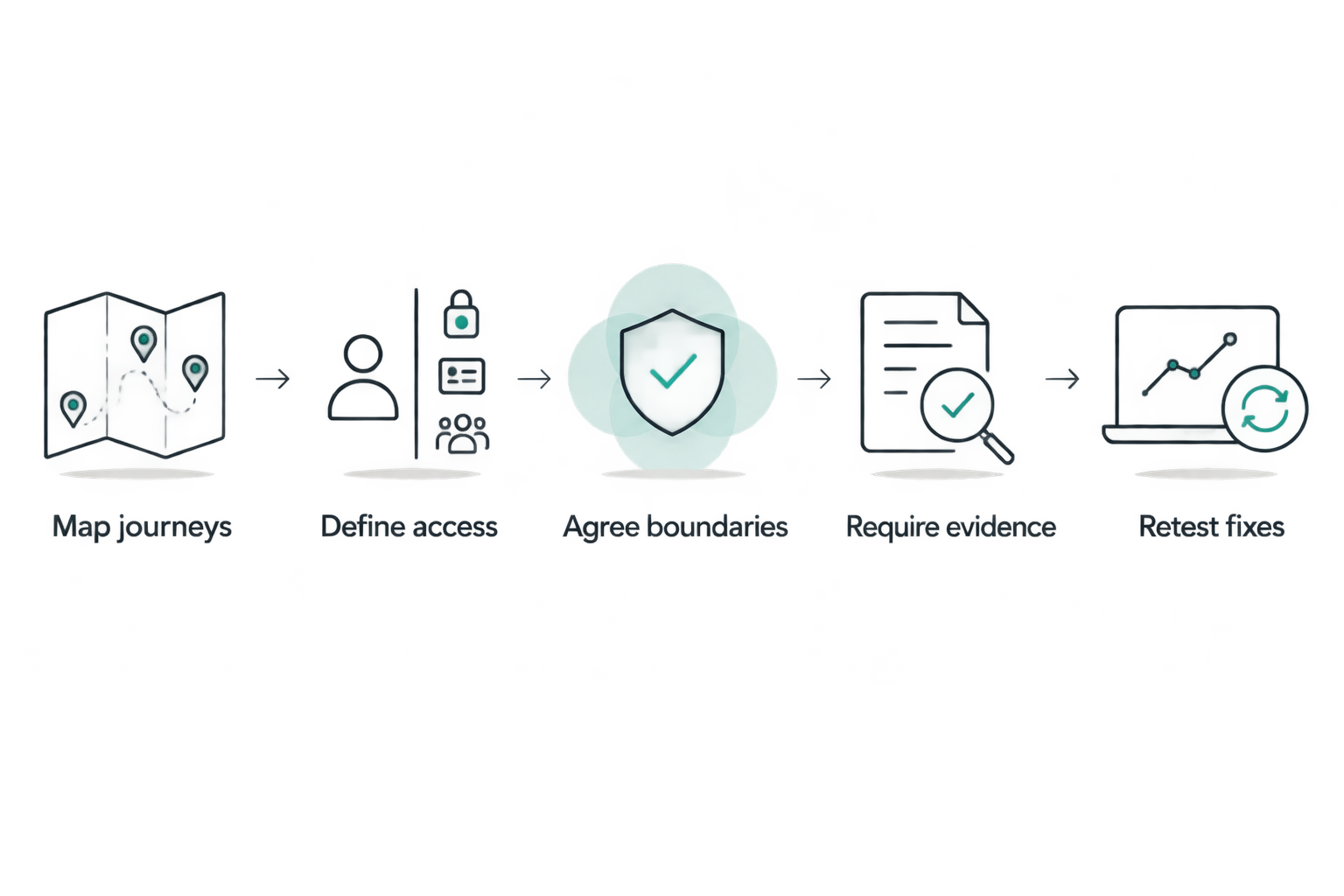
Agree coverage and evidence before the engagement starts.
Start with 3 named journeys: placing an order, viewing another order and requesting a refund. Expand the brief to match your actual store, but keep those concrete actions visible throughout procurement.
Compare the work, not just the proposal total
A useful 2026 comparison starts with identical scope. Separate the work into manual application testing, API testing, supporting-system testing, reporting and retesting.
The drivers behind web application penetration testing costs belong in the scope discussion: authenticated roles, application complexity and the depth of manual testing all affect the work you commission. Ask each supplier to explain those assumptions in the proposal.
Require written answers to these questions:
- Which named journeys receive manual testing?
- Which roles and account boundaries are included?
- Which APIs and integrations are excluded?
- What happens when a serious finding needs immediate attention?
- What does the report contain, and what happens after fixes?
Do not compare an automated scan with a manual assessment as though they are the same deliverable. Both have a place, but they answer different questions.
Keep payments and third-party systems explicit
A payment provider does not make your entire storefront someone else's responsibility. Your own application still controls functions such as customer access, order creation and integration behaviour.
For your 2026 brief, distinguish the components you control from hosted payment services and external applications. Obtain authorisation before testing systems outside your ownership.
Ask suppliers how they will test the hand-off between your application and the payment service without creating uncontrolled transactions. Include the application's handling of payment status, failed payments and duplicate requests where those functions exist.
PCI DSS Requirement 11.4 addresses penetration testing. The applicable scope and obligations depend on your payment environment and validation requirements; do not treat a generic website test as proof that every applicable requirement is met.
Turn findings into a compliance workflow
A penetration test identifies weaknesses within its agreed scope. Your team still needs to fix them, verify the changes and retain evidence.
Use a simple closure record:
- Finding and affected system.
- Business impact and agreed priority.
- Responsible owner and target date.
- Remediation evidence.
- Retest result or documented risk decision.
OneClickComply is best for growing businesses that need compliance automation alongside independent penetration testing. OneClickComply supports risk management, policy generation and security-control remediation; it does not replace an independent assessment of your checkout logic.
Keep the responsibilities separate. Your testing provider supplies technical findings, your developers address application defects, and your compliance process records the resulting decisions and evidence.
Which penetration testing company should you choose?
Start with NCC Group if you want a consultancy-led engagement and have not yet settled on a delivery model. Require a scope covering your real buying journeys before you appoint any provider.
Choose Cobalt for a release-linked testing brief. Choose NetSPI for a platform-led programme across your estate, or HackerOne when you can manage scoped testing alongside a separate bug bounty programme.
For 2026, the deciding document is the statement of work. A recognisable name cannot compensate for excluded APIs, missing customer roles or no agreed retest.
Frequently asked questions
One last thing
Ask every shortlisted supplier to describe how it would test a customer changing an order identifier in a request. That concrete discussion exposes whether account boundaries belong in the proposed work or sit outside it.
Then require the same clarity for discounts, refunds and payment status. Keep testing specific and compliance manageable. Seriously Simple Cyber Compliance.