
Best overall for a SaaS startup: manual web application and API testing. Best for infrastructure risk: cloud penetration testing. Best for a narrow first engagement: external infrastructure testing. This 2026 guide ranks five service types by the problem you need to solve, rather than treating every penetration test as interchangeable.
Why this matters
You need findings your engineers can fix and evidence your customers can assess. A report on public servers does not answer whether one customer can access another customer's records through your application.
For your 2026 shortlist, start with the system and the business question. Define those before comparing providers; the guide to how to scope a penetration test before you buy one explains that decision in detail.
A penetration test examines an agreed scope at a particular time. It does not certify your entire business or prove that every vulnerability has been found.
What makes the best penetration testing service?
Use these six criteria to judge proposals. Ask providers to show how their delivery meets each requirement, not simply confirm that they offer penetration testing.
- Relevant scope: The engagement covers the application, infrastructure or device your customers depend on.
- Manual investigation: Testers examine permissions, business rules and combinations of weaknesses beyond automated scanning.
- Clear boundaries: Written authorisation identifies systems, permitted techniques, exclusions and emergency contacts.
- Actionable evidence: Findings explain affected components, reproduction steps, business impact and remediation.
- Retest terms: The agreement explains how fixes will be checked and how unresolved findings will be recorded.
- Buyer acceptance: The report format and any required provider credentials match your customer's written requirements.
Choose the service that tests your actual product risk, not the proposal with the longest checklist. Credentials support your assessment of a provider; they do not replace a suitable scope.
Startup penetration testing services at a glance
This 2026 ranking compares service types, not named suppliers. Each option addresses a different buying need; request proposals against the same scope before selecting a provider.
| Rank and service | Best for | Standout feature | Key limitation |
|---|---|---|---|
| 1. Manual web application and API testing | Browser-based SaaS products | Examines application permissions and business logic | Does not automatically cover cloud configuration or mobile clients |
| 2. Cloud penetration testing | Products with infrastructure-led risk | Examines attack paths involving cloud resources and identities | Coverage depends on agreed accounts, permissions and provider rules |
| 3. Penetration testing as a service | Teams needing repeated testing engagements | Organises testing and findings through a recurring delivery model | Recurring delivery does not itself guarantee manual depth |
| 4. Mobile application penetration testing | Startups whose product centres on a mobile app | Examines the client and its interaction with backend services | Backend and platform coverage must be explicitly included |
| 5. External infrastructure penetration testing | A focused review of internet-facing systems | Tests exposed services within an agreed perimeter | Does not replace authenticated application testing |
1. Manual web and API testing: best for SaaS product assurance
Manual web application and API testing examines how your product behaves when someone challenges its security boundaries. Testers investigate authentication, access permissions, input handling and business workflows within the agreed scope.
For a multi-tenant SaaS product, ask testers to examine whether accounts can cross customer boundaries. Include ordinary users and administrators, rather than supplying only a login page.
Manual web and API testing pros:
- Examines application-specific business rules.
- Tests access differences between user roles.
- Connects weaknesses into practical attack paths.
- Produces reproduction steps for engineering teams.
Manual web and API testing cons:
- Coverage depends on representative accounts and usable test data.
- Infrastructure outside the scope remains untested.
- Major product changes can make earlier findings less representative.
Best for: Startups selling a browser-based product with customer data, permissions or sensitive workflows.
Ask the provider to distinguish automated discovery from manual investigation. A scan exported into a report is not equivalent to testing whether a legitimate user can abuse a workflow.
Verdict: Buy for a SaaS product assurance engagement when application behaviour is your main concern.
2. Cloud penetration testing: best for infrastructure-led risk
Cloud penetration testing examines agreed attack paths involving your cloud environment. Depending on scope, that includes exposed workloads, identities, permissions and routes between resources.
Separate configuration review from exploitation testing in the proposal. Both have value, but they answer different questions: whether settings meet expectations and whether weaknesses enable an attack.
Cloud penetration testing pros:
- Examines infrastructure-specific attack paths.
- Investigates the effect of excessive permissions.
- Connects exposed services with potential access to other resources.
Cloud penetration testing cons:
- Requires careful boundaries around shared and third-party services.
- Application business logic needs separate coverage.
- Limited access can restrict what testers can establish.
Best for: Startups whose risk centres on cloud identities, infrastructure permissions or exposed workloads.
For a 2026 engagement, document the cloud accounts and environments in scope. Confirm applicable cloud-provider testing rules before authorising activity, including restrictions on disruptive techniques.
Verdict: Buy when infrastructure access is the question; hold if you actually need application permission testing.
3. Penetration testing as a service: best for repeated engagements
Penetration testing as a service, often shortened to PTaaS, describes a delivery model rather than a single testing method. Providers organise testing and findings through a platform, with engagement details varying by supplier.
Assess the underlying testing work. A dashboard does not establish how much manual investigation happens or whether the same product areas receive attention after changes.
Penetration testing as a service pros:
- Gives repeated engagements a common place for findings.
- Can support ongoing communication about remediation.
- Lets you organise testing around product changes when contracted accordingly.
Penetration testing as a service cons:
- Testing depth and coverage vary between agreements.
- Platform access does not mean continuous human testing.
- Recurring findings still need an internal owner.
Best for: Startups with regular releases and a defined need for repeated independent testing.
Ask how the provider handles scope changes, tester handovers and retesting. Specify the work you expect in each engagement rather than accepting an undefined promise of continuous assurance.
Verdict: Buy when repeated testing matches your engineering process; hold for a single, tightly scoped requirement.
4. Mobile application testing: best for mobile-first products
Mobile application penetration testing examines security in the mobile client and its interaction with backend services. Relevant areas include local data handling, session behaviour and communication with APIs.
Specify each supported operating system and the application build. Do not assume that testing one client covers another, or that a mobile engagement includes a full backend assessment.
Mobile application testing pros:
- Examines risks specific to the installed client.
- Tests how the app handles sensitive data locally.
- Connects client behaviour with backend requests.
Mobile application testing cons:
- Different platforms require explicit coverage.
- Backend business logic can sit outside the agreed scope.
- Testers need working builds and representative accounts.
Best for: Startups whose customers primarily use a mobile application.
Make ownership clear where another company supplies part of the app or backend. You need permission to test those components, not just access to the finished application.
Verdict: Buy for a mobile-first product; skip as your primary engagement if you only sell a browser-based service.
5. External infrastructure testing: best for a narrow first scope
External infrastructure penetration testing examines agreed internet-facing systems. Testers investigate exposed services and weaknesses that an attacker could approach from outside your network.
This is a focused option when you need to assess a defined public perimeter. Keep the limitation explicit: testing public hosts does not establish that authenticated customer workflows are secure.
External infrastructure testing pros:
- Sets a clear boundary around public systems.
- Investigates exposed service weaknesses.
- Supports a focused engagement with identifiable assets.
External infrastructure testing cons:
- Misses application behaviour behind logins unless included.
- Does not assess internal access paths by default.
- Incomplete asset lists leave gaps in coverage.
Best for: Startups needing a bounded assessment of public servers and services.
Confirm ownership of every target before testing. Include relevant domains and addresses in the written agreement, and identify third-party systems that must remain excluded.
Verdict: Buy for a perimeter question; skip as a substitute for a SaaS application test.
How the service types are ranked
The ranking prioritises product relevance, manual depth, usable findings and clear verification of fixes. Manual web and API testing takes the default position for browser-based SaaS because it addresses application behaviour directly.
The remaining positions represent different needs, not declining quality. Cloud, recurring, mobile and external infrastructure engagements win when their scope matches your system and buying requirement.
Turn the report into verified fixes
Your 2026 testing plan needs a path from discovery to closure. Agree that process before testing starts, so engineers know what they will receive and who decides whether a finding is resolved.
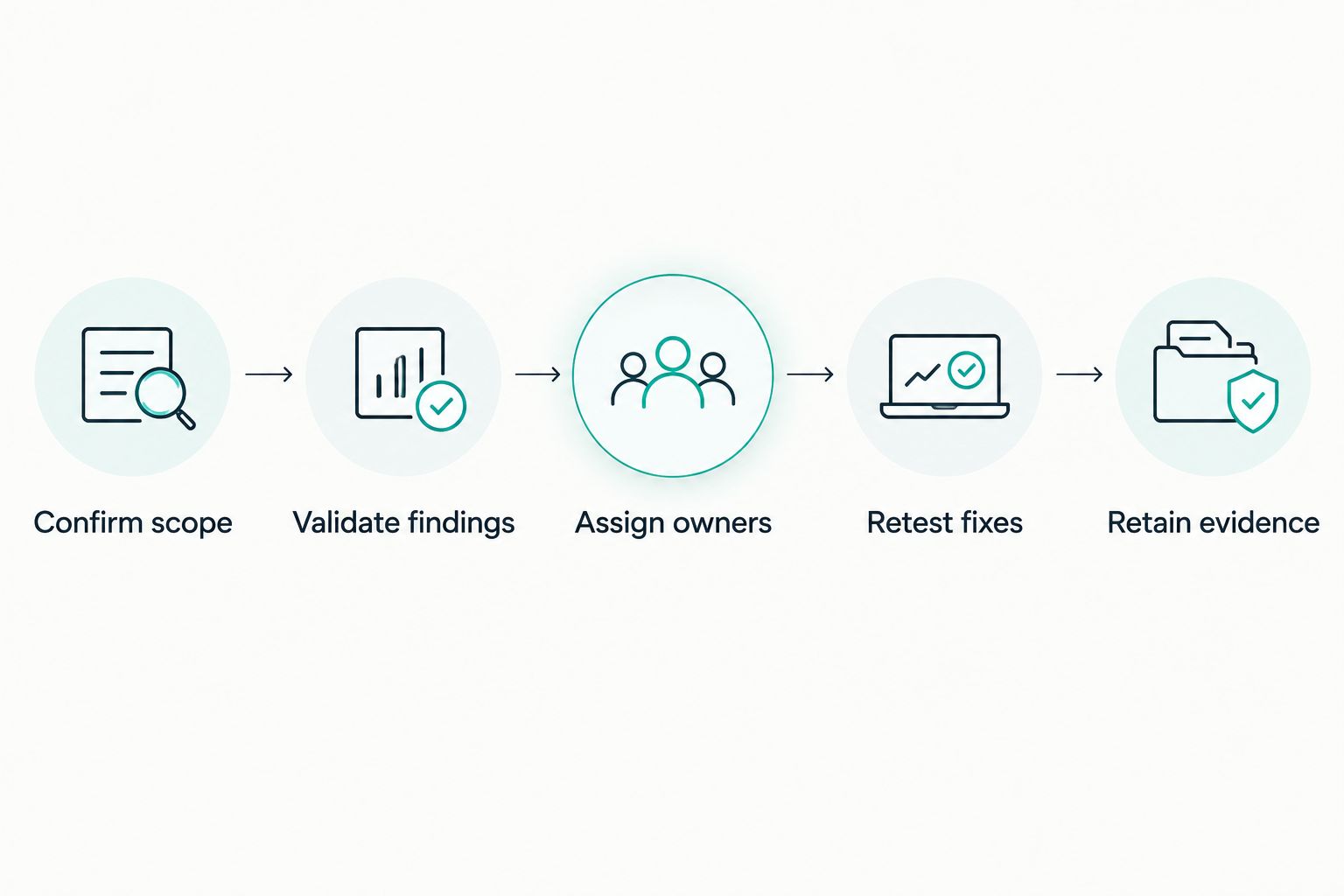
Use this sequence:
- Confirm scope: Record tested systems, excluded systems and the application version.
- Validate findings: Ask for evidence, reproduction steps and an explanation of impact.
- Assign owners: Give each accepted finding a responsible engineer and a target date.
- Retest fixes: Ask the tester to verify the affected behaviour after remediation.
- Retain evidence: Keep the original finding, change record and retest outcome together.
A finding is not closed merely because someone marks the engineering task complete.
Automated checks and independent testing produce different evidence. Keep vulnerability scanning and audit reporting connected through asset names, finding references and remediation records, while preserving the distinction between scan results and manually verified attacks.
OneClickComply is best for growing businesses that need compliance automation alongside independent penetration testing. The platform generates policies, manages risk and trust centres, and auto-remediates security controls; those capabilities serve a different purpose from a scoped independent test.
Use OneClickComply for the compliance automation role. Require the testing provider to define the testing role separately, including report ownership, retest arrangements and evidence handling.
Compare proposals without buying the wrong test
Send every shortlisted provider the same brief. For your 2026 comparison, require written answers rather than relying on a sales demonstration or a generic sample scope.
For a multi-tenant product, request these practical checks:
- 3 user roles: Where your product supports them, include an unauthenticated visitor, a standard user and an administrator.
- 2 test tenants: Create separate customer environments to support cross-tenant access checks.
- 1 emergency contact: Name someone authorised to stop testing if operational problems occur.
These are preparation recommendations, not universal coverage guarantees. Adjust the accounts and environments to match how your product actually works.
Ask who performs the work, which methods require separate permission and what happens if testers cannot access a key feature. Request a redacted sample report and confirm whether it explains limitations as clearly as findings.
Finally, ask the customer requesting the test what evidence they will accept. Resolve requirements for scope, report recency and provider credentials before signing the engagement.
Which penetration testing service should you choose?
Choose manual web application and API testing if you run a browser-based SaaS startup and need a default. Add cloud or mobile coverage where those components create distinct risks; choose recurring delivery only when you need repeated engagements.
Keep the test and compliance programme connected without confusing them. OneClickComply handles compliance automation, while your testing agreement defines the independent investigation and verification you are buying.
Frequently asked questions
One last thing
Ask the tester what they could not test. Missing permissions, broken test accounts and excluded workflows can leave important questions unanswered even when the report contains few findings.
Make limitations part of your acceptance criteria. Fix what matters, verify the result, and keep the evidence clear. Seriously Simple Cyber Compliance.