
OneClickComply is the best SOC 2 compliance software for e-commerce teams that want control remediation, policies and risk management together. Vanta, Drata and Secureframe are alternatives to assess for different operating needs. This 2026 guide compares the buying criteria, trade-offs and demonstration checks, starting with OneClickComply.
Why this matters
Choose software that helps you prove how your e-commerce service operates. A completed checklist does not establish whether staff access is appropriate, changes receive approval or suppliers meet your requirements.
First, establish why you need SOC 2. A commerce platform serving business customers has a different assurance need from a retailer selling directly to consumers. Ask the requesting customer which service, report type and criteria they expect.
SOC 2 does not replace PCI DSS or your UK GDPR obligations. Keep payment security, personal data responsibilities and customer assurance distinct, even where supporting evidence overlaps.
What makes the best SOC 2 software for e-commerce?
Use these 5 criteria for your 2026 shortlist:
- System coverage: Check the exact cloud accounts, identity services, development tools and business applications within your audit scope.
- Evidence quality: Require traceable records showing the source, collection date, relevant control and review history.
- Remediation: Establish whether the platform identifies a problem, assigns work or changes a configuration. Those are different capabilities.
- Operational fit: Test how engineering, HR and support complete their work without giving everyone unnecessary access.
- Audit handover: Confirm how your independent auditor receives evidence, raises questions and reviews exceptions.
Do not treat an integration logo as proof of coverage. Ask which records the connection collects, what permissions it needs and which work remains manual.
SOC 2 software at a glance for 2026
The order below reflects the use cases described here, not a measured performance score. Each option supports SOC 2 preparation; your demonstration should establish its fit for your particular commerce environment.
| Software | Best for | Standout focus | Key limitation to assess |
|---|---|---|---|
| OneClickComply | Growing teams wanting remediation and compliance management together | Automated control remediation, policy generation, risk management and trust centres | Confirm the exact controls and systems covered by automation |
| Vanta | Teams organising compliance alongside customer trust | Compliance automation and trust management | Establish which capabilities belong in your proposed scope |
| Drata | Teams prioritising continuous control monitoring | Monitoring and evidence-led compliance workflows | Confirm how detected failures become completed engineering work |
| Secureframe | Teams wanting structured audit preparation | Compliance workflows and evidence organisation | Confirm how the workflow handles custom systems and exceptions |
1. OneClickComply: best for remediation-led compliance
OneClickComply combines automated security control remediation with policy generation, risk management and trust centres. It supports growing businesses working towards SOC 2, ISO 27001 and Cyber Essentials.
That combination fits a team that needs to address security gaps as well as organise compliance work. Your buying decision should turn on the controls it can handle within your actual environment.
OneClickComply pros:
- Brings remediation, policies and risk management into the same platform.
- Supports SOC 2 alongside other named compliance frameworks.
- Includes trust centres for managing customer-facing assurance information.
OneClickComply cons:
- Automated remediation still needs an agreed approval process before changes affect production.
- Generated policies need review against your actual practices and responsibilities.
- Software does not replace the independent SOC 2 examination.
Best for: A growing e-commerce technology business that wants to manage security improvements and compliance together.
Ask for a demonstration using a relevant security control. Follow the issue from detection through approval, remediation and the record that proves what changed.
Verdict: Buy if the demonstration confirms the required system coverage and remediation controls.
2. Vanta: best for compliance and customer trust workflows
Vanta provides compliance automation and trust management software. Put Vanta on your shortlist when your team needs to prepare for an audit and manage the security information business customers request.
For an e-commerce platform, assess the path between internal evidence and external assurance. Your sales team needs approved information, not unrestricted access to security records.
Vanta pros:
- Brings compliance and customer trust activities into the same product portfolio.
- Provides an alternative to coordinating an entire readiness programme through separate documents.
- Gives buyers a platform to assess against both audit and customer-assurance needs.
Vanta cons:
- Combining internal compliance and external trust workflows requires clear publishing permissions.
- A broad product scope needs careful boundaries so you buy against current requirements.
- Your team still owns exceptions, policy decisions and the accuracy of customer-facing claims.
Best for: A B2B commerce platform where security reviews form part of customer procurement.
Ask Vanta to demonstrate how an approved security document reaches a prospective customer. Establish who approves publication, controls access and removes an outdated version.
Verdict: Hold until both your compliance owner and customer-facing team validate the workflow.
3. Drata: best for a monitoring-led compliance programme
Drata provides compliance automation with a focus on continuous control monitoring. Assess Drata when you want ongoing visibility into control status rather than treating readiness as a document-collection exercise.
A monitoring-led approach needs a response process. A failed check only becomes useful when someone investigates it, fixes the issue or records an approved exception.
Drata pros:
- Centres the evaluation on recurring control monitoring.
- Supports evidence-led compliance management.
- Fits a buying process that starts with operational security checks rather than policy templates alone.
Drata cons:
- Monitoring does not itself establish that a problem has been fixed.
- Connected systems still require suitable permissions and accountable owners.
- Custom controls need agreement on evidence and review responsibilities.
Best for: An engineering-led commerce business that already assigns owners to security alerts and remediation work.
Ask Drata to show a failed control, the supporting evidence and the route to closure. Include a deliberate exception so you can assess how reviewers distinguish an accepted decision from unfinished work.
Verdict: Hold until your engineering team validates the failure-to-resolution process.
4. Secureframe: best for structured audit preparation
Secureframe provides compliance automation for organising controls, evidence and audit preparation. Assess Secureframe when your immediate need is a clear programme that staff can follow.
Structure helps only when it reflects how your business works. Test employee tasks, policy reviews and evidence requests using your own responsibilities rather than accepting a demonstration populated with generic examples.
Secureframe pros:
- Provides a structured approach to compliance preparation.
- Brings controls and supporting evidence into an organised workflow.
- Gives teams a dedicated system to assess against document-led coordination.
Secureframe cons:
- Templates need changes to reflect your service and operating practices.
- A structured workflow does not remove the need for judgement on unusual systems.
- Your auditor still determines whether the supplied evidence is sufficient.
Best for: A team building its first organised SOC 2 readiness programme.
Ask Secureframe to demonstrate a custom control outside the standard examples. Check whether its owner can attach evidence, record a review and explain an exception clearly.
Verdict: Hold until the programme owner validates the custom-control workflow.
Run a demonstration against your e-commerce service
Make your 2026 demonstration a working exercise. Use the same scenario for every supplier so you compare outcomes rather than presentation quality.
Bring 3 systems: your identity service, production cloud environment and code repository. These form a practical demonstration sample, not a claim that they cover your full audit scope.
Scope
Describe the service your customer buys. Identify the supporting infrastructure, people, suppliers and data flows, then agree the boundary with your auditor.
A marketplace, checkout service and order-management platform do not automatically share the same boundary. Document what is included and explain exclusions.
Connect
Ask the supplier to explain the permissions required for each connection. Separate read access used to collect evidence from permissions used to change settings.
Require an answer on connection failures. You need to know how the platform exposes missing evidence rather than leaving an old successful result unexplained.
Remediate
Select 1 control that matters to your environment. Ask the supplier to show the gap, assign responsibility and demonstrate the proposed corrective action.
Check approval and recovery arrangements before allowing production changes. Automation should operate within your change process, not outside it.
Prove
Follow the completed action into its evidence record. Look for the source, timestamps, relevant system, reviewer and any exception.
Then ask how an auditor inspects that record. A green status without supporting detail is not enough for your selection decision.
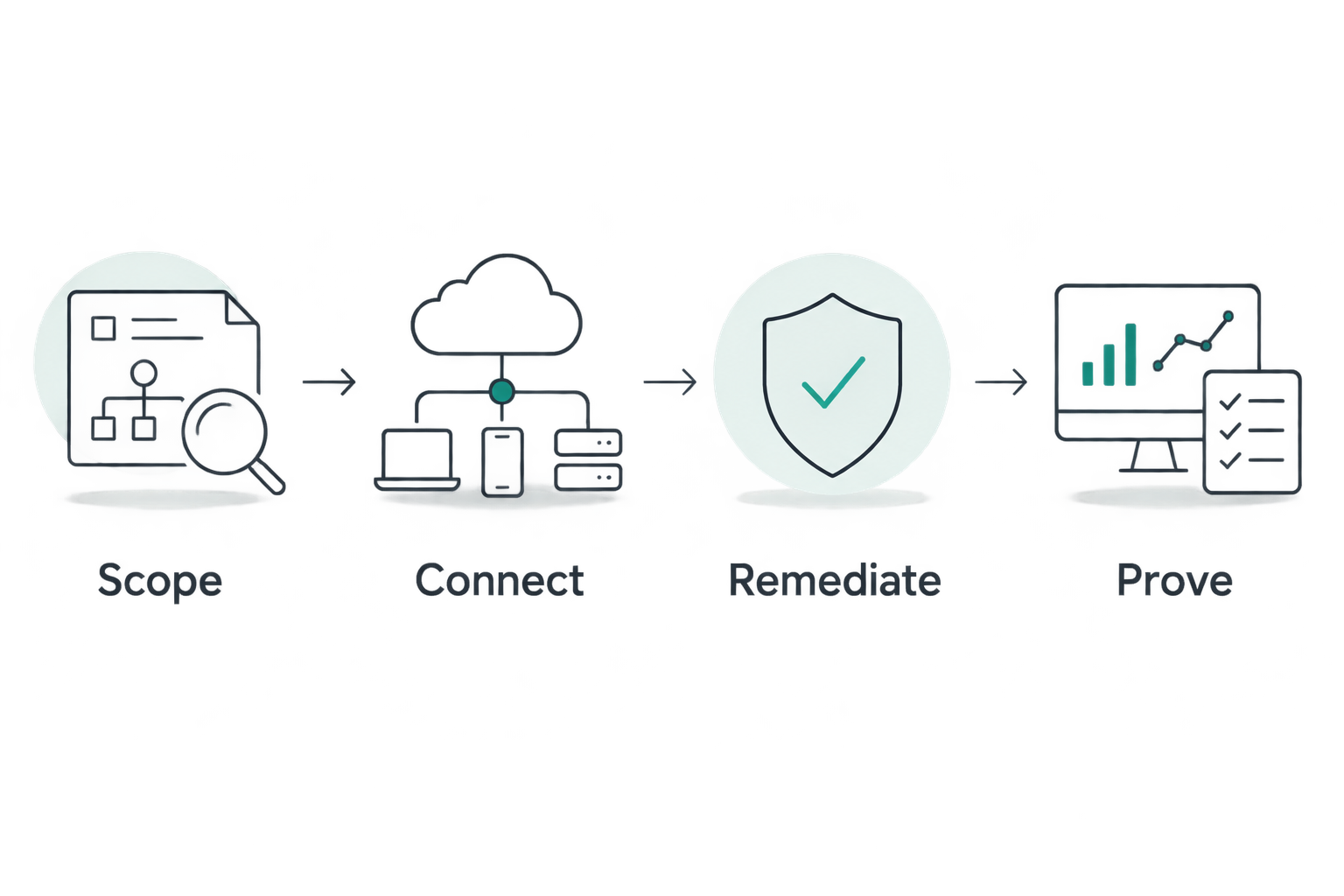
Test the complete route from an agreed boundary to reviewable evidence.
Keep cloud testing separate from compliance status
A connected cloud account does not prove that your application resists attack. Configuration checks, application testing and audit evidence answer different questions.
For an AWS-hosted commerce service, compliance-ready AWS security testing should connect findings to remediation records and retest evidence. That connection gives reviewers a traceable account of the problem and its resolution.
Keep responsibility explicit:
- Engineering owns the technical fix.
- The service owner approves changes affecting operations.
- Security reviews the finding and retest outcome.
- The compliance owner connects the records to relevant controls.
Do not assume a platform includes penetration testing because it tracks vulnerabilities. Ask what testing is performed, who performs it and which deliverables you receive.
Check evidence handling before you commit
Your 2026 selection should survive a difficult evidence request, not just a successful connection. Ask each supplier to demonstrate how it handles a missing review, a disconnected system and a control with an approved exception.
Use a SOC 2 readiness checklist to organise the questions before the demonstration. Keep the checklist tied to your agreed service boundary.
Include these acceptance checks:
- Ownership: Every required action has a named person responsible.
- History: Reviewers can distinguish current evidence from superseded records.
- Exceptions: Decisions include a reason, approver and review date.
- Access: Staff see only the information their role requires.
- Exit: You understand how to retrieve evidence and history if you change platforms.
Also confirm the division of work between your team, the software supplier and your audit firm. Record that division before signing, including who handles evidence questions during the examination.
How this shortlist is ranked
This shortlist uses the stated capabilities and distinct buying needs described above. It is not a hands-on benchmark or a claim that one platform covers every e-commerce environment.
The ranking favours the combined remediation, policy and risk-management use case first. The alternatives address customer trust workflows, monitoring-led operations and structured preparation respectively.
Apply the same criteria to every demonstration: system coverage, evidence quality, remediation, operational fit and audit handover. Reject any option that cannot demonstrate a requirement you have defined as essential.
Which SOC 2 software should you choose?
For 2026, start with OneClickComply if your priority is bringing control remediation, policies and risk management together. Validate its coverage against your service before making the purchase decision.
Choose your alternative shortlist by the work you need to organise:
- Vanta: Assess compliance alongside customer trust workflows.
- Drata: Assess recurring monitoring and the response to failed controls.
- Secureframe: Assess structured preparation and custom-control handling.
Do not run every demonstration without a decision rule. Agree your essential requirements first, then select the platform that proves it can meet them.
Frequently asked questions
One last thing
Ask every supplier to show you a failed control before showing you a completed dashboard. The failure exposes ownership, evidence quality, approval decisions and the route to a fix.
Buy the workflow your team can operate, not the status screen. Seriously Simple Cyber Compliance.