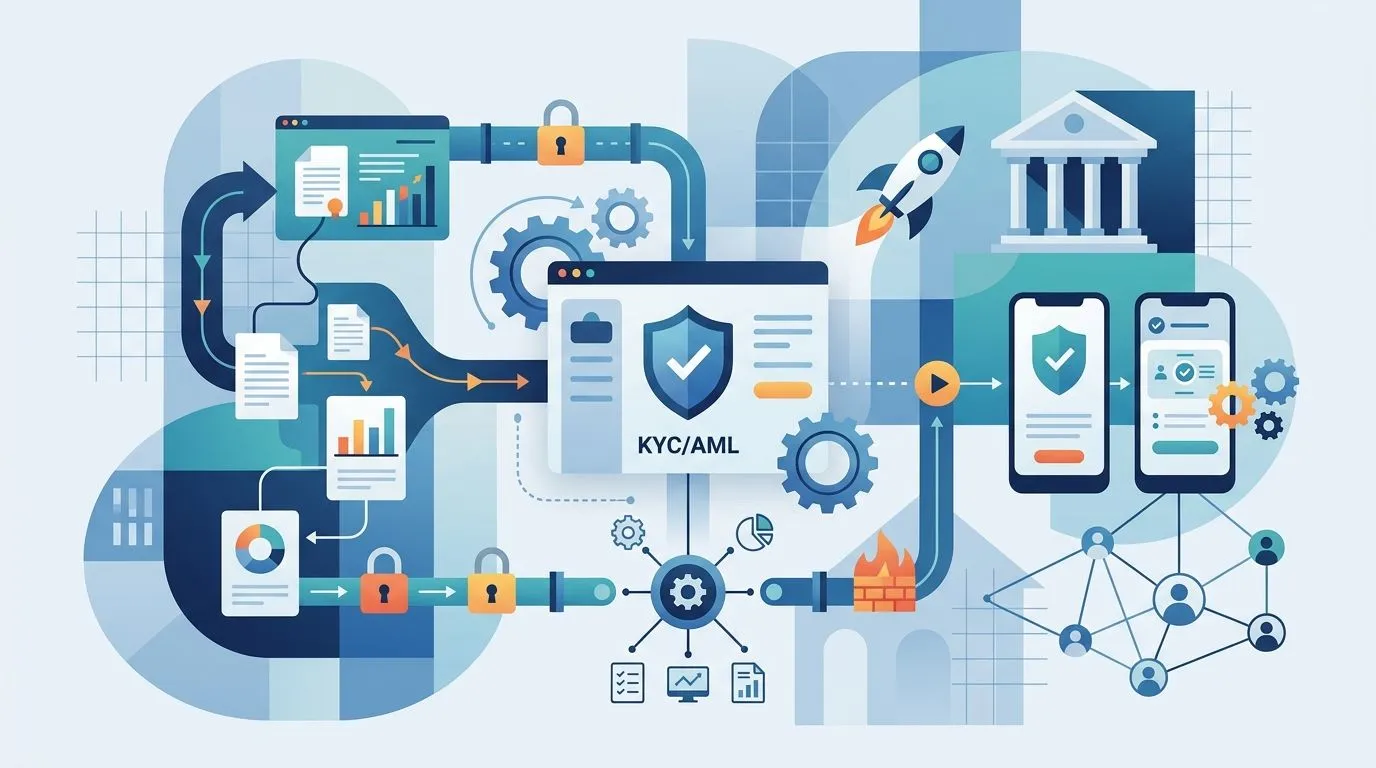
Compliance automation for challenger banks is software that maps ISO 27001, SOC 2, Cyber Essentials, and operational resilience requirements to one evidence base, so a small compliance function can pass FCA, PRA, and enterprise partner audits without hiring a team for each framework. Challenger banks carry a different risk profile than a typical SaaS company: they hold client money, run on open banking APIs, and answer to the FCA and PRA on top of whatever their card scheme, cloud provider, or enterprise banking partner demands. That stacks four or five overlapping frameworks on a team that's usually five people or fewer.
Why compliance automation matters for challenger banks
A challenger bank doesn't get to pick one framework and move on. The FCA and PRA's operational resilience policy required firms to identify important business services and set impact tolerances by 31 March 2022, with a transitional period to embed those controls by 31 March 2025 — that deadline has now passed, and regulators expect ongoing evidence, not a one-time project.
On top of that, enterprise banking partners, card schemes, and cloud infrastructure providers each run their own vendor assessment. A challenger bank selling into corporate clients or running on a banking-as-a-service model will typically field DORA compliance for UK financial services firms questions from EU counterparties even without a direct DORA obligation, because partners push their own third-party risk requirements downstream.
The pattern repeats across frameworks: ISO 27001 for enterprise sales, SOC 2 for US partners, Cyber Essentials for smaller UK suppliers and public sector work, PCI DSS if you issue cards. Each framework asks for the same evidence in a slightly different format. That's the exact problem compliance automation solves in 2026.
How to automate compliance as a challenger bank
Map every framework your regulators and partners require
Start by listing what's actually mandatory versus what's requested by a specific deal. Don't guess — pull the real list from your regulator correspondence, partner contracts, and sales pipeline.
- List FCA and PRA operational resilience obligations tied to your permissions
- Note every framework a current enterprise contract references
- Check whether your card issuing or acquiring setup pulls you into PCI DSS scope
- Flag frameworks requested in active sales opportunities but not yet started
- Identify overlap: ISO 27001 Annex A controls cover much of what SOC 2 Trust Services Criteria ask for
Build one evidence library instead of five
Most challenger banks store access logs, policy documents, and risk assessments in five different places — one per audit. That's where audit fatigue starts.
- Centralise access control evidence, policies, and risk registers in one location
- Tag each evidence item to every framework it satisfies, not just one
- Set a single review cadence instead of five separate ones
- Retire duplicate policy documents once they're consolidated
Automate vendor and third-party risk reviews
Open banking partnerships, cloud infrastructure, and banking-as-a-service providers are where challenger banks carry the most third-party exposure — and where manual tracking breaks down fastest.
- Run a vendor risk questionnaire before onboarding any new API partner or processor
- Re-assess critical vendors annually, not only at contract signature
- Track vendor certifications such as SOC 2 and ISO 27001 against renewal dates automatically
- Escalate any vendor without current certification to your risk register
Vendor risk management software for fintech companies replaces the annual spreadsheet chase with automated renewal tracking, which matters when a challenger bank runs dozens of API integrations at once. OneClickComply automates that vendor tracking alongside your ISO 27001 and SOC 2 evidence, so a control update in one framework updates the vendor register too.
Run continuous control monitoring, not annual snapshots
An annual audit tells you your controls worked on the day of the audit. Regulators and enterprise partners want evidence they work every day.
- Automate daily or weekly checks on access controls, MFA enforcement, and encryption settings
- Alert the compliance owner the moment a control drifts out of spec
- Log remediation timestamps automatically for the audit trail
- Review monitoring coverage quarterly to catch new systems that slipped through
Schedule penetration testing around release cycles
Challenger banks ship product faster than the annual pentest cycle assumes. A test scoped six months ago won't cover this quarter's new API endpoint.
- Scope tests around your actual release cadence, not a fixed calendar date
- Prioritise penetration testing for open banking and fintech APIs ahead of any new data-sharing integration
- Retest fixed findings before closing them, don't just mark them resolved
- Keep a rolling report history to show regulators and partners a pattern, not one snapshot
Prepare board-level reporting on operational resilience
The PRA and FCA expect the board to own operational resilience, not delegate it quietly to IT. Someone has to translate control status into numbers a board understands.
- Report impact tolerance breaches and near-misses every board cycle
- Track certification status for ISO 27001, SOC 2, and Cyber Essentials as a standing agenda item
- Show vendor risk exposure trends, not just a point-in-time count
- Flag any control gap that could affect an important business service
Keep policies current as you add products or entities
A challenger bank that launches a savings product, a lending arm, or a new legal entity inherits new regulatory scope every time. Policies written for one entity rarely cover the next.
- Review policy suites against each new product or entity before launch
- Version-control every policy change with an audit trail
- Re-map controls when your group structure changes
- Retrain staff on updated policies within 30 days of a change
Comparing your options for challenger bank compliance
| Option | Best for | Key limitation |
|---|---|---|
| Spreadsheets and shared drives | Pre-seed banks with one framework and no partner audits yet | Breaks the moment a second framework or a real vendor list appears |
| Generalist GRC platforms | Larger banks with dedicated GRC headcount | Built for broad enterprise use, not tuned to fintech frameworks or open banking controls |
| Point solutions per framework | Teams already running separate tools for pentest scheduling, vendor risk, and policy management | Evidence lives in five places, duplicating work at every audit |
| OneClickComply | Challenger banks running ISO 27001, SOC 2, and Cyber Essentials together with a lean team | Automation covers evidence collection and control mapping; it doesn't replace the pentest or the certification audit itself |
Verdict: a challenger bank running more than one framework should automate evidence collection before it hires a second compliance analyst — tooling scales with each new framework, headcount doesn't.
Automate your bank's compliance stack
See how OneClickComply maps ISO 27001, SOC 2, and Cyber Essentials in one platform.
Common mistakes challenger banks make
- Treating Cyber Essentials as enough for FCA scrutiny. Cyber Essentials covers basic technical hygiene. It doesn't touch impact tolerances or third-party risk reporting.
- Ignoring API partner risk until an incident forces it. Open banking integrations get scoped for functionality, not for what happens when a partner's API exposes customer data.
- Running separate audits off separate evidence sets. Duplicated work multiplies every time a control changes, and nothing stays in sync.
- Waiting for a funding round to start ISO 27001. Enterprise banking partners ask for it during due diligence, and a certification timeline started late blocks the deal.
- Reporting compliance to the board once a year. Regulators expect ongoing evidence of operational resilience through 2026, not an annual snapshot.
Frequently asked questions
One last thing
The FCA and PRA transitional period for embedding operational resilience controls ended on 31 March 2025. If your bank still treats impact tolerance reporting as a project rather than a standing board item in 2026, you're behind where the regulator expects you to be. Fix the reporting cadence first, then automate the evidence behind it. Seriously simple cyber compliance starts there.