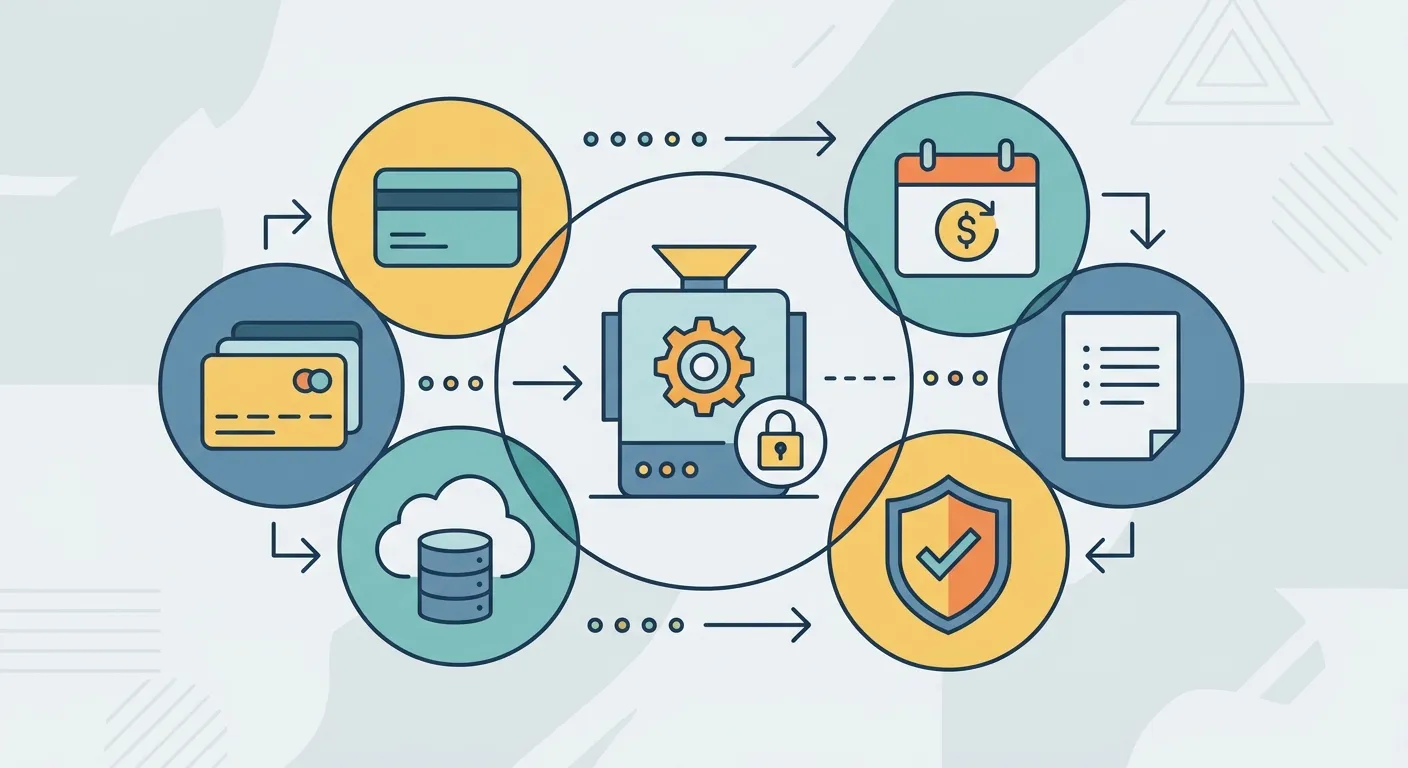
Membership and subscription businesses run on recurring billing, member data, and a long list of connected vendors — and that combination makes cyber security compliance messy fast. This guide breaks down compliance automation for membership businesses: what to prioritise, what to skip, and how to get certified without adding headcount in 2026.
Why this matters
Membership and subscription businesses collect payment details, personal data, and usage history on every member — and every certification body now expects proof, not promises, in 2026. A single missed control on a Stripe webhook or a support tool left with open admin access can stall a SOC 2 audit for weeks.
Online marketplaces and subscription platforms face the same evidence problem: dozens of connected vendors, one audit trail to prove they're all under control. Compliance automation for online marketplaces and platforms covers the same pattern from the platform side.
Compliance automation software closes that gap by pulling evidence directly from your billing, hosting, and identity tools instead of asking your team to screenshot settings every quarter.
Who this is for
This applies to membership platforms, online course and community sites, subscription boxes, and any SaaS business billing recurring member fees. If you're running a monthly membership on Stripe or Chargebee, storing member profiles, and fielding security questionnaires from bigger customers or payment partners, this is written for you.
It's also for founders past 20-30 staff who've outgrown a compliance spreadsheet and need certification evidence collected automatically instead of chased down manually every renewal cycle.
What to look for in compliance automation for membership businesses
Evidence collection tied to your billing stack
Membership businesses run on Stripe, Chargebee, or GoCardless — and auditors want proof those systems enforce access controls, not just a policy document sitting in a drive. Compliance automation that pulls evidence directly from your payment processor and hosting provider saves weeks versus manual screenshotting every quarter. If a tool can't connect to your billing stack, your team ends up doing the work by hand anyway.
Multi-framework support without duplicate evidence
Most membership businesses juggle GDPR, Cyber Essentials, and eventually SOC 2 or ISO 27001 as they add enterprise customers. A platform that maps one piece of evidence — an access control policy, a penetration test report — across multiple frameworks cuts audit prep significantly. Learning how to reduce audit fatigue across multiple compliance frameworks is the difference between one certification cycle a year and constant, overlapping requests.
Vendor risk visibility across your member data supply chain
A typical membership business touches ten to twenty vendors: payment processor, email platform, CRM, hosting, support tool. Each one holds a slice of member data, and auditors increasingly ask for evidence you've assessed each vendor's risk, not just your own controls. Compliance automation that tracks vendor risk automatically catches a lapsed vendor certificate before an auditor does.
A trust centre that answers questionnaires for you
Bigger customers and payment partners send security questionnaires before they'll sign — and membership businesses without a trust centre answer the same 40 questions manually, every single time. A live trust centre cuts that response time from days to minutes and stops sales stalling on security paperwork.
Renewal and continuous monitoring built in
Cyber Essentials needs renewing every 12 months. SOC 2 Type II needs a 6-12 month observation window repeated annually. Compliance automation that tracks renewal dates and keeps monitoring running between audits stops a business from starting each cycle back at zero.
Which certification to prioritise first
SOC 2 Type II — the enterprise unlock. SOC 2 Type II requires 6-12 months of continuous evidence rather than a point-in-time snapshot, which is why enterprise procurement teams trust it more than a self-assessment. If your subscription business is chasing contracts with US or enterprise UK buyers, this is the cert that gets you past security review. SOC 2 compliance for UK SaaS companies walks through the observation window and evidence types. Verdict: Buy if enterprise or US-based customers are already asking for it.
ISO 27001 — the safe pick. ISO 27001 covers 93 Annex A controls under the 2022 revision and signals a management system, not just a checklist, to any partner reviewing your security posture. Membership businesses scaling past 30-50 staff or expanding into EU markets tend to need it within 18 months of their first Cyber Essentials renewal. ISO 27001 for SaaS startups covers what the certification body actually checks during the audit. Verdict: Consider once you've outgrown Cyber Essentials and are fielding EU enterprise deals.
Cyber Essentials — the fast win. Cyber Essentials is a self-assessment questionnaire reviewed by an IASME-approved certification body, typically turned around in one to two weeks, and it's the baseline most UK insurers and public sector buyers ask for first. Every membership business processing member payments should hold this before attempting SOC 2 or ISO 27001. Cyber Essentials for e-commerce and retail businesses covers the same control set most subscription platforms need. Verdict: Buy — this is the default starting point for 2026.
Automate your first certification
See how OneClickComply collects evidence and tracks renewals in one place.
What to avoid
Skip vendor tools that treat every framework as a separate project. Membership businesses running Cyber Essentials, GDPR, and SOC 2 through three disconnected spreadsheets end up re-collecting the same evidence three times a year — that's audit fatigue, not compliance.
Avoid certification bodies that don't explain your renewal cycle upfront. Cyber Essentials lapses every 12 months, and a body that doesn't flag that at sign-up leaves you scrambling in month 11 of the cycle.
Watch out for anything that ignores your billing and invoicing trail. Auditors increasingly check that recurring charges match what members agreed to, the same discipline that goes into adding sales tax to invoices correctly on every recurring bill. A membership business with clean, documented billing evidence moves through an audit faster than one relying on ad hoc spreadsheets pulled together the week before.
Verdict comparison
| Certification | Best for | Time to certify | Renewal | Verdict |
|---|---|---|---|---|
| Cyber Essentials | Baseline for every membership business | 1-2 weeks | Annual | Buy |
| SOC 2 Type II | Enterprise and US-based buyers | 6-12 months evidence window | Annual re-audit | Buy if enterprise deals exist |
| ISO 27001 | Scaling past 30-50 staff, EU enterprise | 3-6 months typical | 3-year cycle, annual surveillance | Consider |
| GDPR compliance | Every membership business handling member data | Ongoing, not point-in-time | Continuous | Mandatory, not optional |
Frequently asked questions
One last thing
Most membership businesses don't fail audits on technical controls — they fail on evidence. A missing screenshot of an access review from four months ago stalls a SOC 2 Type II report as much as an actual vulnerability does. Automate the evidence trail before you automate anything else.