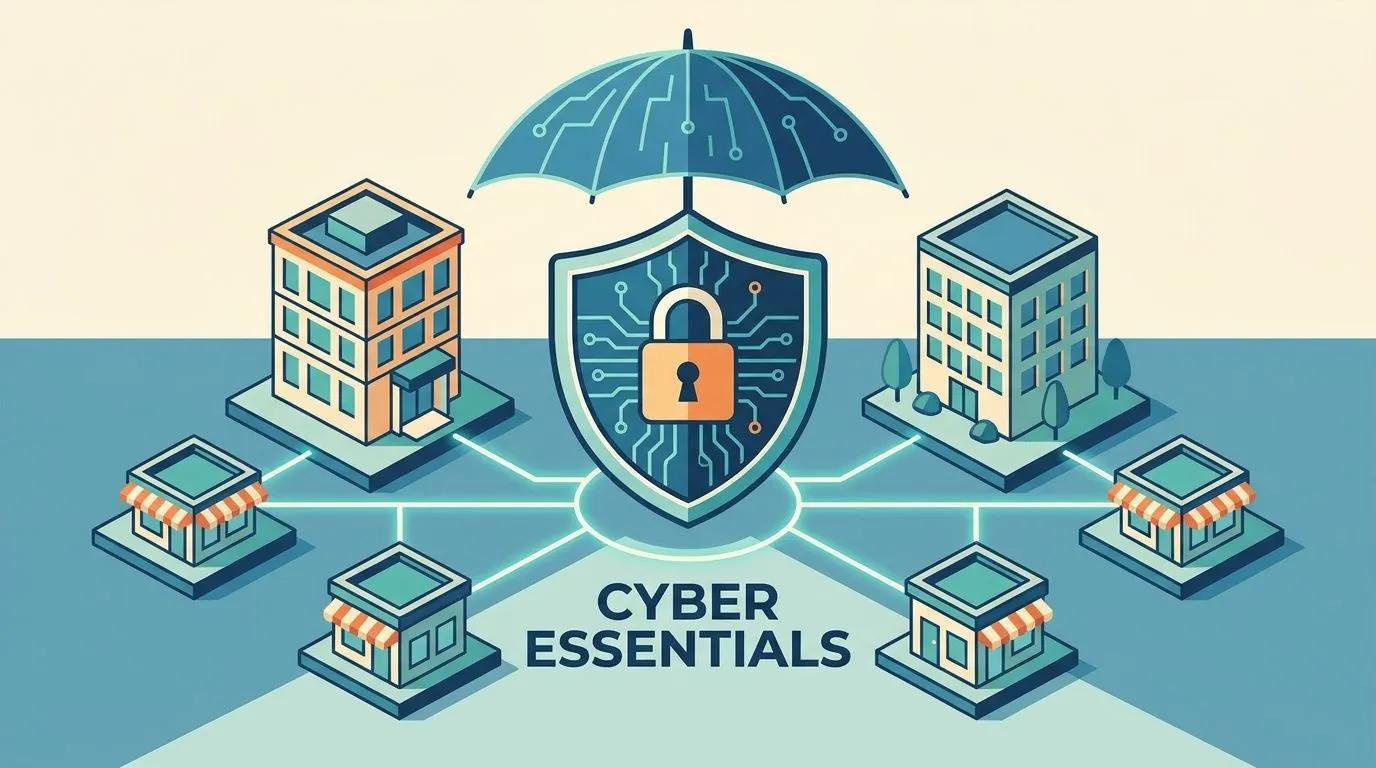
Franchise businesses run one brand across many separately owned sites, and Cyber Essentials for franchises has to answer a question most guidance skips: does the whole network certify once, or does every location need its own certificate?
Why this matters
A franchise agreement covers the brand, not the network security perimeter. Each franchisee usually runs its own devices, its own Wi-Fi, its own till system — which means each one has its own attack surface.
OneClickComply automates the evidence-gathering side of Cyber Essentials, which matters more for franchises than for a single-site business: the paperwork multiplies with every location, and manual tracking falls apart past three or four sites.
Contracts are pushing this faster than most franchisors expect. Insurers, landlords, and B2B customers increasingly ask for Cyber Essentials before they'll sign, and in 2026 that ask is showing up in franchise agreements themselves, not just enterprise procurement.
Who this is for
This guide is for franchisors setting security policy across a network, and for franchisees who've just been told to get certified and don't know where to start. It applies whether you run two locations or two hundred, and whether IT is centralised at head office or left to each site.
What to look for in Cyber Essentials for franchises
1. Scope: one certificate per entity, not per brand
Cyber Essentials certifies a defined IT boundary, not a brand name. If each franchisee is a separate legal entity with its own network, each one needs its own assessment — a franchisor's certificate does not cover them.
Get this wrong and a franchisee tells a customer or insurer they're covered when they aren't. That's the single most common scoping mistake in franchise networks.
2. Consistent device policy across every site
Cyber Essentials checks five technical controls: firewalls, secure configuration, security update management, user access control, and malware protection. A franchise with inconsistent device policy across sites — one location on managed laptops, another on personal phones for the till app — fails at different controls in different places.
Standardise the policy before you certify. It's cheaper to fix once at head office than to chase five franchisees through five separate remediation lists.
3. Cyber Essentials vs Cyber Essentials Plus
Standard Cyber Essentials is a self-assessment questionnaire, verified by an assessor. Cyber Essentials Plus adds an external technical test of the actual devices and network.
Franchises handling card payments, customer health data, or government-linked contracts usually need the Plus version at every site that touches that data — not just at head office.
4. Renewal cadence across every location
Certificates last 12 months. A franchise network that opens new sites through the year ends up with a rolling calendar of renewal dates instead of one annual event.
Track renewal dates per entity, not per brand. A missed renewal at one franchisee doesn't affect the others, but it does affect that site's contracts and insurance.
5. Insurance and contract requirements
Many cyber insurance policies now set Cyber Essentials as a condition of cover, and some franchise agreements are starting to mirror that requirement. Check what the franchise agreement actually mandates before assuming the standard scheme covers it — some contracts specify Plus.
Which franchise setup needs what
The single-site franchisee — get standard Cyber Essentials first. One location, one till system, no separate card environment beyond the standard payment terminal. Standard Cyber Essentials covers the five controls without the cost of an external test. Buy.
The multi-site operator — centralise before you certify. Running three or more locations under one company means automating compliance across multiple entities before assessment day, not after. Certifying five sites with five separate spreadsheets multiplies the admin instead of cutting it. Consider — centralise first, then certify.
The franchisor rolling out network-wide policy — Cyber Essentials Plus. If head office holds customer data or processes payments on behalf of franchisees, an external technical test carries more weight with insurers and enterprise customers than the self-assessment alone. Buy.
The franchise taking card payments at every till — Plus, not standard. Every location processing cards is a separate technical environment for assessment purposes. Standard Cyber Essentials won't satisfy an insurer that specifically asks for the Plus certification. Consider — check the insurance wording first.
What to avoid
- Assuming the franchisor's certificate covers franchisees. It doesn't — each legal entity needs its own scope and its own certificate.
- Certifying once and forgetting the 12-month clock. A new site opened mid-year still needs its own assessment inside its own 12-month window, not the franchisor's.
- Treating Cyber Essentials Plus as optional for card-handling sites. If the insurance policy or the franchise agreement specifies Plus, standard self-assessment leaves that site uninsured on paper even if the assessment itself passes.
Get every franchise site certified
Automate evidence collection across every entity in the network.
Verdict comparison
| Franchise setup | Certification | Renewal cadence | Verdict |
|---|---|---|---|
| Single-site franchisee | Standard Cyber Essentials | 12 months per entity | Buy |
| Multi-site operator | Standard, centralised first | 12 months per entity | Consider |
| Franchisor (head office) | Cyber Essentials Plus | 12 months | Buy |
| Card-handling site | Cyber Essentials Plus | 12 months per entity | Consider |
Frequently asked questions
One last thing
The franchises that struggle most with Cyber Essentials aren't the ones with weak security — they're the ones that certified head office and assumed it covered everyone else. Fix scope first, standardise the device policy second, and the actual assessment becomes the easy part.
Cyber Essentials for franchises isn't complicated once scope is right. Seriously simple cyber compliance means getting that boundary correct before the paperwork starts, not after an insurer or a landlord asks for proof.