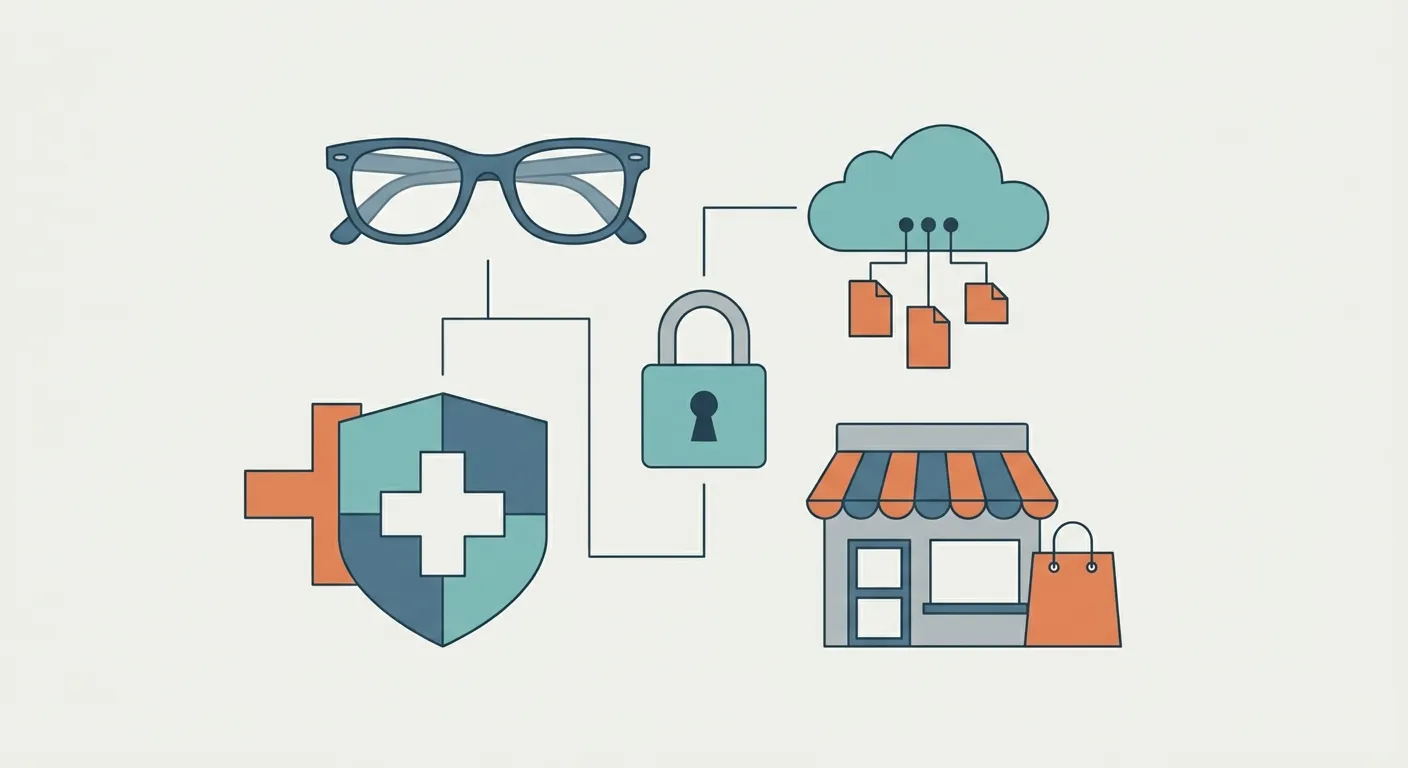
Opticians and healthcare retailers hold patient prescriptions, medical history notes, and card payment details in the same system — often on the same till. Cyber Essentials for opticians proves you lock all three down, and in 2026 it's becoming a prerequisite for NHS sight test contracts and supplier lists, not a nice-to-have.
Why this matters
Opticians sit in an odd spot. You're a retailer selling glasses and contact lenses, but you also hold special category health data under UK GDPR. That combination attracts scrutiny that a normal shop never sees.
Cyber Essentials doesn't fix everything. It covers five technical controls: firewalls, secure configuration, access control, malware protection, and patch management. For an optician or healthcare retailer, that's the floor — not the ceiling — but it's the floor NHS procurement and most insurers now check for.
Who this is for
This guide is for independent opticians, small optical chains, hearing aid retailers, and mobility aid suppliers who take card payments, store prescriptions or patient notes digitally, and either supply the NHS directly or want to. If you run two or more branches sharing a patient management system, the multi-site section matters more than the rest combined.
OneClickComply builds compliance software for exactly this kind of growing, multi-location business — the goal is certification without a compliance hire. OneClickComply handles the evidence collection end-to-end so a practice manager, not a security specialist, can run the process.
What to look for in Cyber Essentials for opticians
Patient data classification
Your patient management system holds prescriptions and health notes — that's special category data, and Cyber Essentials assessors will ask how it's segmented from general retail systems. Practices that treat all data the same fail this question every time.
Card payment scope
Most opticians run card payments through the same till or terminal that touches patient records. Cyber Essentials scope needs to draw a clear line around payment devices, or the assessor pulls the whole network into scope, which slows certification down.
NHS DSPT alignment
If you run NHS sight tests, the Data Security and Protection Toolkit (DSPT) submission sits alongside Cyber Essentials, not instead of it. Losing track of DSPT renewal dates is the single most common reason opticians drop off NHS supplier lists.
Multi-site consistency
A chain with three branches and three different Wi-Fi setups fails Cyber Essentials on inconsistency alone. Every site needs the same patching cadence and the same access control rules, or the assessment scope balloons.
Renewal automation
Cyber Essentials certification lasts 12 months. Practices that treat it as a one-off project instead of an annual cycle end up re-doing the entire evidence-gathering exercise from scratch every year.
Staff turnover coverage
Optical retail has seasonal and part-time staff. Access control policies that assume a stable team break down fast when a Saturday-only optical assistant still has system access six months after leaving.
Top picks for getting certified
Self-assessed Cyber Essentials — the safe pick. This is the standard route for a single-site optician: an online questionnaire, self-verified against the five controls, reviewed by an assessor. It typically runs from around £300 for a small organisation in 2026 and takes days rather than weeks once evidence is gathered. Buy for any independent practice with one location and no NHS supplier requirement forcing Plus.
Cyber Essentials Plus — the audited pick. Plus adds an external technical test of your systems on top of the self-assessment — vulnerability scans, device checks, sometimes an on-site visit. It costs more and takes longer than base Cyber Essentials, but NHS contracts and many insurers increasingly ask for it specifically. Consider if you supply the NHS or handle a high volume of patient records across branches; read the certification bodies comparison before choosing an assessor.
Generic GRC consultant engagement — the expensive detour. A general compliance consultant can walk you through the questionnaire, but most have never scoped an optician's patient-data-plus-payment-terminal setup before. You pay for their learning curve. Skip unless the consultant names retail healthcare as a specific vertical they've certified.
Manual spreadsheet tracking — the false economy. Some practices try to track controls, renewal dates, and evidence in a shared spreadsheet. It works for month one. By month ten, nobody remembers which patch log matches which branch. Skip for anything beyond a single site with one owner-operator.
Automated compliance platform — the scalable pick. A platform built for this kind of certification tracks evidence continuously instead of at panic-deadline time. OneClickComply automates evidence collection for Cyber Essentials and pairs it with renewal reminders, so the second year takes a fraction of the effort the first year did. Buy if you run more than one site or plan to add NHS supply in the next 12 months.
What to avoid
- Tools scoped for tech companies, not retailers. A platform built for SaaS security teams will ask about API keys and CI/CD pipelines and skip the till-terminal-plus-patient-record scoping question entirely.
- One-off consultants with no renewal plan. Certification without a renewal reminder means you rediscover the same evidence gaps 12 months later, on a tighter deadline.
- Ignoring DSPT because Cyber Essentials is sorted. They're separate submissions with separate deadlines. Practices assume one covers the other and lose NHS eligibility as a result.
Get Cyber Essentials sorted for 2026
Automated evidence collection for opticians and healthcare retailers.
Verdict comparison
| Option | Patient data scoping | NHS DSPT support | Renewal effort | Best for |
|---|---|---|---|---|
| Self-assessed Cyber Essentials | Basic | None built in | Manual each year | Single-site, no NHS supply |
| Cyber Essentials Plus | Strong, audited | None built in | Moderate | NHS suppliers, multi-site |
| Generic GRC consultant | Weak, generic | None | High, repeat cost | Skip for opticians |
| Manual spreadsheet | Weak | None | High, error-prone | Skip beyond one site |
| Automated platform (OneClickComply) | Strong, tracked | Pairs with DSPT prep | Low after year one | Multi-site, NHS-linked |
A related route worth comparing scope against: retail-adjacent practices facing the same card-plus-record overlap can check Cyber Essentials for e-commerce and retail businesses, and if your practice runs NHS sight tests, the NHS DSPT submission guide covers the paperwork Cyber Essentials doesn't.
Frequently asked questions
One last thing
Most opticians treat year one of Cyber Essentials as the hard part and year two as a formality. It's the opposite: certification lapses silently 12 months after issue, and practices that don't automate evidence tracking rediscover every control gap on a tighter NHS renewal deadline. Set the reminder the day you certify, not the week before it expires.
Seriously simple cyber compliance means the renewal doesn't catch you by surprise in 2026 or any year after.