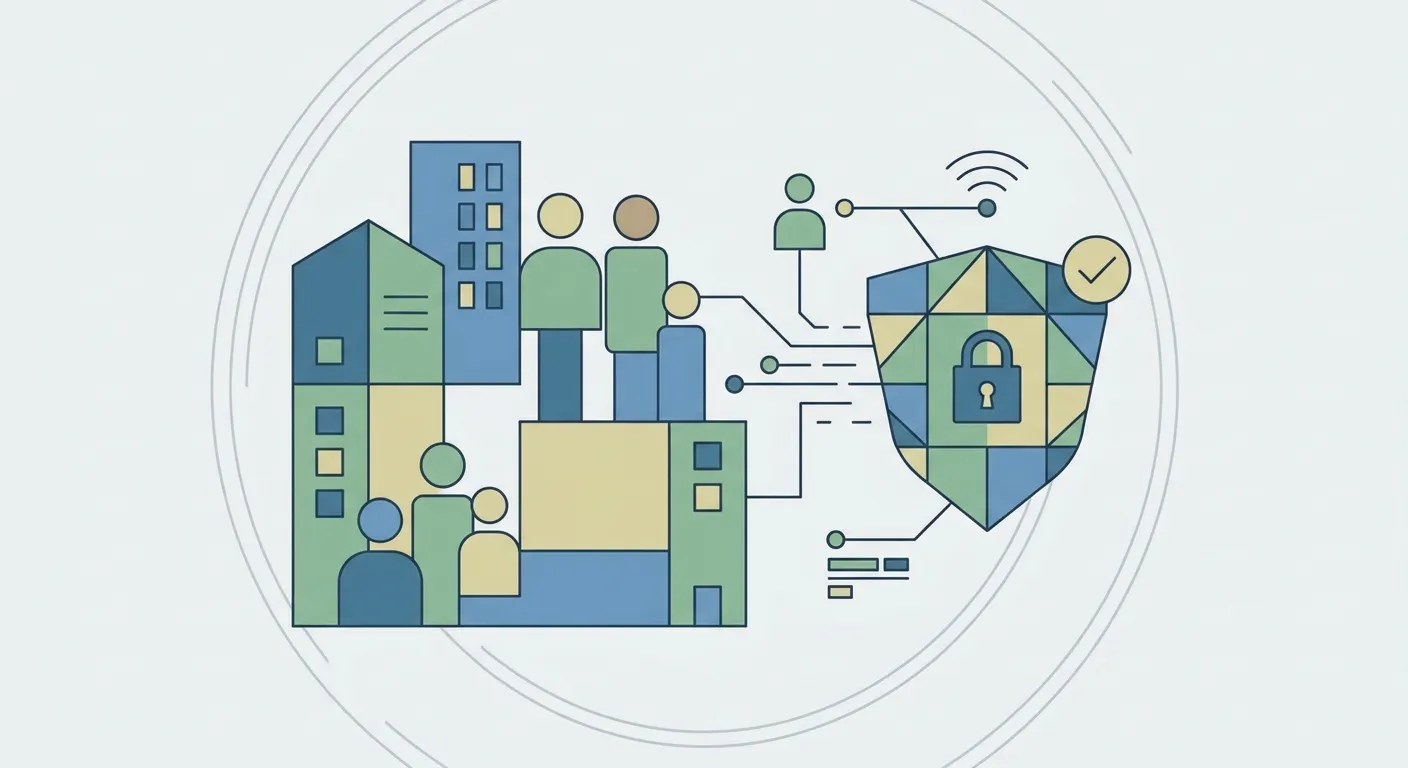
Cyber Essentials Plus for recruitment agencies proves you can be trusted with candidate CVs, right-to-work documents, and client contracts — not just that you filled in a form. Here's what to look for, which routes to certification actually work for a staffing business, and what to skip.
Why this matters
Recruitment agencies run on data most businesses never touch at scale: CVs, salary history, right-to-work checks, bank details for payroll, and client-side contact lists. That data sits in cloud ATS and CRM platforms accessed by consultants working from home, from client sites, and from their own laptops.
Client contracts have caught up. Enterprise clients and public sector frameworks increasingly list Cyber Essentials Plus as a supply chain condition before they'll sign a preferred supplier agreement. Losing certification mid-contract is a commercial problem, not just a security one.
Who this is for
This guide is for staffing and recruitment agencies with anywhere from 10 to 200 staff, running candidate data through a cloud ATS or CRM, and either bidding for contracts that require certification or renewing one they already hold. If you're still deciding between Cyber Essentials and the Plus tier, Cyber Essentials for recruitment agencies covers the base self-assessment version first.
Cyber Essentials Plus adds an external technical audit on top of that self-assessment. An assessor tests your live systems — not your policy binder — against five core controls: firewalls, secure configuration, user access control, malware protection, and patch management.
What to look for in Cyber Essentials Plus for recruitment agencies
Coverage of remote consultant devices
Most recruitment consultants work from home at least part of the week, often on laptops that were never provisioned by a central IT team. Cyber Essentials Plus scope has to include every device that touches the candidate database, not just office desktops.
An assessor will test a sample of these devices directly. If half your consultants are on personal laptops outside the certified scope, the audit either fails or the certification doesn't actually cover your real risk.
Cloud ATS and CRM access control
Your candidate database, whether it's Bullhorn, JobAdder, Vincere, or something similar, is the asset worth protecting. Cyber Essentials Plus checks who can access it, how accounts are provisioned, and whether multi-factor authentication is actually switched on — not just documented as policy.
Agencies with high consultant turnover get caught here more than anyone. An account that should have been disabled the day someone left is exactly what the audit is designed to catch.
Audit-ready evidence, not policy documents
Cyber Essentials Plus is a technical verification, not a paperwork review. Assessors log in, run scans, and check patch levels on real machines. A written policy that says "patches are applied within 14 days" means nothing if the audit shows three laptops running six-month-old software.
Before you book an assessment, work through how to prepare for a Cyber Essentials Plus audit so you know exactly what gets tested and where agencies typically fail on the first attempt.
Speed against your placement pipeline
Agencies bill on placements, not on IT projects. A certification process that takes weeks of consultant time away from desks is a real cost, even when the certification itself is cheap.
Look for a route to certification that runs in the background — automated evidence collection, scheduled scans, dashboards that show gaps before the assessor does — rather than one that needs a dedicated project manager for a month.
Onboarding and offboarding discipline
Recruitment has some of the highest staff turnover of any professional services sector. Cyber Essentials Plus access control checks look directly at how fast accounts get created and killed.
A consultant who left three months ago and still has an active CRM login is the single most common finding in staffing agency audits. Fix the offboarding process before the assessor finds it for you.
Top picks: how recruitment agencies actually get certified
The DIY spreadsheet method — the slow grind. One spec that matters: this covers the self-assessment questionnaire only, with no ongoing evidence trail for the technical audit. Consultants end up chasing screenshots and patch logs by hand the week before the assessment. Skip it if you're aiming for the Plus tier rather than base Cyber Essentials.
Hiring a generalist IT consultant — the outsourced fix. One spec that matters: the consultant manages the technical audit relationship, but evidence collection across devices usually stays manual. Works for a single certification cycle. Gets expensive and slow on annual renewal. Consider it if this is a one-off tender requirement rather than an ongoing client expectation.
Going straight to a certification body — the required step, done alone. One spec that matters: every route to Cyber Essentials Plus ends with a licensed assessor, and choosing the right certification body affects audit turnaround and cost. Consider it once your evidence and scope are already in order, not as your first step.
An automated compliance platform — the safe pick. One spec that matters: continuous evidence collection across the five CE+ controls means no scramble the week before renewal. OneClickComply automates the evidence gathering that recruitment agencies otherwise chase by hand across dozens of remote devices. Buy it if you're renewing annually or bidding for repeat public sector work.
Skipping the base assessment and jumping straight to Plus — the shortcut that backfires. One spec that matters: Cyber Essentials Plus assumes the underlying Cyber Essentials self-assessment controls are already in place; you can't audit controls that were never built. Skip this shortcut — it fails the technical audit almost every time.
Automate your Cyber Essentials Plus evidence
Handle CE+ audit prep end-to-end, without pulling consultants off the desk.
What to avoid
- A certification body that skips vulnerability scanning on cloud-hosted ATS platforms. It looks compliant on paper. It isn't testing where your actual candidate data lives.
- Policies written once during onboarding and never updated as staff churn. Cyber Essentials Plus checks the current state of your systems, not an archived document from 2024.
- Assuming your certification covers your CRM vendor too. Your Cyber Essentials Plus certificate covers your business. Your vendor needs its own security posture, and you should be asking about it separately.
Verdict comparison
| Approach | Speed | Audit-readiness | Ongoing cost control | Verdict |
|---|---|---|---|---|
| DIY spreadsheet | Slow | Weak | Low upfront, high labour | Skip |
| Generalist IT consultant | Medium | Medium | High on renewal | Consider |
| Certification body direct | Fast to book | Depends on your prep | Predictable | Consider |
| Automated compliance platform | Fast, continuous | Strong | Lower over time | Buy |
| Skip-to-Plus shortcut | Fast, fails | Very weak | Wasted spend | Skip |
Frequently asked questions
One last thing
The fastest way a recruitment agency fails a Cyber Essentials Plus audit isn't a missing firewall — it's a former consultant's CRM login that nobody switched off. Assessors test live access, and staffing agencies turn over staff faster than almost any other sector. Fix offboarding before you book the assessment, not after you fail it.
Cyber Essentials Plus for recruitment agencies isn't complicated once the evidence trail exists automatically instead of getting assembled by hand every renewal. That's the whole idea behind Seriously Simple Cyber Compliance.