
Cyber Essentials Plus does not automatically reduce your cyber insurance premium; any discount depends on your insurer’s terms and assessment of your business. For your 2026 renewal, ask for written confirmation of any benefit and compare the cover, excess and exclusions—not just the premium.
Does Cyber Essentials Plus reduce cyber insurance premiums?
Treat a premium reduction as an insurer-specific benefit, not a built-in feature of certification. Cyber Essentials Plus verifies technical controls. Your insurance contract determines what you pay and what protection you receive.
The NCSC’s Cyber Essentials scheme covers 5 technical control areas. Plus adds independent technical testing to the assessment; it does not replace an insurer’s questions about your business or the cover you need.
Keep these distinctions clear when you align Cyber Essentials with cyber insurance requirements.
| Evidence or outcome | What it establishes | What it does not establish |
|---|---|---|
| Cyber Essentials | Assessed answers against the scheme’s technical requirements | Independent technical verification under Plus |
| Cyber Essentials Plus | Independent technical verification against the scheme’s requirements | An automatic insurance discount |
| An insurer’s quotation | Proposed insurance terms for the submitted business information | That certification caused any difference from another quote |
| An issued insurance policy | The agreed cover, subject to its wording and conditions | That every cyber incident is covered |
Why this matters
You need separate decisions about security assurance and insurance. Combining them into a single promise of savings makes it harder to judge either properly.
For your 2026 budget, assess certification on its security and commercial purpose. Record an insurance saving only when the insurer confirms it on comparable terms.
A lower premium is not enough. If the revised policy increases your excess, reduces a cover limit or excludes an important activity, you have changed the protection as well as the payment.
What does Cyber Essentials Plus add to your insurance evidence?
Cyber Essentials Plus gives you independently tested evidence against a defined technical baseline. That is a different claim from saying your business cannot suffer a cyber incident.
The NCSC identifies these 5 control areas:
- Firewalls: control connections between your systems and other networks.
- Secure configuration: remove unnecessary settings and reduce avoidable exposure.
- Security update management: keep supported software updated against vulnerabilities.
- User access control: restrict access to authorised users and appropriate privileges.
- Malware protection: protect systems against malicious software.
Use your certificate to support accurate answers. Do not use it as a substitute for reading the insurance proposal.
An insurer’s question about administrator access, for example, needs an answer about the systems and accounts covered by that question. A certificate covering a narrower part of your organisation does not answer a question about the whole business.
Cyber Essentials: best for demonstrating the baseline
Cyber Essentials uses a self-assessment questionnaire reviewed by an assessor. It gives you a defined set of requirements to work against, rather than an open-ended claim that your security is good.
Its limitation is the assessment method. Do not describe basic Cyber Essentials as independently technically tested in the same way as Plus.
Cyber Essentials Plus: best for independent technical verification
Cyber Essentials Plus adds technical testing against the scheme’s requirements. Choose it when you need that additional assurance, including where a customer or contract requires it.
Its limitation is scope. Plus is not a complete assessment of every security risk, and it does not establish that every insurance condition has been met.
Choose the assessment level your requirements justify. Do not upgrade solely on an unconfirmed premium-saving claim.
Why any cyber insurance benefit varies
There is no single certification-to-discount rule you can apply across insurers. Ask your broker which parts of your submission affect the proposed terms, then separate the certificate from the wider risk information.
These are the main points to resolve:
- Recognition of certification. Does the insurer explicitly recognise Cyber Essentials Plus, and does it distinguish Plus from basic Cyber Essentials?
- Business activities. Does the proposal accurately describe the services you deliver and the information you handle?
- Certification scope. Do the certified organisation and systems match the entities and operations you want insured?
- Other security answers. What evidence does the insurer require beyond the certificate?
- Policy structure. Are the limits, excesses, exclusions and conditions unchanged between the quotes?
- Renewal circumstances. Has anything else changed in your business, claims history or requested cover?
These checks explain why a before-and-after comparison needs care. Your renewal premium can change without certification being the reason.
For a defensible 2026 comparison, ask your broker to identify the certification benefit separately from other changes. If the insurer does not separate it, describe the result as a revised quotation—not a measured certification saving.
How do you check whether your insurer offers a discount?
Get the answer before you commit to certification solely for insurance reasons. Follow this sequence and keep the response with your renewal records.
1. Define the insured business
List the legal entities, business activities and systems the policy must cover. Compare that list with the intended certification scope.
Explain any difference to your broker. Do not assume a certificate for one entity answers questions about the rest of a group.
2. Ask what the insurer recognises
Ask whether Cyber Essentials Plus changes the premium, eligibility, excess or any policy condition. Request a separate answer for each outcome.
A response that certification is viewed positively does not confirm a discount. Ask what changes in the actual quotation.
3. Request a like-for-like comparison
Ask the broker to hold the requested cover and business information constant when explaining the effect of certification. Identify any assumptions about passing the assessment or providing the certificate.
Do not present a planned assessment as completed certification. Keep the submission accurate at the time you make it.
4. Check the written terms
Read the quotation schedule and relevant wording alongside the broker’s explanation. Check whether the claimed benefit depends on maintaining certification or meeting another condition.
Resolve unclear language before accepting the policy. Save the insurer’s response, not just an internal summary of it.
The sequence keeps the decision simple: establish scope, confirm recognition, compare equivalent terms and retain the evidence.
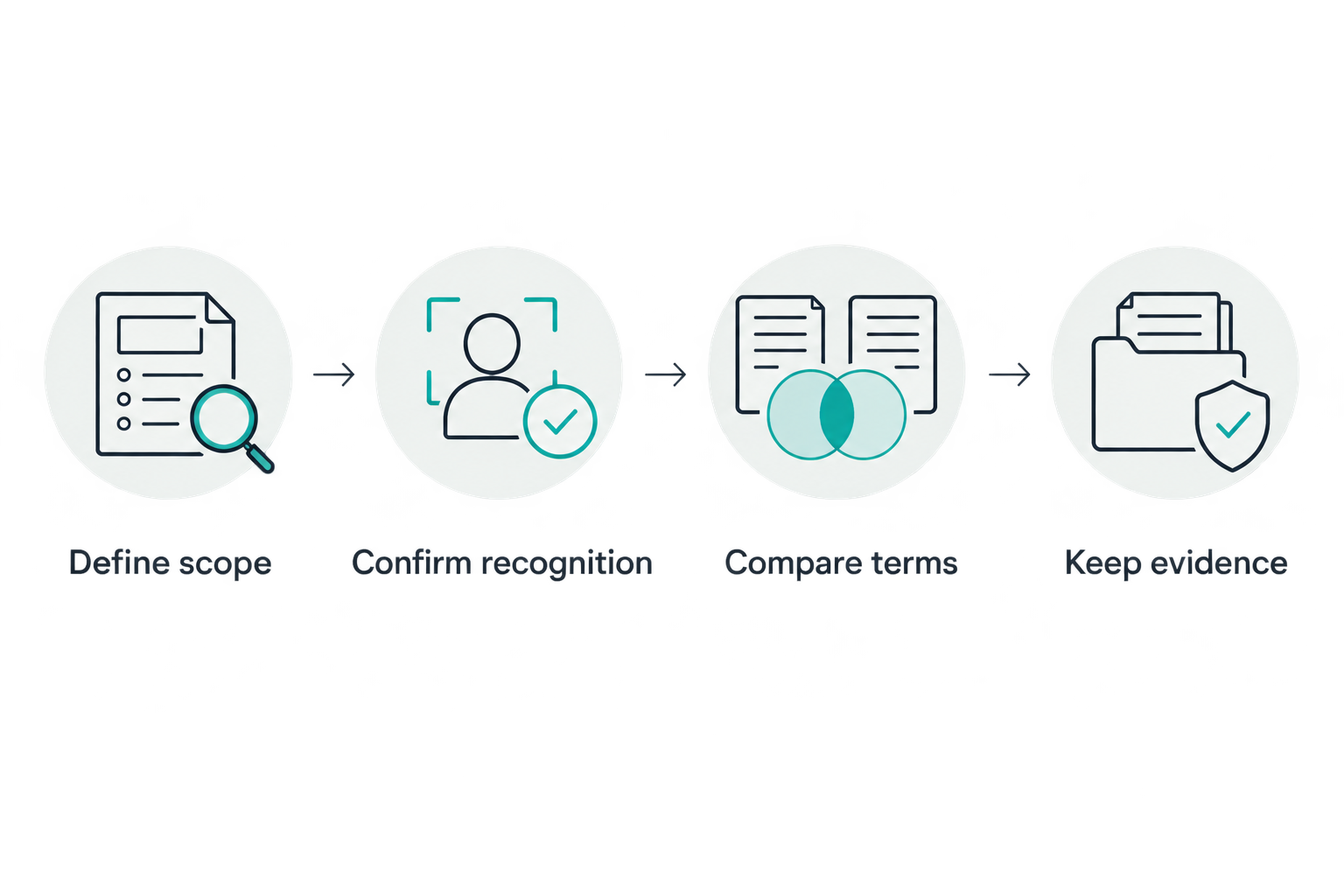
Confirm the insurance benefit against equivalent terms before counting it as a saving.
What should you compare besides the premium?
Run 3 comparison checks before accepting a revised quotation: cover, your contribution to a claim, and your obligations. A certificate does not make these differences disappear.
Check the cover
Compare the insured entities, activities and categories of loss. Look at the overall limit and any separate limits within it.
Ask the broker to explain how the proposed policy treats incident response, business interruption and third-party claims. Do not assume that a familiar policy label means identical protection.
Check your contribution
Compare the excess and any other amount or period you must absorb before cover responds. Ask how these apply to the incidents most relevant to your business.
A lower premium paired with a larger excess is a trade-off. Record it as such, rather than attributing the whole difference to stronger security.
Check your obligations
Read the requirements governing security controls, incident notification and use of response providers. Ask who in your business owns each action.
For your 2026 renewal, keep a short change log against the previous wording. It gives your finance lead a clearer decision than a premium comparison alone.
Does certification replace cyber insurance?
No. Certification assesses controls; insurance transfers specified financial risks under a contract. Neither does the other’s job.
This distinction also matters when you compare international frameworks. Essential Eight and cyber insurance address different questions: implementing security measures and arranging financial protection are separate decisions, just as Cyber Essentials Plus and a UK insurance policy are separate decisions.
Avoid copying insurance conclusions from another framework or jurisdiction into your UK renewal. Ask your broker about your policy and your business.
Also distinguish a separately purchased policy from any insurance offered alongside a certification scheme. Check eligibility and wording directly rather than assuming the arrangements provide equivalent protection.
The practical rule is simple: decide what security assurance you need, then decide what residual risks you want insured. Review where the requirements overlap without treating either document as a substitute for the other.
What evidence should you keep after certification?
Keep evidence that supports the statements you make to your insurer. The goal is an accurate, maintainable record—not a large folder nobody owns.
Build your renewal file around:
- The certificate and its stated scope.
- The assessment date and expiry date.
- The submitted insurance questions and answers.
- Supporting records for specific security statements.
- Written clarification of any conditions or certification benefit.
- A record of material changes raised with your broker.
NCSC guidance states that Cyber Essentials certification lasts 12 months. Check your certificate’s dates against your policy period rather than assuming both renew together.
Give each insurance answer an owner. Your IT lead can confirm technical settings; the person responsible for insurance should confirm that those answers match the wording of the question.
OneClickComply is best for growing businesses that want to automate Cyber Essentials compliance work. The platform auto-remediates security controls, generates policies and manages risk; it does not replace an insurer’s assessment or your responsibility for accurate insurance answers.
Automation supports the work. You still need to confirm scope, review evidence and approve what you submit.
Is Cyber Essentials Plus worth it without a premium reduction?
Assess Cyber Essentials Plus against a documented requirement, not just an insurance hypothesis. Independent technical verification has a clear purpose even when your insurer does not confirm a discount.
Use these decision rules:
- A customer requires Plus: assess the required scope and delivery timetable.
- You want independent verification: use Plus to test the technical baseline within its scope.
- Insurance savings are the only reason: obtain written confirmation before making that the business case.
- You need broader assurance: identify the additional risks that require separate assessment.
For 2026 planning, keep confirmed obligations separate from hoped-for financial benefits. That prevents an uncertain discount from carrying the entire case for certification.
Your board summary should state the requirement, the intended scope and the evidence you expect to obtain. Add an insurance benefit only where the insurer has confirmed one.
What should you ask your broker before renewal?
Send a short, specific request. Ask the broker to answer these questions in writing:
- Does this insurer recognise Cyber Essentials Plus separately from Cyber Essentials?
- Does certification change any proposed term, and which one?
- Is the comparison based on unchanged cover and business information?
- Does the certificate scope match the proposed insured entities?
- What must remain true throughout the policy period?
- What should you report if certification expires or your systems change?
Keep the answers alongside the accepted policy. If you change broker or insurer, ask again rather than assuming the previous arrangement carries over.
The outcome you need is a clear contractual position, not a general assurance that certification helps.
Frequently asked questions
One last thing
Ask whether certification changes eligibility or a policy condition, even if it does not change the premium. Those are different outcomes and deserve separate answers.
Keep the security decision clear and the insurance comparison like for like. Seriously Simple Cyber Compliance.