
DORA does not automatically apply to a UK financial services firm just because it operates in financial services. In 2026, you need to distinguish direct obligations on an in-scope EU financial entity from contractual requirements passed to a UK technology supplier and oversight of a designated critical technology provider. Brexit removes neither the obligations of an in-scope EU subsidiary nor the requirements your EU customers put into technology contracts.
Does DORA apply to UK financial services firms post-Brexit?
Not across the board. Your legal entity and its activities determine the answer, not the location of your group headquarters. Article 2 of DORA identifies the categories of financial entities within scope and sets out exclusions.
Use this table to separate the main situations before starting a DORA gap analysis for ICT risk management.
| Your situation | DORA position | Next move |
|---|---|---|
| UK-only financial entity without an in-scope EU entity or relevant EU authorisation | UK financial regulation alone does not bring the entity within DORA | Record the scope decision and assess applicable UK rules |
| UK group with an in-scope EU-authorised subsidiary | Direct duties attach to the EU subsidiary | Assign accountability and map shared technology services |
| UK business supplying technology services to an in-scope EU financial entity | Customer contracts bring DORA-related requirements | Review service terms, evidence and incident support |
| UK technology provider designated critical under DORA | The EU critical-provider oversight framework applies | Confirm designation and the applicable oversight obligations |
| UK firm operating through an EU branch | A branch address alone does not settle scope | Check the entity's status and the relevant sector rules |
These are different legal routes. A customer questionnaire, an EU office and a critical-provider designation do not create the same obligations.
Why this matters
A mistaken scope decision creates the wrong work. You either build a programme for duties your UK entity does not hold, or overlook obligations sitting with an EU subsidiary or supplier contract.
For your 2026 assessment, separate regulatory scope, contractual commitments and operational evidence. They connect, but none substitutes for the others.
DORA addresses digital operational resilience: managing technology risk, handling incidents, testing resilience and controlling technology dependencies. A certificate or policy library alone does not demonstrate that those arrangements work.
Direct application: check the EU financial entity
Start with the legal entity holding the relevant authorisation or registration. Do not start with the trading name on your website.
DORA covers specified categories, including credit institutions, payment institutions, investment firms, and insurance and reinsurance undertakings. Article 2 also contains exclusions, so a sector label is not a complete scope assessment.
For a UK-headed group, distinguish:
- The UK parent: ownership of an EU business does not automatically make the parent an in-scope EU financial entity.
- The EU subsidiary: an entity within a covered category must assess its own DORA obligations.
- Shared service companies: group technology arrangements need assessment as service dependencies, not automatic treatment as regulated financial entities.
- Branches: check the underlying entity and sector rules rather than treating every EU establishment as a subsidiary.
The EU financial entity remains responsible for meeting its obligations when another group company runs its systems. Centralising technology does not transfer regulatory accountability to the UK parent.
Your scope record should name the entity, authorisation, applicable category, exclusions considered and decision owner. Keep the reasoning alongside the conclusion.
Contractual exposure: check what you supply to EU customers
A UK business supplying information and communication technology services to an in-scope EU financial entity faces a different question: what must the customer require from the supplier?
DORA Article 30 sets contractual requirements for technology service arrangements. Additional provisions apply where those services support critical or important functions.
Your EU customer needs terms covering matters such as service descriptions, data protection, incident assistance, cooperation with authorities and termination. For services supporting critical or important functions, requirements extend further into areas including audit rights, service levels and exit arrangements.
Review the actual service and contract:
- Identify the customer legal entity receiving the service.
- Describe the technology service rather than relying on a broad commercial label.
- Establish whether the customer treats the supported function as critical or important.
- Check subcontracting, data locations and access arrangements.
- Confirm that incident assistance and exit commitments match what your team can deliver.
Signing a DORA addendum does not turn a UK supplier into an EU-regulated financial entity. It does create contractual commitments that need operational owners and evidence.
Do not describe every supplier request as a direct statutory duty on your business. Ask the customer to identify the relevant requirement and explain how it relates to the service.
Critical-provider oversight: check formal designation
Ordinary technology supply and critical-provider oversight are separate routes. DORA Article 31 establishes the designation framework for critical ICT third-party service providers.
Supplying an EU bank does not, by itself, make your business a designated critical provider. Neither does receiving a detailed security questionnaire.
For a third-country provider that is formally designated critical, DORA includes an EU subsidiary requirement connected to continued provision of services to EU financial entities. Confirm the designation, relevant notices and applicable requirements with specialist legal advice.
Your first task is therefore factual: establish whether a designation applies to the provider and services concerned. Do not infer critical status from the commercial importance of a customer.
Why DORA exposure varies between UK firms
Two UK businesses selling to financial services customers can have different obligations. The differences come from their legal position and service relationships, not simply their size.
- Entity status: an in-scope EU financial entity has a different position from a UK-only company.
- Authorised activities: Article 2 lists covered categories and exclusions.
- Service type: technology services need a different assessment from unrelated professional services.
- Function supported: support for a critical or important function brings additional contractual requirements.
- Group structure: shared technology services create dependencies across otherwise separate legal entities.
- Critical designation: formal designation introduces oversight beyond ordinary supplier contracting.
Use these factors in your 2026 scope review. Repeat the review when authorisations, acquisitions, customer services or group technology arrangements change.
How do you check your firm's DORA position?
Use 5 steps to turn a broad question into a documented decision. Complete legal scoping before buying tools or promising that your business is DORA compliant.
1. Map entities
List the UK and EU legal entities involved, their authorisations and their activities. Record which entity contracts with customers and which entity operates the technology.
Avoid a single group-wide yes-or-no answer. Different companies in the same group need different conclusions.
2. Check scope
Assess each relevant entity against Article 2 and its exclusions. Escalate uncertain cases, including branch structures, to legal counsel familiar with the relevant financial services regime.
Record why an entity is outside scope as carefully as why another is inside it. A conclusion without reasoning is difficult to defend when the business changes.
3. Trace services
Connect technology services to the financial entities and business functions they support. Include intra-group arrangements and relevant subcontracting dependencies.
Ask the EU financial entity to confirm its classification of the supported function. Do not substitute your sales team's assessment for the customer's regulatory analysis.
4. Review contracts
Compare existing terms with applicable DORA requirements and the customer's service classification. Assign owners to audit access, incident assistance, continuity, subcontracting and exit commitments.
Check delivery before signing. A contract should not promise access, information or recovery support that your operating arrangements cannot provide.
5. Assign evidence
Give each applicable requirement an owner, supporting records and a review point. Keep legal conclusions separate from technical control evidence, but make the connection between them clear.
For your 2026 review, test whether someone outside the project can follow the chain from entity to service, obligation and evidence. If they cannot, simplify the record.
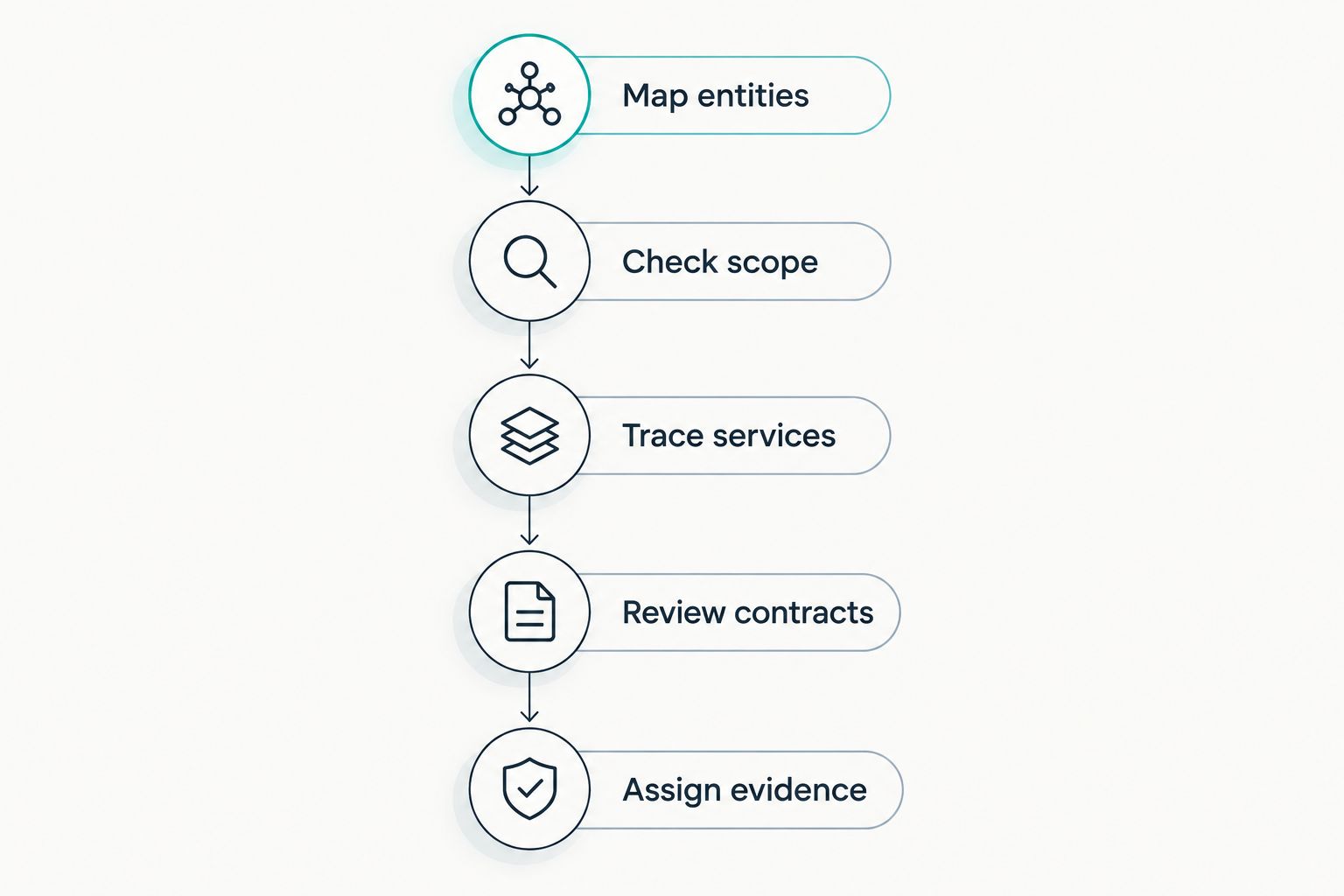
Decide legal scope before collecting evidence or committing to contract terms.
What evidence should you prepare after confirming scope?
Build evidence around the obligations you actually hold. An EU financial entity's regulatory file and a UK supplier's customer assurance pack serve different purposes.
Useful records include:
- Scope decision: entity names, authorisations, applicable provisions and approved reasoning.
- Service map: systems, supported functions, providers and relevant subcontractors.
- Risk records: identified technology risks, treatment decisions and accountable owners.
- Incident arrangements: escalation routes, customer contacts and reporting responsibilities.
- Contract records: agreed requirements, unresolved gaps and operational owners.
- Testing evidence: exercises, findings, corrective actions and follow-up decisions.
- Exit arrangements: practical plans for service transition and data handling.
Keep evidence tied to the entity and service concerned. A group policy offers context, but it does not prove that a particular subsidiary tested its recovery arrangements or that a supplier can meet an agreed escalation process.
Do UK operational resilience rules replace DORA?
No. UK operational resilience requirements and DORA are separate regimes. Meeting applicable FCA or PRA requirements does not automatically satisfy the obligations of an in-scope EU entity.
Reuse evidence where the underlying work genuinely overlaps. Service mapping, incident exercises and supplier assessments can inform both programmes, but each needs its own applicability assessment and mapping.
For 2026 planning, maintain separate records of regulatory recipients, reporting triggers and responsible entities. Do not assume that notifying a UK authority fulfils an EU reporting obligation.
Does ISO 27001 certification satisfy DORA?
No. ISO 27001 certification does not establish DORA compliance. It provides an information security management framework, while DORA imposes specific legal requirements on covered entities and arrangements.
Existing risk assessments, access controls, supplier reviews and incident processes give you material to assess. Check their scope, detail and operation against the applicable DORA requirements rather than treating certification as an exemption.
The practical benefit is reuse. The limitation is that management-system certification does not decide legal scope, replace required contract terms or complete regulatory reporting.
Where does compliance automation help?
OneClickComply compliance automation is best for growing businesses organising security controls, policies and risk management. The platform supports automated remediation, policy generation, risk management and trust centres.
Use OneClickComply compliance automation for the security management work it supports, not as a substitute for a legal scope decision. Those capabilities do not establish that a particular DORA obligation, reporting process or contract requirement has been met.
Keep accountability with named people. Software can support your programme; management still approves risk decisions, and legal advisers resolve uncertain regulatory scope.
Frequently asked questions
One last thing
The most useful first document is an entity-and-service map, not a compliance checklist. It shows whose obligation you are addressing before your team starts collecting evidence for the wrong company.
Confirm the scope. Assign the work. Keep the evidence current with OneClickComply where its capabilities fit. Seriously Simple Cyber Compliance.