
Smaller financial institutions’ DORA compliance is the management of technology risk to keep financial services running through disruption. Use this DORA compliance checklist to confirm your scope, assign owners, test recovery and keep evidence ready in 2026, without copying a large bank’s operating model.
Why DORA compliance matters for smaller financial institutions
DORA requires evidence that your arrangements work, not just policies that describe them. For a smaller institution, the practical task is to connect management decisions, technology controls and supplier responsibilities without creating duplicate records.
Start with a DORA gap analysis for ICT risk management. Compare your current arrangements with your applicable obligations before commissioning new documents or tools.
DORA’s proportionality principle considers your size, overall risk profile, and the nature, scale and complexity of your services. It does not create a blanket exemption for small firms, and the simplified framework applies only to specified categories.
For your 2026 programme, separate legal requirements from internal working practices. A spreadsheet can record a decision; it cannot make an untested recovery process effective.
Legal reference: DORA, Articles 2–4 and 16, covering scope, proportionality and the simplified ICT risk management framework.
Build your DORA compliance checklist
Work through these steps in order. Keep one action register with an owner, required evidence, due date and approval status for each gap.
Your completion test is simple: another person should be able to find the evidence and understand what it proves. A completed task without supporting evidence is not a reliable control record.
Confirm your legal scope
Check each legal entity against DORA’s scope before applying a group-wide checklist. Record your authorisation category, relevant exclusions and competent authority, rather than deciding applicability from turnover or headcount alone.
A UK address does not settle the question. Distinguish an EU-authorised financial entity from a UK supplier serving EU financial customers, because direct regulatory duties and contractual requirements are different.
Keep a short scope decision that a new compliance lead can understand without reconstructing the discussion. Where your position depends on an exemption or the simplified framework, record the specific legal basis and obtain an appropriate review.
- List regulated entities, authorisations and jurisdictions.
- Match each entity to the relevant DORA category.
- Record applicable exclusions and their legal basis.
- Confirm whether the standard or simplified framework applies.
- Separate direct obligations from customer contract requirements.
- Name the person responsible for reviewing scope changes.
Assign management accountability
Give your management body a clear view of technology risk and the decisions it owns. DORA places responsibility for the ICT risk management framework with the management body; appointing a supplier or compliance lead does not transfer that responsibility.
Use existing meeting minutes, a responsibility matrix and a risk register first. Record approvals and unresolved decisions in those documents rather than creating a separate reporting pack for every framework.
For smaller teams, pay particular attention to cover and independent challenge. If the same person operates a control and checks it, explain how you review that work and address conflicts within your applicable requirements.
- Assign an accountable management sponsor and operational owners.
- Approve the ICT risk management framework and relevant policies.
- Record risk tolerance and escalation decisions.
- Identify deputies for essential response roles.
- Plan relevant management-body training.
- Keep evidence of challenge, approvals and follow-up actions.
Map services, systems and controls
Start with the financial services you deliver, then identify the people, systems, data and suppliers that support them. An asset inventory alone does not explain which failure would interrupt a critical or important function.
Build this map manually in a shared register before choosing automation. Use service owners to confirm dependencies, including identity services, outsourced administration and recovery arrangements that sit outside your core application.
OneClickComply compliance automation supports security-control remediation, policy generation and risk management. That provides an automation route for underlying compliance work; assess any DORA-specific mapping, reporting or register requirements separately before relying on a platform.
- Name each service and its business owner.
- Identify critical or important functions using a documented assessment.
- Map supporting systems, information assets and ICT suppliers.
- Link risks to controls and supporting evidence.
- Record shared dependencies and single points of failure.
- Review the map when services or suppliers change.
The service map should connect five elements: Services, Systems, Suppliers, Controls and Evidence. Keep those connections visible so a failed control leads to a business-impact discussion, not just a technical ticket.
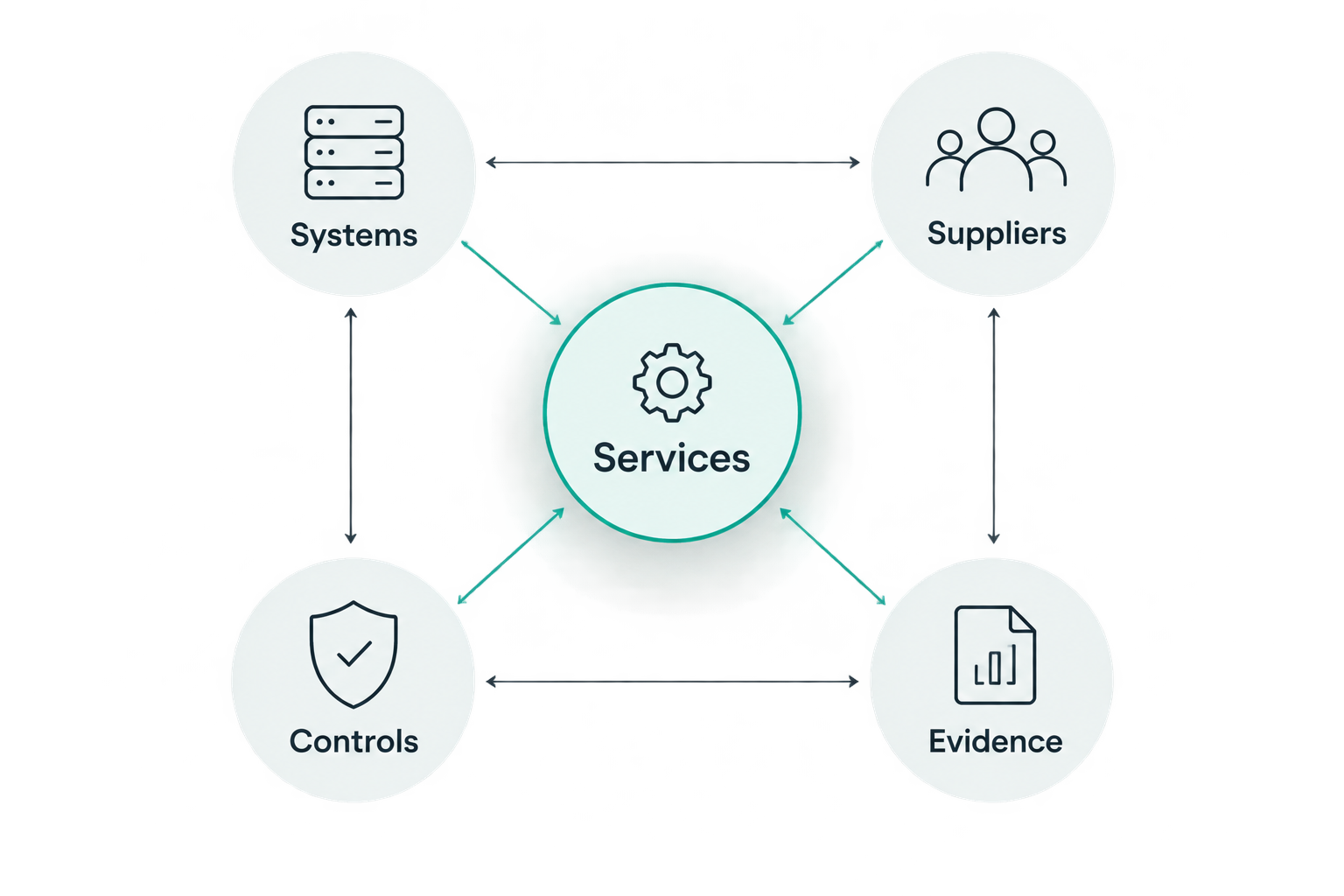
Map controls and suppliers to the services they protect.
Establish protection and recovery controls
Turn the service map into practical protection and recovery measures. Cover access, secure configuration, patching, monitoring, backups and change control, with evidence that matches the systems supporting your financial services.
Start with existing administrator reports, change records and backup logs. Each record should identify its source, the period covered and the person who reviewed exceptions.
For the 2026 checklist, keep recovery objectives separate from test results. A documented target states what the business needs; a restoration test shows whether the current arrangements achieve it.
- Review privileged access and remove unnecessary permissions.
- Track vulnerabilities, remediation decisions and overdue actions.
- Document backup scope, protection and restoration procedures.
- Set recovery objectives using business-impact analysis.
- Keep change approvals and rollback instructions.
- Record control failures, exceptions and corrective actions.
Prepare incident classification and reporting
Create an incident process that works outside normal working hours. Staff need a clear route to report disruption, while decision-makers need enough information to classify the event and assess regulatory reporting duties.
Use a controlled incident log and draft reporting templates first. Do not substitute a generic data-breach process: DORA incident reporting and data-protection reporting have different scope and assessment requirements.
Set out the applicable reporting timetable, submission channel and escalation contacts in your runbook. Check these against the current technical rules and your competent authority’s instructions before approving the procedure.
- Define incident intake, escalation and decision-making roles.
- Apply the relevant major-incident classification criteria.
- Record detection, classification and reporting timestamps.
- Prepare initial, intermediate and final reporting workflows.
- Coordinate regulatory, customer and supplier communications.
- Run a rehearsal with a deputy covering the primary decision-maker.
Test resilience and close findings
Build your testing programme around risk and the services that matter. For entities other than microenterprises, DORA requires appropriate testing at least annually on ICT systems and applications supporting critical or important functions.
Do not confuse that requirement with threat-led penetration testing. DORA’s advanced testing applies to identified entities, generally at least every 3 years, subject to the authority’s permitted adjustment of frequency.
Begin with a defined scenario and a written test plan. For example, rehearse the loss of an essential supplier, then restore a relevant backup and check whether staff can continue the affected service.
- Define test scope, objectives, responsibilities and safety boundaries.
- Select tests proportionate to your risks and applicable obligations.
- Exercise incident decisions and communication routes.
- Test restoration rather than checking backup completion alone.
- Assign owners and deadlines to findings.
- Retest fixes and record the closure decision.
Legal reference: DORA, Articles 24–27, covering resilience testing and advanced threat-led penetration testing.
Control ICT suppliers and retain evidence
Keep a register of contractual arrangements for ICT services, not just a list of suppliers your procurement team considers high risk. Distinguish arrangements supporting critical or important functions and apply the relevant contract requirements.
Use the prescribed register structure from the start. A general vendor spreadsheet can support initial information gathering, but missing identifiers or relationships create rework when preparing the required register of information.
For your 2026 review, connect each important supplier to a service owner, contract, risk assessment and exit approach. A supplier certificate is useful evidence, but it does not replace your assessment of dependency, contractual rights or continuity.
- Record ICT contractual arrangements using the applicable register templates.
- Assess supplier risk, concentration and relevant subcontracting dependencies.
- Review contracts against applicable DORA requirements.
- Document service monitoring and incident-notification responsibilities.
- Prepare and test exit arrangements where required.
- Retain reviews, approvals, findings and remediation evidence.
Legal reference: DORA, Articles 28–30, covering ICT third-party risk, concentration risk and contractual provisions.
Compare your delivery options
Choose the approach that closes your actual gaps. Legal interpretation, control operation and evidence administration are different jobs, even when one person coordinates them.
The comparison below separates those jobs. No option removes management accountability, and none should be treated as proof of DORA compliance on its own.
| Option | Best for | Main benefit | Key limitation |
|---|---|---|---|
| Shared registers and existing document tools | A clearly scoped programme with named internal owners | Lets you organise existing records without changing platforms | Updates, evidence checks and follow-up remain manual |
| DORA specialist adviser | Scope decisions, regulatory interpretation and contract review | Adds focused expertise to defined questions | Advice does not operate controls or maintain records for you |
| OneClickComply compliance automation | Growing businesses automating security controls, policies and risk management | Supports control remediation, policy generation and risk management | Assess DORA-specific coverage separately; automation does not replace legal interpretation |
| Combined internal ownership and specialist support | Teams needing both operational control and targeted external review | Keeps decisions inside the institution while adding focused assistance | Requires clear boundaries between internal and external responsibilities |
Before selecting an approach, ask for a demonstration using your own sample requirements. Check whether you can identify the owner, inspect the evidence, record an exception and retrieve the history without relying on a presentation.
For OneClickComply, assess the underlying compliance-automation functions against your documented needs. Keep any unsupported requirement assigned to a separate process rather than assuming it is covered.
Common mistakes smaller financial institutions make
Treating small size as an exemption
A lean team is not a legal classification. Confirm your entity category, exclusions and framework before reducing the checklist, and keep the reasoning with your scope decision.
Buying a platform before identifying gaps
A tool cannot resolve an unanswered scope question. Finish your applicability assessment and service map first, then select software against the controls and records you actually need.
Treating a supplier certificate as a complete assessment
A certificate does not explain your institution’s dependency on a service or whether you can leave it safely. Review the contract, service role, concentration risk and relevant recovery arrangements together.
Marking recovery complete after a backup succeeds
A successful backup job does not prove successful restoration. Test the restore process and confirm that the recovered service meets the business need, including access and operational checks.
Reusing an ISO 27001 checklist without a DORA assessment
Existing information-security work provides useful evidence, but DORA contains specific governance, reporting, testing and third-party requirements. Map that evidence to each applicable obligation and record the remaining gaps explicitly.
Frequently asked questions
One last thing
Choose one critical service and ask someone outside the project to follow its evidence trail. Can that person find the owner, dependencies, recovery test, supplier contract and unresolved risks without asking where everything lives?
Use the result to improve your 2026 checklist. Missing connections matter more than a polished completion percentage because they expose where your operating process still depends on individual memory.
Keep the work clear, assigned and testable. Seriously Simple Cyber Compliance.