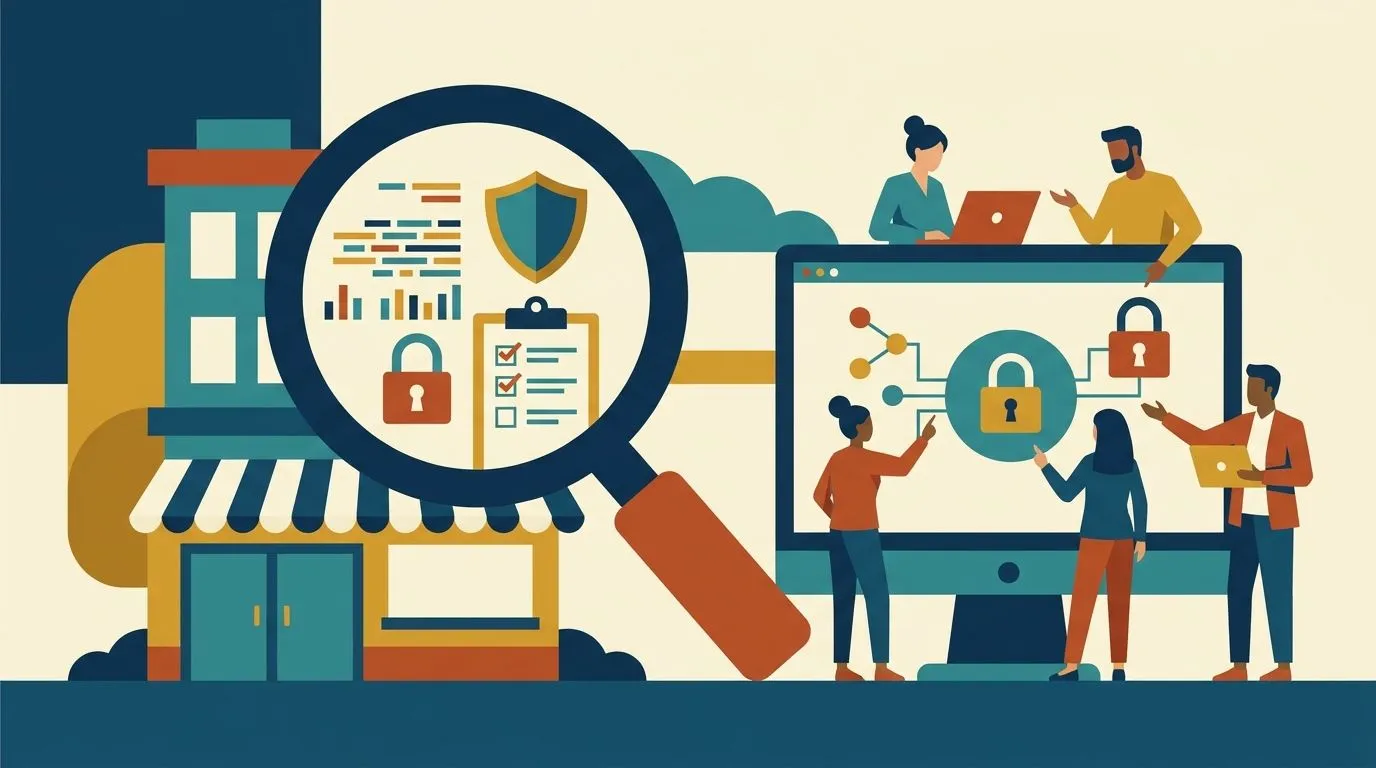
A cyber security audit for a small business is a structured review of your systems, accounts, and processes that finds security gaps before an attacker or a certification assessor does. Done properly it's a repeatable six-step process, not a one-off document you produce once and file away.
Why this matters
Most small businesses only think about a cyber security audit when a customer contract demands Cyber Essentials or a client asks for proof of controls in a security questionnaire. That's backwards.
An audit run on your own schedule finds the unpatched laptop or the ex-employee's live login before a client's due diligence team does. It also gives you a documented baseline, which speeds up every certification you pursue after it — Cyber Essentials, ISO 27001, or SOC 2.
How do you run a cyber security audit for a small business?
Run the audit as a sequence, not a checklist you fill in once:
- Define the scope. Decide which systems, offices, and data types are in scope. A five-person consultancy scopes differently than a 40-person business running its own cyber security maturity assessment across three sites.
- Build an asset inventory. List every device, cloud account, SaaS tool, and third-party vendor with access to company data.
- Review the technical controls. Check firewalls, secure configuration, user access control, malware protection, and patch management — the same five areas Cyber Essentials assesses.
- Test the controls, not just the policy. A policy that says "patches applied within 14 days" means nothing if nobody checks it. This is where you'd scope a penetration test if the business handles sensitive data or customer payment details.
- Interview staff. Ask who has admin access, who owns password resets, and whether anyone still has a login from a role they left months ago.
- Score every gap by risk, not by how easy it is to fix. A missing MFA setting on a finance admin account outranks an outdated screensaver policy.
- Remediate and re-check. Close the highest-risk items first, then re-run the control review on those items only — you don't need to repeat the full audit to confirm a fix.
What does a cyber security audit actually check?
Different audit types check different depths of the same ground. A small business rarely needs all five at once — match the audit to what a contract or buyer is actually asking for.
| Audit type | What it covers | Best for |
|---|---|---|
| Internal self-review | Asset inventory, policy check, basic config review | Businesses building a first baseline — Do first |
| Cyber Essentials | 5 technical controls: firewalls, secure config, access control, malware protection, patch management | Businesses bidding for UK government or supplier contracts — Get certified |
| Cyber Essentials Plus | Same 5 controls, verified by an independent technical assessment | Businesses that need proof controls work, not just a questionnaire — Recommended for contracts |
| ISO 27001 | 93 Annex A controls across organisational, people, physical, and technological themes | Businesses selling to enterprise or regulated buyers — Long-term investment |
| Penetration test | Active exploitation attempts against a defined scope | Businesses that have already passed Cyber Essentials and want proof under attack conditions — Run annually |
Verdict: a small business audit program in 2026 should combine an annual internal review with Cyber Essentials as the baseline certification, and layer in ISO 27001 or a penetration test once a contract or buyer requires the deeper proof.
Why audit scope varies
No two small businesses run the same audit, because the risk surface isn't the same. Scope depends on:
- Headcount and admin sprawl — more staff means more accounts to review and more chances someone still has access they shouldn't.
- Cloud vs on-premise infrastructure — a business running everything through SaaS tools audits identity and access differently than one with a server room.
- Contract requirements — a customer or procurement portal mandating Cyber Essentials sets the minimum audit scope for you.
- Prior incidents — a business that's had a phishing incident or a lost device audits that specific control area more deeply next time round.
- Vendor and supply chain exposure — the more third parties touch your data, the more the audit has to extend past your own systems.
- Regulatory obligations — data protection law, sector rules, or insurer requirements can force controls an audit otherwise wouldn't flag.
Is a cyber security audit the same as Cyber Essentials certification?
No — a cyber security audit is a broader review, while Cyber Essentials is one specific certification built on five technical controls. An internal audit can cover policy, staff behaviour, and vendor risk that Cyber Essentials never touches, and a business can pass Cyber Essentials while still having gaps an audit would catch.
How often should a small business run a cyber security audit?
At least once a year, and immediately after any major change — a new cloud vendor, an office move, or an acquisition. Businesses renewing Cyber Essentials annually often fold the technical control review into that renewal cycle rather than running two separate processes.
Can you run a cyber security audit yourself, or do you need an external auditor?
You can run the internal review yourself using the seven-step process above, but Cyber Essentials Plus and ISO 27001 certification both require sign-off from an accredited external assessor. Businesses without an in-house security lead often bring in outside help for the technical half of the audit — the same due diligence you'd apply comparing managed IT service providers also applies to picking a penetration tester or assessor: check accreditation, scope clarity, and turnaround time before signing anything.
OneClickComply doesn't replace the technical testing step, but it automates the evidence collection and control mapping that eats most of the time in steps 3 and 6 — so the audit doesn't stall waiting for someone to find last quarter's patch logs.
Automate your next compliance audit
See how evidence collection and control mapping run without spreadsheets.
Frequently asked questions
One last thing
The step businesses skip most often isn't the technical control review — it's the vendor risk check. Cyber Essentials Plus assessors and ISO 27001 auditors both dig hardest into third-party access, so if your audit stops at your own systems, it stops short of where the real gaps usually sit.