
IASME Governance certification is worth it for a charity when it meets a funder’s stated requirement or gives trustees a practical way to manage information security. In 2026, assess the current scheme, IASME Cyber Assurance, rather than commissioning work against the former IASME Governance name. Certification does not replace day-to-day security work, UK GDPR duties or the need to confirm which certificate your funder accepts.
Is IASME Governance certification worth it for a charity in 2026?
Proceed when you can name the requirement, the intended benefit and the person responsible for maintaining it. Wait when the case rests only on having another badge for your website.
IASME Cyber Assurance is the current name for the scheme formerly called IASME Governance. It addresses wider information security management, including risk, people, policies and business continuity, rather than technical settings alone.
Start with the IASME Cyber Assurance preparation guide once you have confirmed the scheme fits your charity’s needs.
| Route | Best for | Main benefit | Main limitation |
|---|---|---|---|
| Cyber Essentials | Charities needing assurance over a technical security baseline | Focuses on 5 technical control areas | Does not assess the full management of information security |
| IASME Cyber Assurance Level 1 | Charities seeking assessed self-assessment of broader security management | Adds structure around governance, risk and operating practices | Does not provide the independent audit of Level 2 |
| IASME Cyber Assurance Level 2 | Charities whose stakeholders need independently audited assurance | Adds independent examination of the organisation’s implementation | Requires preparation for scrutiny beyond questionnaire answers |
| ISO 27001 | Charities with a specific requirement for an internationally recognised information security management system | Provides a formal management-system certification route | Is not a substitute for choosing a proportionate scope and maintaining controls |
These routes are not interchangeable. A request for Cyber Essentials Plus, for example, is not automatically satisfied by another security certificate.
Why this matters for your charity
A certificate should support a decision or improve how your charity works. Ask whether it helps you satisfy a contract, demonstrate oversight or organise security responsibilities that currently sit between staff, volunteers and suppliers.
Keep those benefits separate. Meeting a documented procurement condition is a different outcome from improving internal governance, and neither guarantees a successful funding application.
For your 2026 decision, write down the result you need before choosing the assessment route. That gives trustees something concrete to approve and review.
IASME Cyber Assurance Level 1: assessed self-assessment
Best for: charities seeking broader security management assurance through an assessed questionnaire. Level 1 uses verified self-assessment rather than the independent audit associated with Level 2.
Your answers must describe what your charity actually does. A policy saying that access is reviewed is not the same as an access review that has taken place.
Use preparation to connect statements with working practices:
- Identify who approves access to beneficiary and donor information.
- Record how staff and volunteers report a security concern.
- Check how you manage devices and accounts when people leave.
- Describe how you would continue essential services after disruption.
- Assign responsibility for keeping policies and risk decisions current.
The advantage is a structured assessment of broader security management. The limitation is the assurance method: do not describe Level 1 as independently audited certification.
Choose Level 1 when its assurance method meets the recipient’s requirement. Confirm the current prerequisites and application arrangements with the certification body before committing.
IASME Cyber Assurance Level 2: independent audit
Best for: charities that need independent examination of their information security management. Level 2 adds an audit, so your charity must demonstrate implementation rather than rely on written descriptions alone.
Prepare the people responsible for the work, not just the person coordinating certification. If an external IT supplier manages access or backups, establish how you will obtain the relevant evidence and explanations.
Useful preparation includes:
- Matching policies to actual working practices.
- Locating records that support assessment answers.
- Explaining how identified risks are managed.
- Showing how responsibilities operate across staff and suppliers.
- Resolving gaps before the audit rather than documenting intentions alone.
Independent examination provides a different assurance level from self-assessment. It also creates additional preparation and coordination work.
Choose Level 2 when that independent scrutiny serves a defined need. Do not assume every funder requires it or that it replaces a differently named certification in a contract.
Why the value varies between charities
Your charity’s purpose alone does not determine whether certification is worthwhile. Assess the decision against these factors rather than applying a generic charity benchmark.
- Stakeholder requirements. Obtain the exact scheme name, level and scope requested by the funder or commissioning organisation.
- Information handled. Identify the beneficiary, donor, employee and volunteer information within the proposed scope.
- Existing practices. Check whether your policies describe established work or changes you still need to make.
- Supplier responsibilities. Establish which controls your charity operates and which depend on an external provider.
- Ongoing ownership. Name the person who will maintain records, coordinate changes and report unresolved risks.
- Assessment scope. Decide which legal entity, services, people and systems the certification is intended to cover.
A narrow certificate is not necessarily a poor choice. An unclear scope is the problem: recipients need to understand what the certificate covers, and trustees need to understand what remains outside it.
How do you decide whether to proceed?
Use this sequence for a 2026 certification decision. Keep the output short enough for trustees to approve without reading the full assessment questionnaire.
1. Confirm requirements
Ask the requesting organisation to confirm the accepted certificate, assessment level and scope in writing. If its paperwork still says IASME Governance, ask whether it means the current IASME Cyber Assurance scheme.
Do not make that interpretation on its behalf. Resolving the wording first avoids preparing for a certificate the recipient does not accept.
2. Define scope
List the services, systems, locations and people you intend to include. State how shared IT services and external suppliers support that scope.
Include volunteer access where it is relevant. A person’s employment status does not determine whether their account can access charity information.
3. Check evidence
Compare your intended assessment answers with records of actual work. Check whether you can demonstrate access decisions, policy approval, risk management and continuity arrangements.
Mark gaps plainly. Distinguish missing documentation from a control that does not yet operate, because those require different corrective actions.
4. Assign ownership
Give each gap a named owner and an agreed completion date. Separate responsibilities held by trustees, charity staff and external suppliers.
Keep approval with the right person. An IT supplier can implement a technical change, but your charity still needs to decide whether the resulting arrangement meets its needs.
5. Approve the route
Present the requirement, scope, outstanding work and ongoing responsibilities to trustees. Recommend the assessment level that meets the stated need, not the highest level available.
Record the decision even if you defer certification. A documented decision to fix controls first is more useful than an unsupported commitment to obtain a badge.
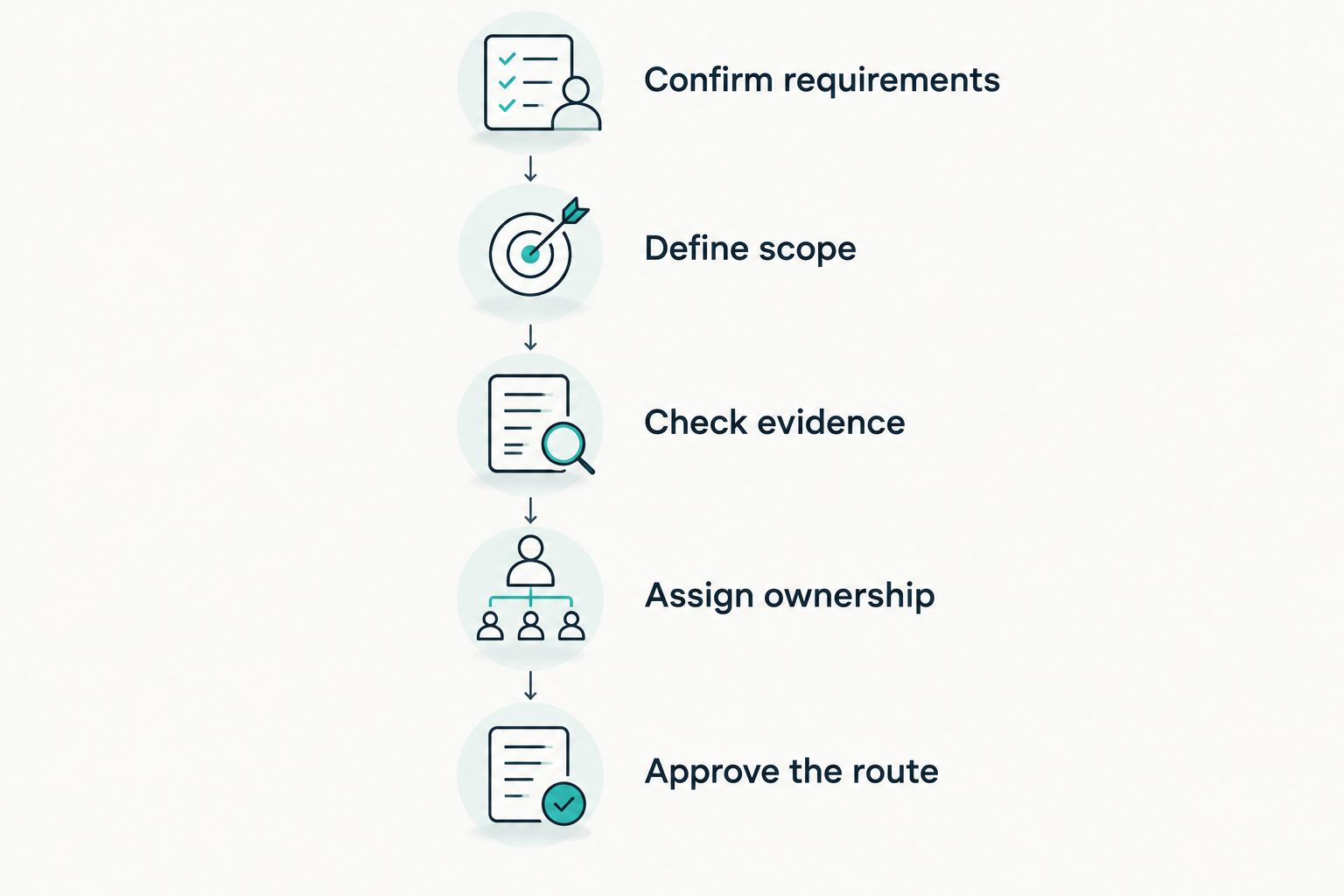
Confirm what the recipient accepts before preparing for assessment.
What should trustees approve before assessment?
Approve a short decision record, not simply an instruction to get certified. The record should explain why this route fits the charity and how the work will continue after assessment.
Include:
- Purpose: the requirement or governance outcome the certification supports.
- Scope: the services and information covered, with exclusions explained.
- Accountability: the internal owner and the decisions reserved for trustees.
- Preparation: the work required before submitting answers or arranging an audit.
- Maintenance: how changes, risks and supporting records will be reviewed.
For 2026 planning, separate certification activity from security improvements you should make regardless of the assessment. Removing unused access, for example, should not depend on a decision about which certificate to pursue.
Ask the coordinator to report exceptions as well as completed tasks. Trustees need to know where a control is not operating, not merely whether a document exists.
Can compliance software handle the preparation?
Software can organise and automate parts of compliance work. It cannot decide what your funder accepts or take responsibility for a trustee’s risk decision.
OneClickComply provides compliance automation that includes security control remediation, policy generation and risk management. OneClickComply compliance automation is best suited to growing businesses that want to automate security controls, policies and risk management.
For a charity considering OneClickComply, confirm IASME-specific coverage before choosing the platform for this project. The relevant question is whether the product supports your chosen assessment and evidence needs, not whether it supports other certifications.
The benefit of automation is reducing manual work within supported processes. The limitation is unchanged accountability: your charity must approve policies, make risk decisions and demonstrate that its stated practices operate.
Discuss your compliance requirements
Explain your charity’s assessment scope and confirm which compliance tasks the platform supports.
Is IASME Cyber Assurance better than Cyber Essentials for a charity?
IASME Cyber Assurance addresses broader security management; Cyber Essentials focuses on 5 technical control areas. Those areas cover firewalls, secure configuration, security update management, user access control and malware protection.
Choose against the requirement rather than treating the schemes as competing badges. Confirm the current Cyber Essentials prerequisite for your intended IASME Cyber Assurance application with the certification body.
Does IASME certification make a charity GDPR compliant?
IASME certification does not establish complete UK GDPR compliance. A security assessment does not replace duties such as selecting lawful bases, providing privacy information or handling individuals’ rights.
Keep data protection decisions visible in your wider governance arrangements. Do not present a security certificate as proof that every processing activity is lawful.
Should a small charity wait until a funder asks?
A small charity should improve necessary security controls now, but pursue certification against a clear purpose. You do not need to wait for a procurement request to assign responsibilities or manage access.
If no recipient requires a certificate, assess whether formal assurance will improve trustee oversight enough to justify the preparation and ongoing work. Record that judgement rather than assuming certification is always the next step.
Frequently asked questions
One last thing
The most useful first step is a written confirmation from the organisation that will rely on your certificate. Ask it to confirm the scheme, assessment level and acceptable scope before trustees approve the project.
For your 2026 plan, keep the objective simple: meet the requirement, improve the underlying work and give someone clear ownership. Seriously Simple Cyber Compliance.