
Yes—penetration testing is worth it for a small SaaS company when you need to check customer-data protection, validate a major release or meet a buyer’s security requirement. The work does not end with the report: you need engineering time to fix findings and confirm the fixes work. For your 2026 security plan, buy a test against a clear business risk—not a generic promise to make your product secure.
Is penetration testing worth it for a small SaaS company?
Commission a penetration test when its findings will change what you ship, fix or tell a customer. A small team benefits from a focused assessment of its most important security boundaries. Headcount alone is not a useful reason to test—or to postpone testing.
Use the decision table below before requesting proposals. Then document the boundaries using the guide to scoping a penetration test before you buy one.
| Your situation | Best next move | Benefit | Limitation |
|---|---|---|---|
| You are launching customer-facing access to sensitive data | Test the relevant application and API workflows | Checks whether important access restrictions hold | Only covers the agreed workflows and environment |
| A buyer requires independent testing evidence | Confirm the requirement, then commission a matching test | Produces evidence tied to the buyer’s request | Acceptance depends on that buyer’s criteria |
| You have known serious defects awaiting fixes | Fix the known defects, then test the corrected build | Uses testing time to investigate remaining weaknesses | Delays independent assessment of other areas |
| You are changing account roles or tenant separation | Focus testing on the changed security boundaries | Examines the effect of the change | Does not assess unrelated features automatically |
| You have no defined question or remediation owner | Write the scope and assign ownership first | Makes the assessment actionable | Preparation does not replace testing |
Why this matters
Your SaaS product makes promises through its design. Customers expect their records to stay separate, account roles to limit access and sensitive actions to require permission.
A penetration test investigates whether those promises hold under deliberate challenge. It adds a different perspective from a review of whether a feature works as intended.
For your 2026 planning, separate the security outcome from the procurement outcome. Finding and fixing an access-control weakness improves the product; supplying a report answers a customer request. Neither outcome automatically proves the other.
When testing delivers the clearest value
Before exposing important customer workflows
Best for: a product approaching launch or a significant expansion. Test the workflows that create, read, export, change or delete customer information. Include the access paths behind the interface, not just the visible pages.
A useful objective is specific: confirm that an ordinary user cannot retrieve another customer’s records through the API. That objective tells the tester what matters and tells your engineers what a finding would mean.
The limitation is timing. If the tested build changes substantially before release, review whether the results still describe what you are shipping. Keep the tested version and excluded features in the report.
When customer procurement requires evidence
Best for: a SaaS company responding to a documented buyer requirement. Ask the buyer what evidence they accept before commissioning work. Clarify scope, report age, tester qualifications and expectations for unresolved findings.
Do not assume a short confirmation letter and a detailed technical report are interchangeable. Agree what you can share, with whom and under what confidentiality arrangements.
For a 2026 procurement review, record the buyer’s actual wording alongside the test scope. This prevents your sales team from promising coverage the assessment never provided.
After changes to trust boundaries
Best for: a SaaS company changing how users or systems gain access. Prioritise changes to sign-in, permissions, tenant separation, integrations and administrative functions.
The benefit is focus. You direct testing towards the places where the product’s security assumptions have changed, rather than treating every release as identical.
The limitation is coverage. A focused assessment of a new integration does not establish that the rest of your application has no weaknesses. Describe the result as a test of that integration, not the entire platform.
What should a small SaaS company test?
Start with the actions that would matter most if someone performed them without permission. Build the scope around those actions and the systems that enforce their restrictions.
For a multi-tenant application, ask the tester to investigate separation between customer accounts. For an API-led product, make authenticated API behaviour a named part of the scope.
| Assessment option | Best for | What it contributes | What it does not replace |
|---|---|---|---|
| Manual application and API penetration testing | Checking permissions and business workflows | Human investigation of application-specific behaviour | Routine checks across every release |
| Automated vulnerability scanning | Repeated checks for detectable known weaknesses | Repeatable checks across configured targets | Human investigation of complex business logic |
| Cloud configuration review | Examining infrastructure settings and access | Review of the configured environment | Testing application-level tenant separation |
| Compliance automation | Managing policies, controls and risk records | Organisation of ongoing compliance work | Independent attempts to exploit application weaknesses |
These approaches answer different questions. Choose by the uncertainty you need to resolve, not by which option produces the longest report.
Before accepting a proposal, check whether authenticated testing is included. An assessment that only reaches your sign-in page cannot establish how permissions behave inside customer accounts.
Why penetration-testing value varies
The value depends on how well the assessment matches your product and what happens afterwards. Use these factors to compare proposals for your 2026 programme:
- Business objective: Name the launch decision, customer requirement or technical uncertainty the test must support.
- Scope: List the applications, APIs, environments and workflows included. Record exclusions just as clearly.
- Access: Provide agreed test accounts and relevant roles so the tester can examine authenticated behaviour.
- Environment: Explain differences between the test environment and production. Do not treat untested differences as covered.
- Remediation ownership: Assign someone who can turn findings into engineering work and make risk decisions.
- Retesting: Agree how the tester will check fixes and report anything that remains unresolved.
A wider scope is not automatically a better purchase. Ask the provider how the proposed effort addresses your highest-priority workflows and what will receive limited attention.
How do you turn a test into a useful outcome?
Follow a sequence that connects the business question to verified fixes. Keep the scope, report and engineering records together so you can explain what changed.
- Set the objective. Write the decision the test must support. Avoid an objective as broad as proving the company is secure.
- Agree the scope. Name the targets, account roles, exclusions, permitted techniques and contact arrangements. Obtain the required authorisation before testing starts.
- Prepare access. Supply working test accounts, relevant documentation and safe test data. Confirm how the tester should report an urgent finding.
- Review findings. Ask for reproduction steps, affected components, business impact and recommended corrective action. Resolve unclear findings before assigning work.
- Fix and retest. Assign owners, implement changes and confirm whether the reported weaknesses remain. Keep unresolved risks visible.
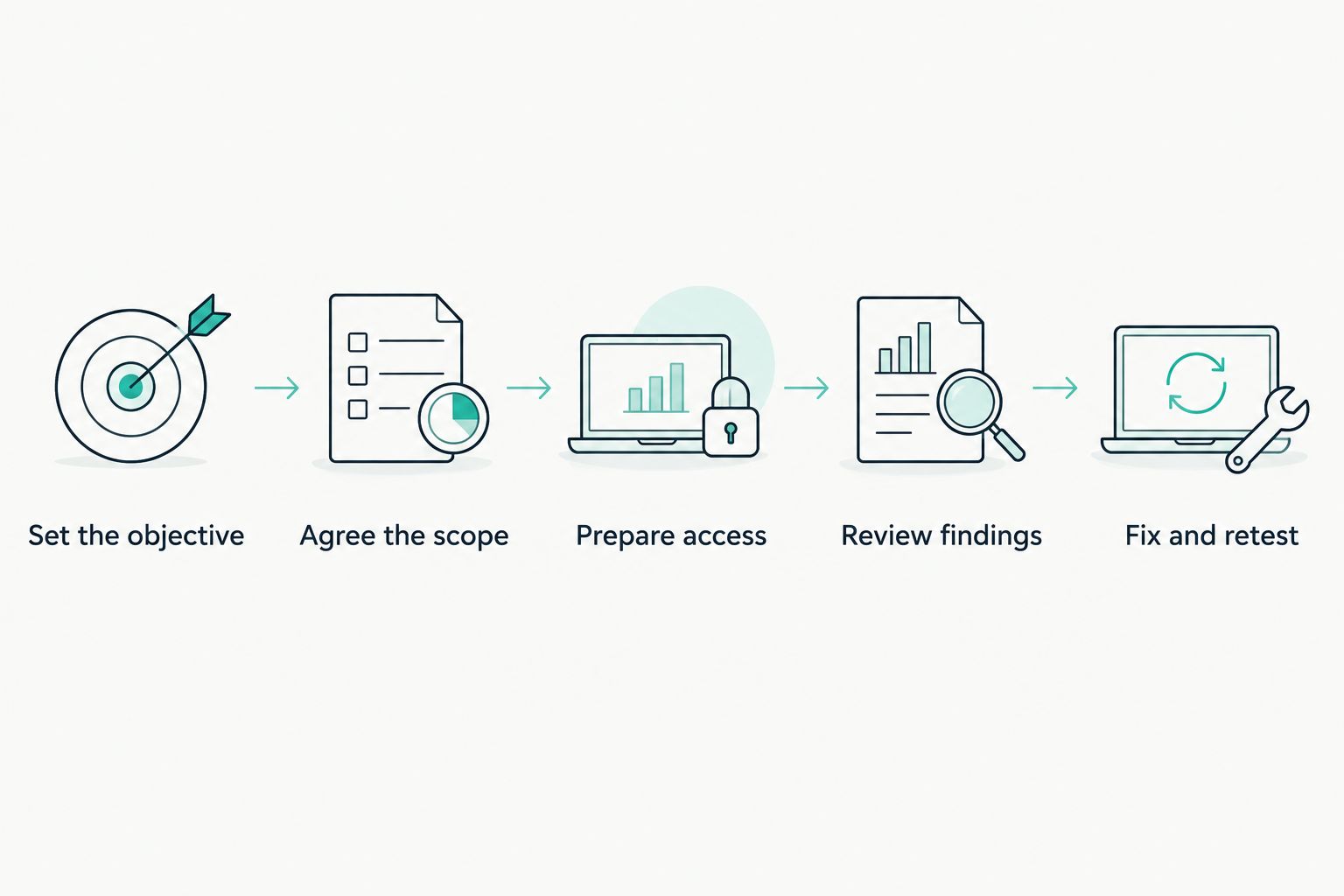
Agree what the test must answer before testing begins, then verify the fixes.
Do not close an issue solely because a code change has been merged. Record the evidence that the fix addresses the reported behaviour, including any independent retest agreed with the provider.
For each finding, keep a clear status: unresolved, fixed, awaiting verification or accepted through your risk process. A report and a ticket marked complete tell different stories unless the supporting evidence connects them.
Is a vulnerability scan enough for a small SaaS company?
A vulnerability scan is not enough when your question concerns customer permissions or application-specific business logic. Scanning is useful for repeatable checks, but it is not interchangeable with a scoped investigation by a tester.
Use scanning to support routine security work. Commission manual testing when you need someone to examine whether legitimate features can be combined or misused to cross a security boundary.
Does a penetration test prove your SaaS company is compliant?
A penetration test does not prove compliance on its own. It supplies technical evidence about the agreed scope; a compliance programme also needs the policies, responsibilities and operating practices relevant to its requirements.
Do not promise ISO 27001 certification or a SOC 2 report simply because testing is complete. Confirm the applicable requirements and how the test evidence supports them.
Should you wait until enterprise customers ask?
Do not make customer demand your only trigger for penetration testing. Your product’s data, access model and planned changes are also reasons to assess security boundaries.
If a customer request is the immediate trigger, use it to define the required evidence. Keep your own risk priorities in scope rather than treating the assessment only as a sales document.
Where compliance automation fits
OneClickComply is best for growing SaaS businesses that need to automate compliance controls, policies and risk management. Its platform supports work towards certifications and assurance frameworks including ISO 27001, Cyber Essentials and SOC 2.
OneClickComply handles control auto-remediation, policy generation, risk management and trust centres. That addresses compliance work around security testing; it does not make a penetration-test report proof that every control works.
For your 2026 programme, keep the responsibilities distinct. Testers investigate the agreed targets, engineers correct product weaknesses, and your business owns decisions about unresolved risk.
Automate your compliance work
Explore control auto-remediation, policy generation, risk management and trust centres.
Frequently asked questions
One last thing
Ask what was not tested before asking how many findings were reported. A report without findings is hard to interpret unless you understand the access, exclusions and depth of the assessment.
Before approving a test, name the engineer responsible for reviewing its results. Keep the next step concrete: fix the weakness, verify the change and retain the evidence.
Keep technical testing and compliance work connected without confusing their roles. OneClickComply supports the compliance work. Seriously Simple Cyber Compliance.