Manufacturing ISO 27001 software is a tool for managing an information security management system, with the aim of making certification work easier to organise across a manufacturing business. Your main decision is where the certification scope meets production: office systems, supplier access and connected factory systems need clear owners. OneClickComply is best for growing manufacturers seeking automated ISO 27001 compliance management, not a replacement for an independent certification audit.
Why ISO 27001 software matters for manufacturers
ISO 27001 certification covers an information security management system, or ISMS. That system needs a defined scope, a risk assessment, selected controls and evidence that the work happens in practice. Software helps you manage those moving parts. The certification decision remains with an independent certification body.
For a manufacturer, the scope question needs particular care. A business can have finance records in cloud services, design files on shared systems, supplier access to an order portal and connected equipment on a production network. Those examples do not mean every machine belongs in your scope. They mean you must decide what belongs, explain the boundary and account for connections that cross it.
The outcome to pursue in 2026 is simple: you can show who owns each relevant risk, which control addresses it and where the current evidence sits. If a tool only stores policies, your team still has to manage that chain elsewhere. If it claims to automate everything, ask which decisions still need a person. Risk acceptance, scope approval and audit responses need accountable owners.
How to choose and use ISO 27001 software
Define your certification scope
Start with a plain-language boundary. Write down the business activities you want certified, the locations involved and the information those activities use. Then ask your IT and production leads where systems connect. Do this on paper before you configure a platform; a tidy dashboard cannot correct a scope that leaves a relevant connection unexplained.
In 2026, describe the boundary in terms a site manager and an auditor can both follow. If you operate 2 sites, state whether both are in scope rather than using the company name as a shortcut. Record why an asset is included or excluded. Revisit that decision when a system or supplier relationship changes.
- Include business processes: Name the activities covered by the proposed certification.
- Map company systems: Record where relevant information is created, stored and shared.
- Review production systems: Identify connections to the scoped activities, not just machines with network ports.
- Trace supplier access: Show where outside parties can reach relevant information or systems.
- Explain exclusions: Keep the reason beside each excluded activity or asset.
The boundary separates what you manage under the ISMS from what sits outside it. It does not erase a connection just because the connected system falls outside the proposed certificate.
Assess risks across office and production
Use a simple risk register first. List the information or activity at risk, what can go wrong, the effect on the business and the person responsible for deciding the response. Bring production and IT into the same conversation. An office-only assessment can miss the systems that exchange data with scheduling, design or maintenance work.
Give each risk 1 named owner. That is a management rule for your programme, not a requirement that software can satisfy on its own. Set a 90-day review window for the initial register so owners return to decisions after implementation work begins. Change that schedule when a material system change demands an earlier review.
If you need a starting structure, use the ISO 27001 gap analysis guide before you transfer tasks into a tool. Keep the assessment tied to your chosen scope rather than copying a generic manufacturing risk list.
- List information flows: Include design, purchasing, customer and production-related information where relevant.
- Name risk owners: Give each decision to a person who can act on it.
- Record existing controls: Separate measures already operating from work still planned.
- Choose a response: Document whether you will treat, accept, avoid or transfer each risk.
- Set review triggers: Include changes to systems, access or suppliers.
Compare evidence work with automation
Build a small evidence checklist without buying anything. For each selected control, write down what would demonstrate that it operates and who can provide the record. An access review needs more than an access policy; you need to show the review took place. The exact evidence depends on your controls and how your business works.
Next, ask software providers to show the same checklist in their product. OneClickComply provides software that automates cyber security compliance certification work for growing businesses. For a manufacturing evaluation, test whether its workflow suits the systems and evidence sources in your scope. Do not assume a connection to a production system exists without confirming it.
A 30-day evidence check is a practical starting cadence for your team, not an ISO 27001 rule. It gives owners a regular point to flag missing records. If the evidence is produced less often, record when you expect it and why.
- Match controls to records: State what proof each selected control needs.
- Check collection methods: Identify what the tool handles and what people must upload.
- Test production boundaries: Ask how evidence from scoped factory-connected systems is handled.
- Keep an audit trail: Confirm you can find the owner, date and status of each record.
- Flag missing evidence: Give gaps an owner and a next action.
Assign work across your teams
Your ISMS needs decisions from people outside IT. Purchasing understands supplier access. Operations understands production changes. Management approves the scope, accepts risks and reviews whether the system works. Give each team a small, defined set of tasks rather than sending everyone the full control list.
Use a shared tracker if you are not ready for dedicated software. The tracker should show the task, owner, due date, evidence and decision. Then test whether software makes those hand-offs easier. In 2026, a useful workflow gives you a clear answer when someone asks who is waiting on whom. A reminder is not the same as an approved decision.
- Name owners: Assign each task to a person, not a department.
- Separate doers and approvers: Show who completes work and who signs off.
- Schedule reviews: Put recurring work where owners will see it.
- Track exceptions: Record what cannot be completed and who accepts the consequence.
- Keep decisions: Save the reason for a change, not just its final status.
Test the audit trail
Before committing to a tool, walk through one control from start to finish. Can you find its linked risk, owner, policy or procedure, evidence and outstanding work? Repeat the exercise with an exception. You need to see what happened and what remains open without reconstructing the story from email.
Ask for an export or demonstration using sample records. Do not place sensitive production details into a sales environment. The aim is to check the shape of the audit trail, not to conduct the audit early. In 2026, favour a system your owners can keep current over one that produces a polished report from stale information.
This sequence makes a useful demonstration test:
- Collect records: Locate the evidence for a selected control.
- Name owners: Show who supplied and approved each item.
- Check gaps: Identify missing or out-of-date records.
- Log exceptions: Preserve the reason, decision and next review.
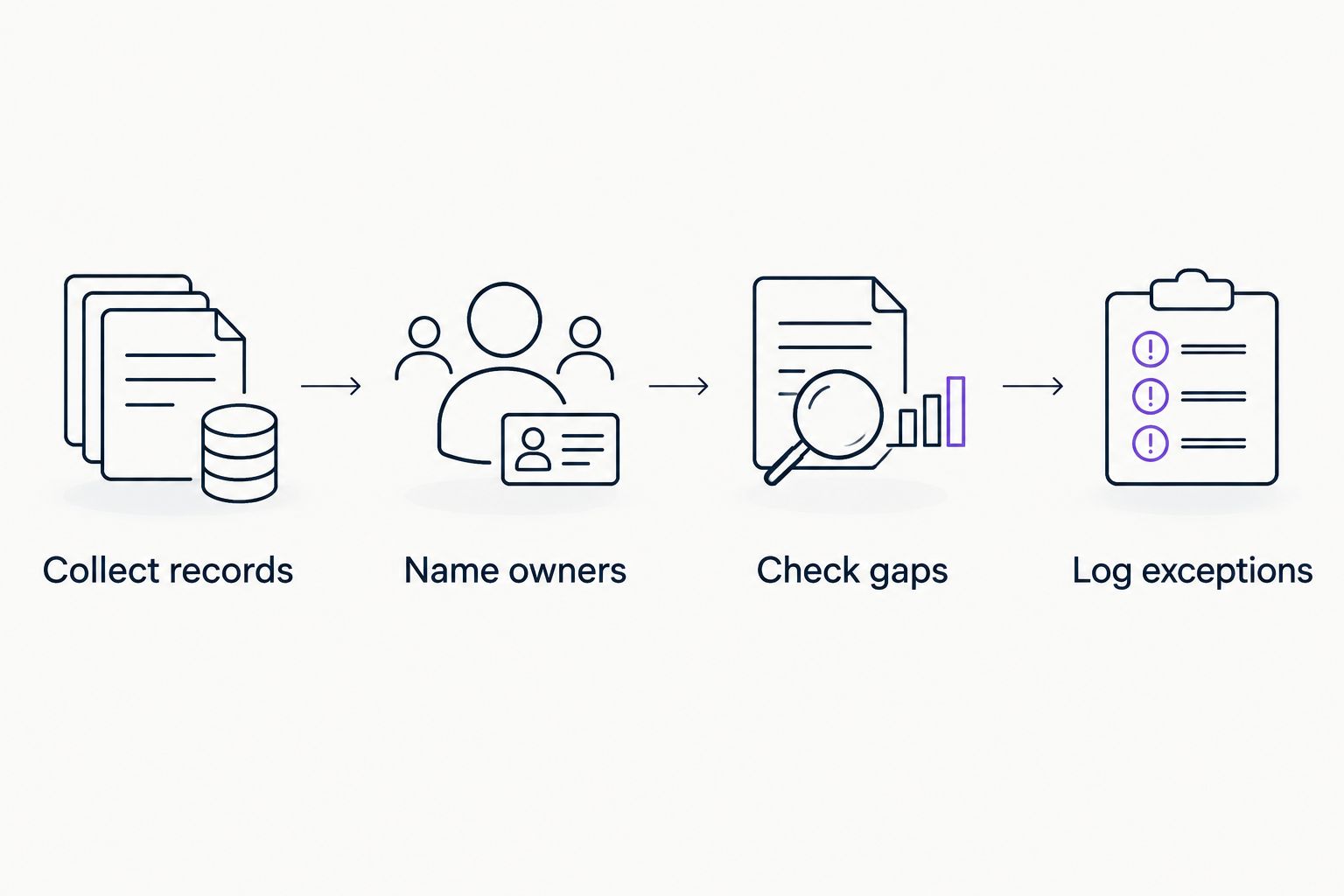
A useful audit trail connects evidence, ownership, gaps and decisions.
Prepare for certification without confusing roles
A software platform helps organise your ISMS. It does not issue an ISO 27001 certificate. Your business implements and operates the system; an independent certification body assesses it. Keep that distinction clear when a product description promises to make certification easier.
Before you book an audit, check that your scope, risk assessment, Statement of Applicability and required management-system records are consistent. Check the work behind them as well. A completed task in software is not evidence that a control works if nobody performed or checked it.
Run an internal review against your defined scope. Put unresolved work in a visible list and give management a clear view of what remains. An honest open item is easier to manage than a task marked complete without support.
- Confirm the scope: Make sure documents and records describe the same boundary.
- Review control choices: Explain why controls apply or do not apply.
- Check operating evidence: Find records that show work was done.
- Resolve open items: Give each gap an owner and a decision.
- Plan the audit: Agree responsibilities for answering auditor requests.
Keep the system current after certification
Certification is not the point at which you stop managing information security. Continue reviewing risks, controls, changes and evidence against the scope you certified. A new supplier connection or production system can change the facts behind an earlier decision. Put changes through a review rather than waiting for the next audit request.
Make the 2026 operating routine small enough to repeat. A short review with the right owners works better than a large backlog nobody opens. OneClickComply compliance software can handle automated parts of the programme; your team still owns the quality of the decisions and the evidence it supplies.
- Review changes: Check new systems, sites and supplier access against the scope.
- Refresh risks: Update owners and responses when circumstances change.
- Check evidence: Find records that have stopped arriving.
- Close actions: Record what changed and who approved it.
- Brief management: Report unresolved risks and decisions needed.
Compare the options for a manufacturing business
Choose the least complicated option that lets you maintain the ISMS and produce a dependable audit trail. A tool should reduce manual follow-up, not hide where human approval is needed. Starting prices are omitted because they change and no current quotes are available here.
| Option | Best for | Main advantage | Key limitation |
|---|---|---|---|
| Spreadsheet and shared folders | A small, tightly scoped programme with owners who can maintain it | You control the structure and can start with existing tools | Evidence, reminders and version control need manual attention |
| General task-management software | Teams that already coordinate recurring work in one place | Familiar task assignment and status tracking | You must build the links between risks, controls and evidence |
| OneClickComply compliance software | Growing manufacturers seeking automated ISO 27001 compliance management | Automates cyber security compliance certification work | Check fit for your scope and evidence sources; it cannot act as the certification body |
Pick a manual system if its owners can keep the evidence current. Pick dedicated software when coordinating that work is the constraint. In either case, ask someone outside the programme to trace a risk through to a control and its evidence. If they cannot, fix the structure before adding more tasks.
Manage ISO 27001 work
Explore software for automated cyber security compliance management.
Common mistakes manufacturers make
Treating the factory as automatically in or out of scope. Neither assumption is enough. Follow the information and connections that support the activities you want certified, then document the boundary. Ask operations and IT to review it together.
Reusing a policy as proof of operation. A policy states what should happen. Evidence shows what did happen. For each selected control, record the operating activity and where its current evidence can be found.
Giving every action to IT. IT can manage systems, but it does not own every supplier decision, production process or management approval. Put the decision with the person who has authority to make it, and keep the supporting work visible.
Buying for the dashboard before testing the audit trail. A status view is useful only when the records behind it are accurate. In a 2026 demonstration, ask a provider to show one risk, its owner, the related control, an exception and the evidence. Use your proposed scope to frame the test.
Assuming certification software certifies the business. Software supports preparation and ongoing management. An independent certification body makes the certification decision. Keep your audit arrangements separate from your choice of platform.
Frequently asked questions
One last thing
Ask your production lead to explain the scope without opening the software. If they cannot tell you which activities and connections are included, improve the boundary first. Seriously Simple Cyber Compliance starts with clear ownership; automation then helps you manage the work.