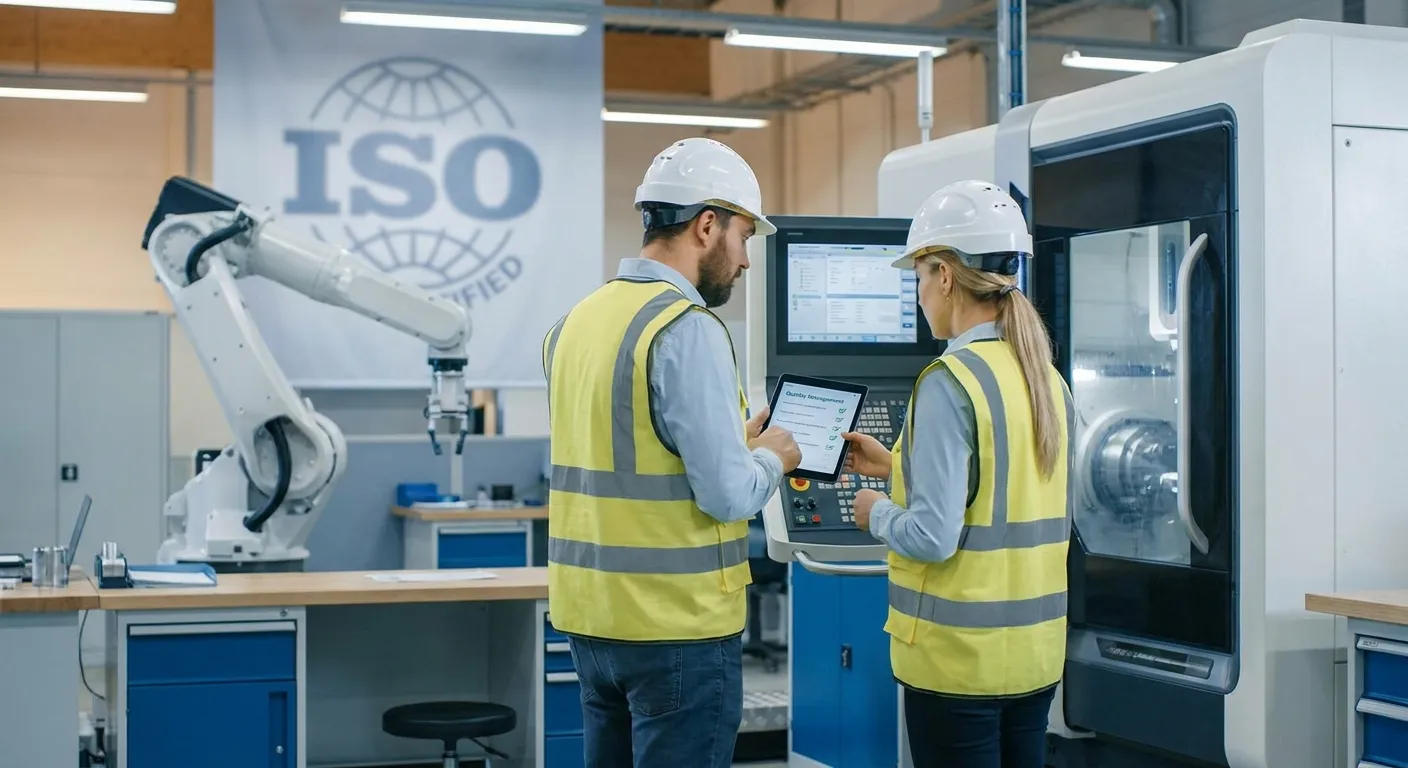
ISO 9001 for manufacturing companies proves your quality management system holds up under an external audit — and in 2026, more customers bundle that request with a Cyber Essentials or ISO 27001 certificate before they'll sign a purchase order.
Why this matters
Customers buying from manufacturers and engineering firms in 2026 don't stop at ISO 9001. Automotive buyers ask for IATF 16949. Aerospace buyers ask for AS9100. Government, defence, and NHS buyers ask for Cyber Essentials or Cyber Essentials Plus on top of the quality certificate, and they ask for it in the same tender document, not a follow-up email.
A manufacturing firm that treats ISO 9001 as a standalone box-tick loses contracts to a competitor that shows up with ISO 9001 and a cyber security certificate already in hand. Firms that get ahead of this pair a quality management system with a cyber compliance platform like OneClickComply from the start, so evidence for both audits lives in one place instead of two separate spreadsheets managed by two separate teams.
Who this is for
This guide is for manufacturing and engineering firms — machine shops, contract manufacturers, fabricators, and component suppliers — preparing for first-time ISO 9001 certification or renewing an existing one in 2026. It's also for firms supplying automotive, aerospace, defence, or public sector buyers who now ask for a cyber security certificate alongside the quality management system, not instead of it. If your last three tender documents mentioned information security or Cyber Essentials, this is your read.
What to look for in ISO 9001 for manufacturing and engineering firms
Process documentation that matches the shop floor
Auditors reject documentation copied from a template when it doesn't reflect what actually happens on the line. Your quality manual needs to describe your real inspection points, your real non-conformance process, and your real supplier approval steps — not a generic version borrowed from a consultant's pack three years ago.
Traceability records an auditor can pull in minutes
ISO 9001 auditors sample batches and ask you to trace a part from raw material to shipped product. If that trace takes an afternoon of searching spreadsheets instead of minutes, you've already flagged a weak record-keeping system before the auditor writes a single finding on the report.
Multi-site certification support
Firms running more than one facility need a system that certifies consistently across sites, not a patchwork of local practices that each pass on their own terms. A single QMS structure that scales across two or three sites in 2026 saves a second full audit cycle eighteen months later.
Alignment with sector-specific standards
IATF 16949 for automotive and AS9100 for aerospace build on ISO 9001's core clauses rather than replace them. Picking a QMS structure that maps cleanly onto whichever sector standard your biggest customer requires now saves a rebuild when that customer's next audit cycle lands.
Cyber security overlap for connected equipment and supply chain contracts
Manufacturing floors run more networked equipment in 2026 than they did five years ago — PLCs, connected sensors, remote-monitored CNC machines. A quality system audit increasingly sits next to a cyber security audit covering that same connected estate, and buyers ask for both in the same tender pack.
Renewal and surveillance audit cadence
ISO 9001 certification runs on a three-year cycle with annual surveillance audits in between. Firms that build evidence collection into daily operations pass the surveillance audit in a day; firms that scramble every twelve months spend a week reassembling records instead of running the shop.
Top picks: compliance moves that pair with ISO 9001
ISO 9001 rarely travels alone in 2026. Here's what manufacturing and engineering firms pair with it, and what each move is actually worth.
The safe pick — Cyber Essentials for supply chain contracts Cyber Essentials is the certificate most UK public sector and construction-linked supply chains ask for before ISO 9001 even comes up. The scheme covers five technical controls, completes within one to two weeks of submitting the self-assessment, and renews every 12 months. The approach covered in Cyber Essentials for engineering and construction contractors transfers directly to manufacturing firms chasing the same public sector work. Buy if a single tender document asks for both ISO 9001 and Cyber Essentials — that combination shows up constantly in 2026 procurement packs.
The heavyweight — ISO 27001 for firms handling customer IP and CAD data Contract manufacturers and engineering firms holding customer CAD files, proprietary tooling designs, or defence-adjacent specifications increasingly get asked for ISO 27001 instead of Cyber Essentials. The 2022 revision runs to 93 Annex A controls and certifies on a three-year cycle with annual surveillance audits — the same rhythm as ISO 9001, which is exactly why buyers ask for both together. OneClickComply automates the evidence collection behind that certificate the same way it does for the process in ISO 27001 for SaaS startups, even though the buyer profile there is different. Consider this pick if your top three customers by revenue require it in writing; Skip it for now if none of your current contracts mention information security certification.
The procurement unlock — security questionnaire automation Before either certificate lands, most enterprise and public sector buyers send a security questionnaire running 80 to 150 questions before they'll issue a purchase order. Answering that by hand every time a new customer's procurement team asks costs days per response. Security questionnaire automation for procurement teams turns a multi-day exercise into a same-day turnaround by reusing answered evidence across submissions. Buy if you're fielding more than two or three of these a quarter.
What to avoid
Generic ISO 9001 template packs bought off a marketplace and never adapted to your process. Auditors spot copy-paste language in the first ten minutes of a stage 1 audit, and a mismatch between the manual and the shop floor is one of the most common non-conformances raised in 2026 assessments.
Treating the quality manual as a once-a-year paperwork exercise. Surveillance audits increasingly sample live records instead of the manual itself, so evidence needs to exist the day the auditor asks for it, not the week before the visit.
Scoping connected shop floor equipment out of your cyber security certificate. PLCs, remote-monitored CNC lines, and networked sensors sit inside the same risk boundary a Cyber Essentials or ISO 27001 assessor will ask about. Manufacturers running connected equipment across multiple sites face the same evaluation questions industrial buyers weigh up when picking IoT platforms for industrial manufacturers — device visibility, patching cadence, and network segmentation all come up in both conversations, and leaving connected kit out of scope is a gap an assessor will find.
Verdict comparison table
| Compliance move | Typical timeline | Renewal cycle | Best for | Verdict |
|---|---|---|---|---|
| ISO 9001 | 6-12 months first-time | 3 years, annual surveillance | Any manufacturer selling on quality reputation | Buy |
| Cyber Essentials | 1-2 weeks after submission | 12 months | Public sector, MOD, construction supply chains | Buy |
| ISO 27001 | 3-6 months implementation | 3 years, annual surveillance | Firms holding customer IP or CAD data | Consider |
| Security questionnaire automation | Days to set up | Ongoing | Firms fielding 3+ questionnaires a quarter | Buy |
Frequently asked questions
One last thing
Most manufacturing firms run ISO 9001 and cyber security certification as two separate projects on two separate calendars in 2026. The firms that combine evidence collection for both cut total audit prep time close to half, because a shipped-parts traceability record and a security incident log are both just evidence trails sitting in different folders. OneClickComply automates the cyber security side of that trail — ISO 27001, Cyber Essentials, SOC 2 — so the quality team isn't also running the security audit by hand. Seriously simple cyber compliance, running next to whatever quality system already keeps the shop floor honest.