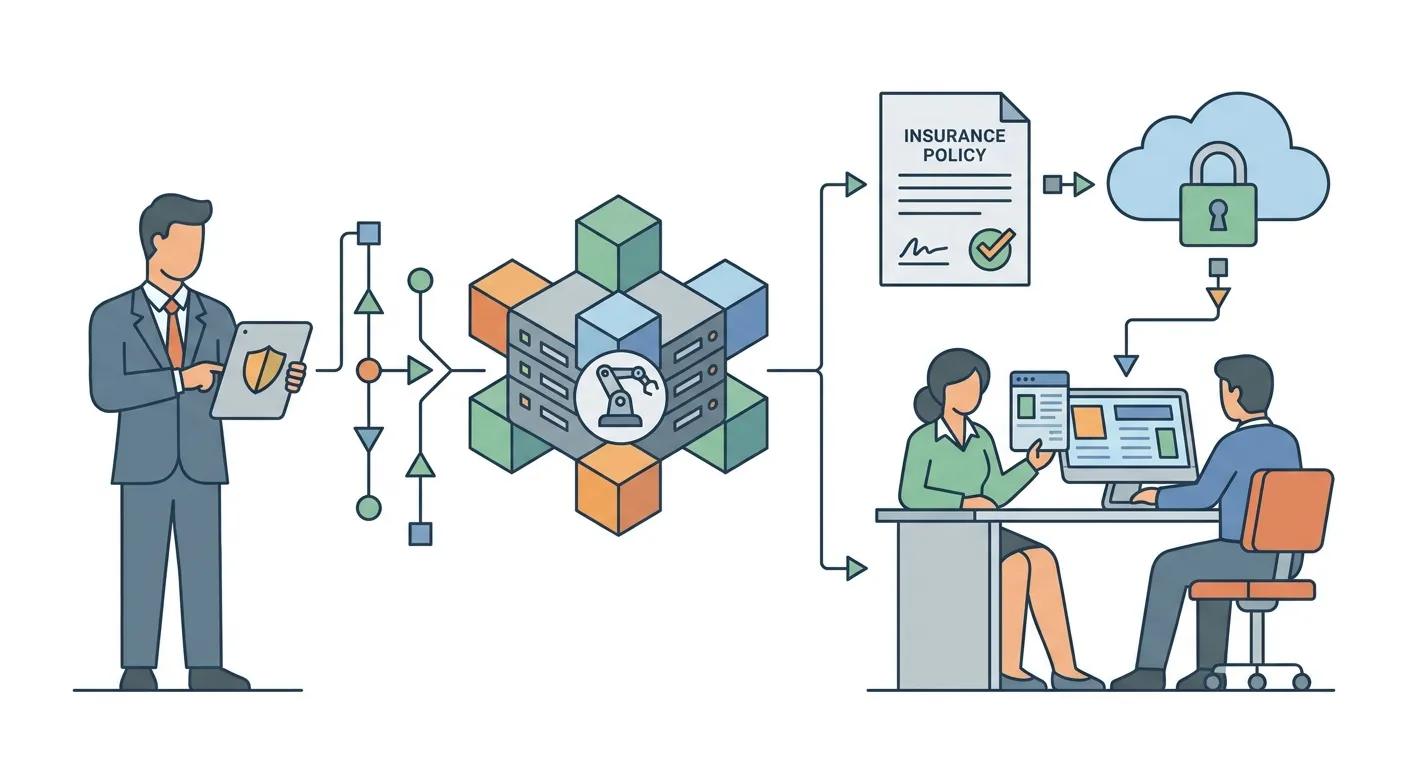
Insurance underwriters writing cyber cover in 2026 still open most submissions to a security questionnaire — and most of those get answered by hand, once a year, under deadline pressure. Security questionnaire automation for insurance underwriters closes that gap: it turns a 40-to-150-question form into a repeatable, evidence-backed submission instead of a fresh essay every renewal.
Why this matters
A cyber insurance underwriter reviewing 50+ submissions a month can't manually verify every self-attested answer. That's exactly where questionnaires stop being useful signal and start being paperwork.
Vendor risk management software for insurance brokers exists because both sides of this exchange — the broker packaging the submission and the underwriter pricing it — need the same evidence, formatted the same way, every time. OneClickComply automates the compliance evidence side of that answer: certificates, control mappings, and audit history that back up what the questionnaire claims instead of restating it in prose.
The underwriting cycle runs on trust plus verification. In 2026, more carriers are asking for the verification part explicitly, not assuming it.
Who this is for
This is written for underwriting teams at MGAs and carriers pricing cyber policies, brokers assembling submissions across multiple clients, and the in-house risk or IT lead who ends up answering the questionnaire every renewal cycle. If your team handles more than one carrier relationship a year, manual answering stops scaling somewhere around the third submission.
What to look for in security questionnaire automation for insurance underwriters
Standardised scoring against a named framework
A good tool maps answers to NIST CSF or ISO 27001 Annex A controls, not a proprietary rubric nobody outside the vendor recognises. Underwriters comparing submissions across applicants need a common reference point, or every score is subjective.
Evidence verification, not self-attestation
An answer of "yes, we have MFA enforced" means nothing without a linked configuration export or certificate date. Tools that attach evidence turn a claim into a fact an underwriter can actually price against.
Turnaround time on renewal
Cyber Essentials Plus certificates need renewing every 12 months. If the automation doesn't track that clock and flag lapses before a submission goes out, the underwriter finds the gap instead — usually after the quote's already been priced.
Audit trail and version history
Questionnaire answers change year over year as controls mature or slip. A platform with no version history makes it impossible to tell whether a "no" from 2024 became a "yes" in 2026 because of a real fix or a copy-paste error.
Fit with existing submission workflow
Brokers packaging multiple client submissions a quarter need output that drops into whatever format the carrier's portal expects — PDF, SIG Lite, or a CAIQ-style form. A tool that only exports its own proprietary template adds a manual reformatting step right back in.
Top picks for insurance underwriting teams
The applicant-evidence pick — the one that shortens the underwriter's job before the submission even lands. Instead of a written explanation, each answer links to a certificate reference, so a claim about access control ties straight back to a live Cyber Essentials Plus or ISO 27001 record. Because CE+ runs on a 12-month renewal clock, automation that tracks expiry catches lapses before they become a declined claim later. How to respond to security questionnaires faster covers the mechanics. Buy for any team answering more than one carrier's questionnaire a year.
The broker packaging pick — built for the submission, not the sale pitch. Standard forms like the Cloud Security Alliance's CAIQ run past 261 questions; automation that maps answers to existing Cyber Essentials Plus and ISO 27001 evidence turns that into a reuse exercise instead of a rewrite. Cyber Essentials Plus for insurance brokers breaks down what carriers actually check for in this segment. Buy for brokers packaging submissions for more than one client a quarter.
The general sales-tool pick — built for sales cycles, not underwriting cycles. These handle SIG Lite-style forms of 150-plus questions quickly, but most don't map answers to a specific framework version, which underwriters increasingly ask for by name. Security questionnaire automation tools built for sales teams is worth reading before you buy one for underwriting use. Consider only if underwriting isn't the primary use case.
The spreadsheet-and-email pick — still running most renewal cycles in 2026, and it's the slowest option on this list by a wide margin. Every answer gets typed from memory, nothing links to a certificate, and version history lives in whoever's inbox has the last copy. Skip for any team handling more than a handful of submissions a year.
Get underwriting-ready evidence
Automate the Cyber Essentials and ISO 27001 evidence underwriters ask for.
What to avoid
- Stale knowledge-base auto-fill. A tool that pulls last year's answers without checking whether the underlying control still holds will hand an underwriter a submission that contradicts the certificate attached to it.
- Treating self-attestation as verification. An unverified "yes" is an opinion, not evidence — and pricing a policy on it shifts risk the underwriter didn't actually price.
- Single-clock renewal reminders. Cyber Essentials and ISO 27001 surveillance audits run on separate schedules. One calendar alert catches one of them and misses the other.
Verdict comparison
| Approach | Verification depth | Turnaround speed | Renewal fit | Verdict |
|---|---|---|---|---|
| Applicant-evidence automation | Certificate-linked | Same-day reuse | Tracks 12-month CE+ cycle | Buy |
| Broker packaging tools | Framework-mapped | Days, not weeks | Matches multi-client renewals | Buy |
| Sales-team questionnaire tools | Answer-matched only | Fast for sales, weak on underwriting nuance | No framework tracking | Consider |
| Spreadsheet and email | Self-attested | Manual, week-plus | None | Skip |
Frequently asked questions
One last thing
Most rejected or delayed cyber insurance submissions in 2026 don't fail because a control is missing. They fail because a questionnaire answer contradicts the certificate attached to it — someone typed "yes" to MFA enforcement from memory, and the evidence export says otherwise. Run every claim through the same evidence source before it goes to underwriting. That's the whole premise behind OneClickComply's approach to cyber compliance automation: certificates and control evidence that stay current, so the questionnaire answer and the audit trail always agree.