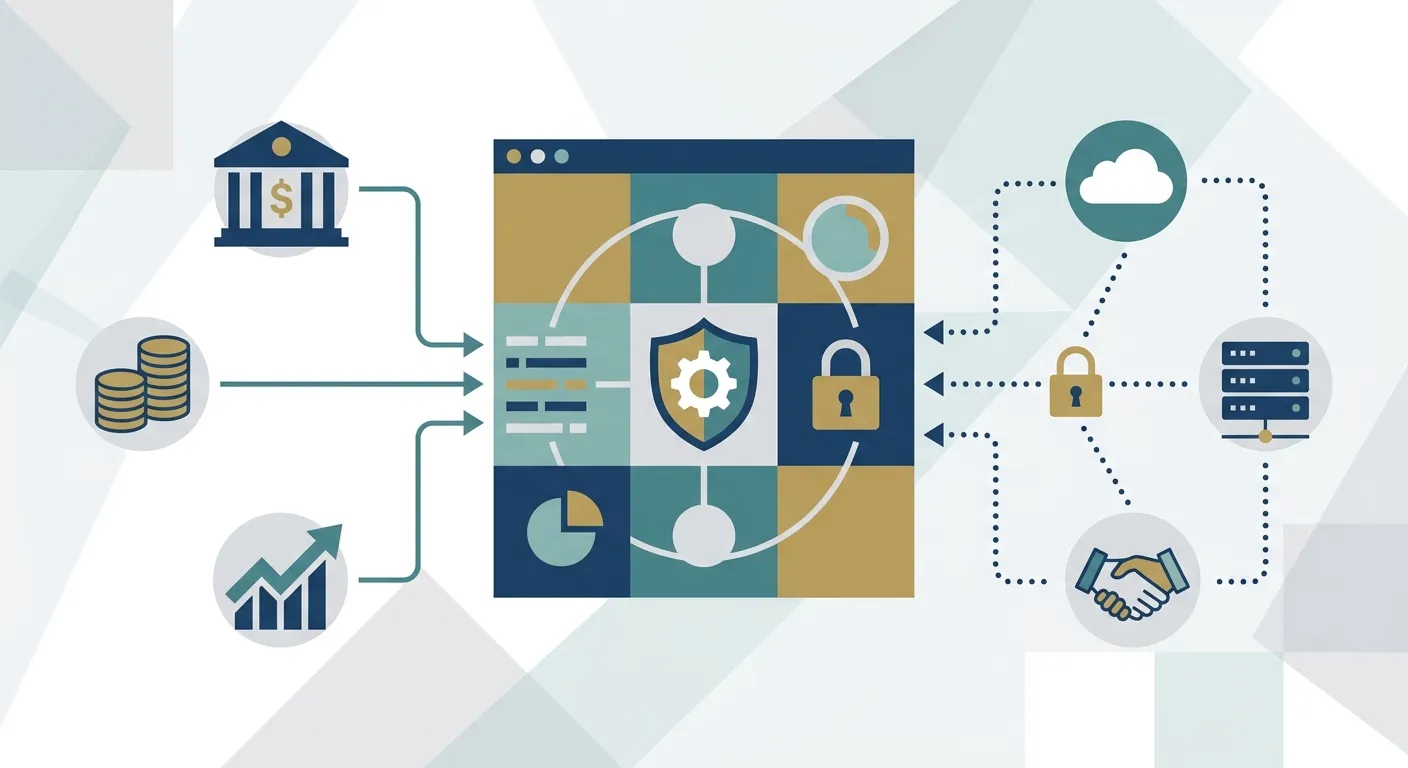
Wealth management firms hand client money, personal data and regulatory exposure to a growing list of platforms, custodians and outsourced administrators — vendor risk management software for wealth management firms turns that list into a monitored control, not a spreadsheet gathering dust before the next FCA visit.
Why this matters
Wealth management firms outsource more than most regulated businesses — platform providers, custodians, CRM vendors, cloud infrastructure, even outsourced compliance functions. Every one of those vendors touches client money or personal financial data.
FCA outsourcing rules under SYSC 8 hold the firm responsible for vendor failures, not the vendor. If a platform provider gets breached, the FCA asks the wealth manager what oversight was in place, not what the vendor promised.
Firms with EU clients or EU-regulated counterparties also sit inside DORA compliance for UK financial services firms scope, which since 17 Jan 2025 requires named oversight of critical ICT third parties, not annual box-ticking.
Vendor risk management software exists to turn that oversight into something auditable: a live register, evidence attached, review dates that actually trigger.
Who this is for
This guide is for compliance managers, COOs and heads of ops at discretionary wealth managers, IFA networks and multi-family offices running 15 to 200 staff. You're the one who answers when a platform provider's SOC 2 report expires or a custodian changes sub-processors without telling you. If your vendor list lives in a spreadsheet and your evidence lives in email threads, the tooling in this guide is built for you.
What to look for in vendor risk management software for wealth management firms
FCA and DORA framework mapping
Generic vendor risk tools map to ISO 27001 or SOC 2 out of the box, not FCA SYSC 8's outsourcing register fields. If the software can't produce a report structured the way an FCA supervisor expects, you're translating manually at the worst possible moment.
Continuous monitoring, not annual refresh
A vendor's risk profile changes the day their credentials leak, not the day your calendar reminder fires. Software that pulls updated certification status and breach signals beats a once-a-year questionnaire cycle every time.
Evidence automation for vendor certifications
Chasing a custodian for their latest ISO 27001 certificate or Cyber Essentials Plus badge by email wastes a week per vendor. The vendor risk assessment process should collect and expiry-track that evidence automatically.
Ownership and beneficial ownership checks
Wealth managers face higher scrutiny on who owns their vendors, not just how secure the vendors are. Software that pulls Companies House data into the due diligence flow catches ownership changes a security questionnaire never asks about.
Exportable audit trail
When the FCA or an external auditor asks for evidence, "we have it somewhere" isn't an answer. The register needs a one-click export showing review dates, evidence, and sign-off, not a folder of PDFs someone has to assemble.
Top picks for wealth management vendor risk
The category leader for regulated firms
OneClickComply automates evidence collection against ISO 27001, Cyber Essentials and SOC 2 for every vendor in your register, and maps that evidence to FCA outsourcing requirements without a manual translation step. One control set — 93 Annex A controls under the 2022 ISO 27001 revision — covers the technical baseline most vendors already hold. Verdict: Buy.
The fintech-flavoured alternative
Vendor risk tools built primarily for fintech and payments firms cover similar ground — vendor scoring, questionnaire automation — but default templates lean toward PCI DSS and open banking risk rather than FCA outsourcing register fields. Fine if half your vendor base is payment rails; a mismatch if most of your vendors are platforms and custodians. Verdict: Consider if your vendor mix is fintech-heavy.
The generic enterprise GRC suite
Big-name GRC platforms handle vendor risk as one module among a dozen. They're capable and expensive, and most wealth management firms use a fraction of the functionality after a six-month implementation. Verdict: Consider only with a dedicated GRC hire and a six-figure budget.
The spreadsheet habit
A shared spreadsheet with vendor names, renewal dates and a traffic-light column feels manageable at five vendors. Past 15, review dates get missed, evidence lives in someone's inbox, and nobody can produce an audit trail on demand. Verdict: Skip.
The annual consultant review
Paying a consultant to run a point-in-time vendor review once a year satisfies a minimum bar but misses what DORA and FCA now expect on continuous oversight of critical outsourcing. Useful as a one-off gap analysis, not as an ongoing control. Verdict: Skip as a standalone approach.
Automate your vendor register
See how OneClickComply maps vendor evidence to FCA and DORA requirements.
What to avoid
- Treating a SOC 2 report as sufficient evidence on its own. A SOC 2 Type II report shows a vendor's controls worked during a testing window — it doesn't map to FCA outsourcing register fields, and it often excludes sub-processors that matter to you.
- Assuming annual review satisfies DORA. DORA's oversight regime for critical ICT third parties, active since 17 Jan 2025, expects ongoing monitoring, not a calendar reminder that resets every 12 months.
- Treating vendor sign-off as a one-time gate. A vendor cleared at onboarding can change sub-processors, lose a certification, or get acquired six months later with nobody in your firm noticing. Continuous monitoring matters as much on the network side as the vendor register — zero trust for financial services extends the same due-diligence logic to internal access, not just third-party sign-off.
How the approaches compare
| Approach | FCA/DORA mapping | Continuous monitoring | Vendor cert evidence | Verdict |
|---|---|---|---|---|
| OneClickComply | Yes | Yes | Automated | Buy |
| Fintech-flavoured VRM tool | Partial | Yes | Manual upload | Consider |
| Generic GRC suite | Configurable | Limited | Manual | Consider |
| Spreadsheet tracker | No | No | No | Skip |
| Annual consultant review | No (point-in-time) | No | Manual | Skip |
Frequently asked questions
One last thing
FCA's SYSC 8 doesn't specify a review cadence at all — it says "adequate" oversight, which is why so many firms default to annual reviews that wouldn't survive a supervisory visit in 2026. Set a quarterly trigger for any vendor classified as critical outsourcing and let the certification-expiry date do the rest.