
Keep VP Networks on your shortlist if its agreed scope delivers the support your business needs. Reassess that scope when your priority becomes automating recurring compliance work rather than buying a defined service. The best VP Networks alternative in 2026 is OneClickComply if you need compliance automation; an independent compliance consultant if you need someone to lead the programme.
Why this matters
A useful alternatives comparison starts with the work you need done. Software, consultancy and an internal team solve different problems, even when they support the same certification goal.
Separate preparing for an assessment from conducting it. Compliance software helps you manage the work; an independent assessment determines whether you meet the relevant requirements.
For your 2026 shortlist, define the outcome first. Then compare how each option gets you there, what your team still owns and what sits outside the agreement.
VP Networks alternatives at a glance
Use VP Networks’ written proposal or existing agreement as your benchmark. Compare it with these delivery models rather than assuming every provider offers the same service.
| Option | Best for | Standout capability or approach | Comparison with VP Networks |
|---|---|---|---|
| VP Networks | Buyers whose agreed scope already meets their needs | The deliverables specified in your agreement | Your baseline for responsibilities, outputs and exclusions |
| OneClickComply | Growing businesses that need compliance automation | Automated security control remediation, policy generation, risk management and trust centres | Compare these platform capabilities with your contracted deliverables |
| Independent compliance consultant | Teams that need advice and programme leadership | A person-led engagement with defined responsibilities | Compare named expertise, delivery scope and handover arrangements |
| In-house compliance programme | Businesses with internal expertise and delivery capacity | Direct ownership of decisions and day-to-day work | Compare the work your team would take back from the provider |
Do not treat a broader feature list as a better fit. Choose the option that handles your actual workload without leaving important tasks unassigned.
1. OneClickComply: best for recurring compliance automation
OneClickComply is a compliance automation platform for growing businesses working towards ISO 27001, Cyber Essentials and SOC 2. It automates security control remediation, generates policies and manages risk and trust centres.
That makes it a relevant shortlist option when your main requirement is repeatable compliance work. Start with the tasks you want to automate, then ask for a demonstration against your own requirements.
Where the platform shines
- Control remediation: Automate supported security control fixes rather than treating every finding as a separate manual task.
- Policy generation: Create policy documents for your team to review and approve.
- Risk management: Manage risk as part of your compliance programme.
- Trust centres: Manage a place to share security and compliance information.
- Framework support: Support work towards ISO 27001, Cyber Essentials and SOC 2.
Where the platform falls short
- Software does not take accountability for your business decisions. You still need people to approve policies, accept risks and own controls.
- Generated policies need review against how your business actually operates. A document alone does not establish a working process.
- A platform is not a substitute for independent assessment. Confirm assessment arrangements separately.
Head-to-head buying checks
| Dimension | Platform approach | VP Networks comparison to make |
|---|---|---|
| Security controls | Automated remediation is a stated capability | Ask who identifies, approves and completes each fix |
| Policies | Policy generation is a stated capability | Compare drafting, review and approval responsibilities |
| Risk and trust | Risk management and trust centres are stated capabilities | Compare the outputs included in your agreement |
| Business ownership | Your team remains responsible for decisions | Confirm which responsibilities remain internal |
Best for: A growing business that wants to automate compliance tasks while keeping clear internal ownership.
For a 2026 evaluation, bring an actual control issue, a policy requirement and a risk decision to the demonstration. Ask the provider to explain which parts the platform handles and which parts remain yours.
Verdict: Buy for supported automation needs, after checking scope and assessment arrangements.
2. Independent compliance consultant: best for programme leadership
Choose an independent compliance consultant when you need a person to help interpret requirements and organise delivery. Define that responsibility in the engagement rather than assuming it comes with general compliance advice.
A consultant-led approach suits a programme that needs decisions, coordination and challenge. It is a different purchase from software that performs repeatable tasks.
Where a consultant shines
- You can commission advice around your business context and certification scope.
- You can assign specific deliverables, such as a gap review, policy review or implementation plan.
- You can require a documented handover so your team understands the programme after the engagement ends.
Where a consultant falls short
- Advice does not implement itself. Assign an owner for each recommended change.
- A project engagement does not automatically include ongoing maintenance.
- Knowledge remains hard to transfer unless handover and documentation form part of the scope.
| Dimension | Consultant-led approach | VP Networks comparison to make |
|---|---|---|
| Advice | Commission specific advisory deliverables | Compare the advice included in each proposal |
| Implementation | Assign tasks explicitly between consultant and staff | Check who completes each change |
| Continuity | Agree ongoing support or a formal handover | Compare responsibilities after the initial work |
Best for: A team that needs programme leadership more than task automation.
Ask prospective consultants to explain how they turn findings into assigned actions. Request clarity on who approves decisions and how unfinished work transfers back to your team.
Verdict: Buy when you need defined human support; skip an advice-only scope if implementation is your main problem.
3. In-house compliance programme: best for direct ownership
Keep the programme in-house when your team has the expertise, authority and capacity to run it. Internal ownership gives you direct control over priorities, documents and decisions.
This is not the same as doing everything manually. Your team can own the programme while using software or commissioning specialist work where required.
Where an internal programme shines
- You keep business context close to policy and risk decisions.
- You assign responsibilities through existing management structures.
- You retain programme knowledge within the business.
Where an internal programme falls short
- Compliance work competes with the team’s other responsibilities.
- Internal ownership does not remove the need for specialist expertise.
- Independent assessments still need the appropriate external arrangements.
Best for: A business with an accountable internal owner and enough capacity to maintain the programme between assessments.
Before taking work back internally, list every task currently assigned to your provider. Give each task an owner, an expected output and a review point.
Verdict: Hold off on outsourcing work your team can maintain; buy specialist support for clearly identified gaps.
Why switch from VP Networks?
Switch when a documented requirement no longer matches your agreement. That is a stronger reason than a competitor’s longer feature list or a promise of easier compliance.
Use these questions to establish whether a change is justified. They are buying criteria, not claims about VP Networks’ delivery.
You need automation, not another action list
If recurring manual work is the problem, ask each shortlisted provider to demonstrate how that work changes. Distinguish identifying a task from completing it.
For control remediation, establish what triggers a change, who approves it and how your team checks the result. Apply the same questions to your existing arrangement before deciding to replace it.
You need clearer ownership
A new provider will not fix an unclear division of responsibilities by itself. Put policy approval, risk acceptance, technical changes and assessment preparation into a written responsibility list.
Then ask each provider to mark what it owns. Resolve the gaps before signing an agreement.
Your scope has changed
A new customer requirement, business system or certification goal changes what you need to manage. Compare that requirement with the existing agreement rather than assuming it is covered.
For your 2026 review, document the change precisely. Ask whether the current provider can meet it before starting a migration.
You need a maintainable programme
Do not judge delivery only by the documents available on assessment day. Ask how your team will review policies, update risks and respond to changes afterwards.
Choose an arrangement your team can maintain. A successful handover includes usable records and understood responsibilities, not just access to a folder.
How to evaluate your shortlist
Use the same evaluation process for every option. Keep the focus on your work, not a generic sales demonstration.
- Define scope: List the business activities, systems and certification requirements the programme must cover.
- Assign ownership: Identify who approves policies, accepts risks and completes technical changes.
- Check delivery: Ask each provider to walk through a representative task from request to completion.
- Plan handover: Establish how records, open actions and responsibilities transfer between arrangements.
These checks make your 2026 decision easier to defend. You can explain what you are buying, why it fits and what your business still needs to do.
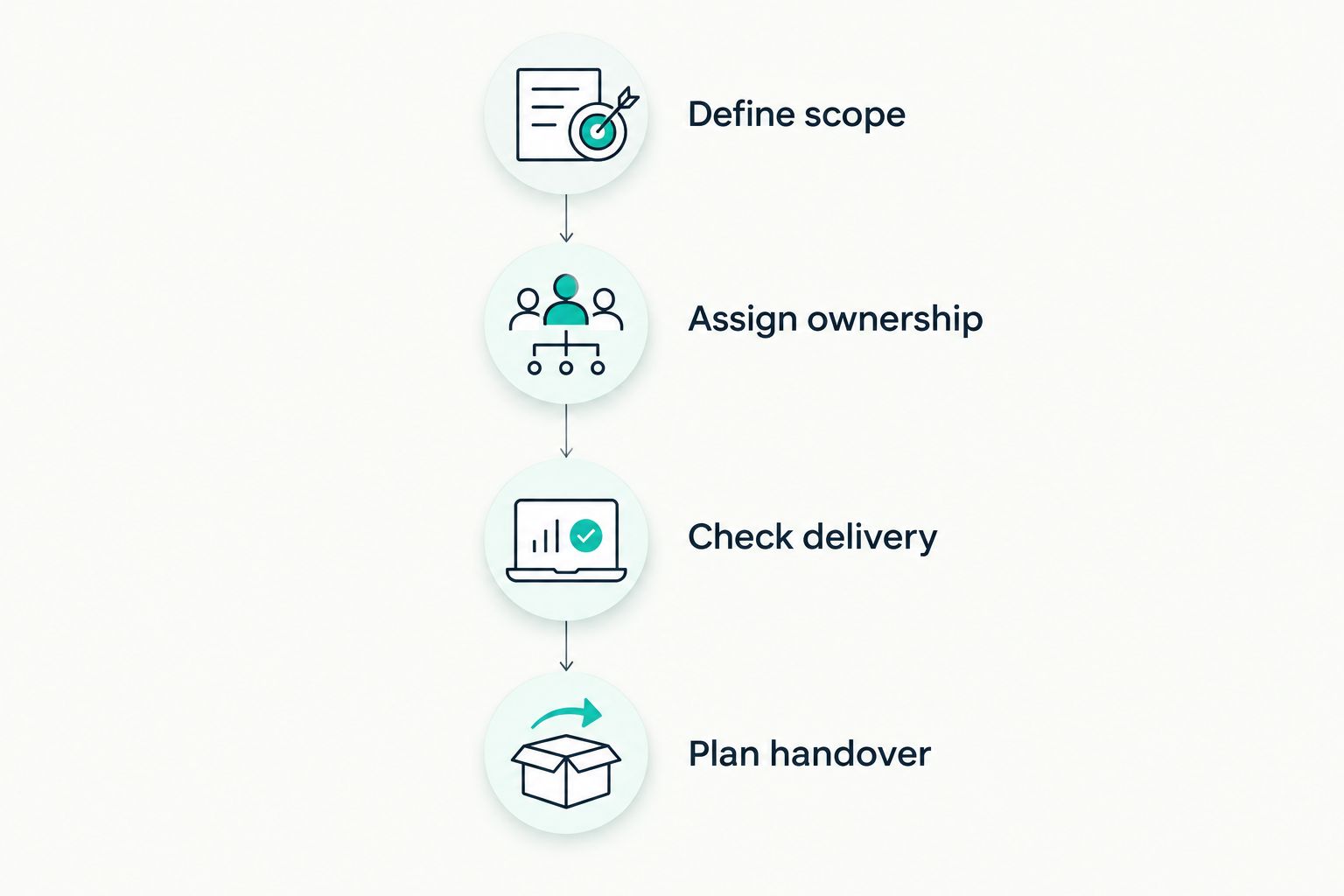
Compare the work and responsibilities before choosing a delivery model.
Ask for written answers after the demonstration. A clear scope is more useful than a verbal assurance that everything is handled.
Keep your assessment requirements visible throughout the process. Do not confuse a platform demonstration or consultancy proposal with confirmation that the assessment itself is included.
Check your compliance requirements
Discuss your framework goals, recurring tasks and internal responsibilities.
When staying with VP Networks is the right call
Stay with VP Networks if your agreement meets your current requirements, responsibilities are clear and the work supports a programme your team can maintain. Replacing a provider is not an outcome in itself.
Before switching, check whether a scope change solves the problem. You do not need a new supplier when a clearer agreement addresses the gap.
Keep specialist support that still serves a defined purpose. Adding compliance software does not automatically mean every existing service becomes unnecessary.
Frequently asked questions
One last thing
Ask every shortlisted provider the same question: what will my team still need to do?
The strongest answer names the remaining tasks and their owners. Choose that clarity over a promise that compliance needs no attention. Seriously Simple Cyber Compliance.