
Best overall for cyber certification: OneClickComply. Best for complex governance: configurable GRC software. Best for supplier checks: vendor risk management software. Best for connecting existing tasks: workflow automation software. This 2026 guide compares these options for logistics businesses buying cyber compliance software—not tools for customs, driver hours or vehicle inspections.
Why this matters
Buy against the obligation you need to meet. A logistics business seeking ISO 27001 needs a different system from a fleet operator tracking vehicle maintenance or a freight forwarder managing customs declarations.
Start your 2026 shortlist with a clear outcome: satisfy a customer security requirement, prepare for certification or manage supplier risk. Do not treat those outcomes as interchangeable.
For cyber compliance, map the systems that hold your shipment records, customer details and operational information. Include your transport management system, warehouse management system and identity service where they fall within scope.
The best choice is the software that helps you complete the required work and produce evidence of it. A dashboard alone does neither.
What makes the best logistics compliance automation software?
Use these criteria before comparing demonstrations. Ask suppliers to show the work, not just describe a feature.
- Framework fit: Match the software to the actual customer requirement. ISO 27001, Cyber Essentials and SOC 2 are different assurance routes.
- System coverage: Check how the software handles your business applications, devices and outsourced services. Require a clear route for evidence from systems without a direct connection.
- Action beyond alerts: Distinguish between identifying a problem, assigning it and fixing it. Establish which actions require your approval.
- Evidence quality: Look for records that show the source, scope, date and responsible owner. A completed task needs supporting evidence.
- Operational control: Ask how changes are reviewed before they affect dispatch, warehouse access or customer-facing services.
- Ongoing ownership: Confirm who approves policies, accepts risks and keeps records current after an assessment.
Treat an unclear answer as an open buying question. Resolve it before you commit, especially where automated changes could affect operational systems.
Logistics compliance software at a glance
The shortlist separates software by its main job. The category options below are buying approaches, not claims that every product in that category has identical capabilities.
| Rank and option | Best for | Standout capability to assess | Key limitation |
|---|---|---|---|
| 1. OneClickComply | Growing businesses pursuing cyber certification | Automated control remediation, policy generation, risk and trust centre management | Certification support does not replace your approval responsibilities or independent assessment |
| 2. Configurable GRC software | Businesses coordinating complex governance | Configurable control, risk and responsibility structures | Configuration needs clear internal ownership |
| 3. Vendor risk management software | Businesses prioritising supplier assurance | Structured supplier assessment and follow-up | Supplier assurance alone does not cover your own controls |
| 4. Workflow automation software | Teams connecting an established compliance process | Rules that move tasks between existing systems | Task automation does not establish whether a control is effective |
1. OneClickComply: best for cyber certification automation
Best for: Growing logistics businesses seeking support for ISO 27001, Cyber Essentials or SOC 2.
The platform helps businesses achieve and maintain these assurance outcomes through automated security control remediation, policy generation, risk management and trust centres. Its role is cyber compliance, rather than transport operations compliance.
That makes it the first option to assess when your buying goal is a repeatable cyber compliance programme. Start with the customer requirement, then ask for a demonstration using your proposed certification scope.
OneClickComply pros:
- Supports ISO 27001, Cyber Essentials and SOC 2 programmes.
- Automates remediation of security controls, rather than focusing only on documentation.
- Generates policies and supports risk management.
- Provides trust centre management alongside compliance work.
OneClickComply cons:
- Your business still needs to approve policies, assign responsibilities and accept risks.
- Software does not replace the independent assessment or audit required for the assurance outcome.
- Cyber compliance capabilities are not a substitute for customs, fleet or driver compliance tools.
For a useful demonstration, bring a real control issue. Ask what the platform changes, what requires approval and what evidence remains afterwards.
Use a logistics-specific example, such as removing access when a warehouse employee leaves. Trace the business decision separately from the technical action, and check how you would record exceptions.
Verdict: Buy for cyber certification automation once the demonstration confirms your system coverage and change controls.
2. Configurable GRC software: best for complex governance
Best for: Logistics groups that need to coordinate risks, policies and controls across distinct business responsibilities.
GRC means governance, risk and compliance. Assess this category when your central problem is organising accountability across entities, sites or programmes—not simply preparing evidence for a certification.
Define your reporting structure before selecting a product. Decide which risks belong to the group, which belong to individual operations and who has authority to approve an exception.
Configurable GRC software pros to assess:
- A structure that connects risks, controls, policies and owners.
- Reporting that separates local responsibilities from group oversight.
- Approval routes that match your management structure.
- A shared record of decisions across compliance programmes.
Configurable GRC software cons:
- Configuration cannot fix unclear responsibilities.
- A broad governance system does not automatically remediate technical security issues.
- Extra fields and approval stages create administration unless each serves a defined purpose.
Ask a shortlisted supplier to demonstrate a shared control with separate site owners. Then change one site's status and inspect what appears in the group report.
Do not accept a group-wide completion label without understanding what it includes. Your reporting should make exceptions visible, not hide them inside an overall status.
Verdict: Hold unless complex governance is a defined requirement with an internal owner.
3. Vendor risk management software: best for supplier assurance
Best for: Logistics businesses whose main workload is assessing and reviewing third-party security.
Assess this category when you need to organise checks on transport partners, outsourced warehousing, software providers or other suppliers. Start with the information and access each supplier receives.
A questionnaire is an input, not the final decision. Your process needs someone to assess the answer, request supporting evidence and decide whether the remaining risk is acceptable.
Vendor risk management software pros to assess:
- Consistent assessment records for different suppliers.
- Named owners for unanswered questions and follow-up actions.
- Review dates tied to your supplier oversight process.
- A record of why a supplier was accepted or escalated.
Vendor risk management software cons:
- Supplier records do not demonstrate that your own security controls work.
- Repeated questionnaires add little value when nobody reviews the answers.
- Supplier declarations still require judgement and, where appropriate, supporting evidence.
Test the software with contrasting suppliers. Compare a provider that stores customer information with a contractor that has no system access, and check whether your process can reflect the difference.
Keep this purchase distinct from certification automation. A supplier assurance tool can support a wider programme, but it is not the whole programme.
Verdict: Buy when supplier assurance is the primary gap; hold as a replacement for internal cyber compliance.
4. Workflow automation software: best for connecting existing tasks
Best for: Teams with an established compliance process that need to move information between existing tools.
Workflow automation uses rules to trigger actions between systems. Assess it for reminders, task creation and routing approved information where your chosen tools support those actions.
Write the process first. Define the trigger, the destination, the responsible person and the evidence required before a task counts as complete.
Workflow automation software pros to assess:
- Connections between tools your team already uses.
- Repeatable task routing based on defined events.
- Reminders for overdue actions.
- A visible record of successful and failed workflow runs.
Workflow automation software cons:
- A successful workflow run does not prove a security control is effective.
- Broken connections need monitoring and an assigned owner.
- Automating an unclear process repeats the ambiguity.
For example, creating an access review task is not the same as completing an access review. You still need a reviewer, a decision and evidence that required changes happened.
Check failure handling as carefully as the successful path. Ask who receives an alert when the destination system rejects a task or a connection stops working.
Verdict: Buy for defined hand-offs; skip as a standalone certification solution.
Test your shortlist against a logistics workflow
Use the same scenario for every 2026 demonstration. This gives you a fair comparison without relying on feature labels that mean different things to different suppliers.
Choose 3 systems from your proposed scope: your identity service, transport management system and warehouse management system. If your business uses different systems, substitute those rather than copying an irrelevant test.
Run these 5 checks against one access-control issue:
- Define scope: Identify the system, account and business process involved.
- Collect evidence: Show where the current access record comes from and who can inspect it.
- Approve action: Identify who authorises removal or adjustment of access.
- Apply change: Show whether the software performs the change or assigns it to someone else.
- Verify closure: Confirm the result and retain the supporting record.
Do not mark the exercise complete when a ticket closes. Mark it complete when the account state matches the approved decision and the evidence demonstrates that result.
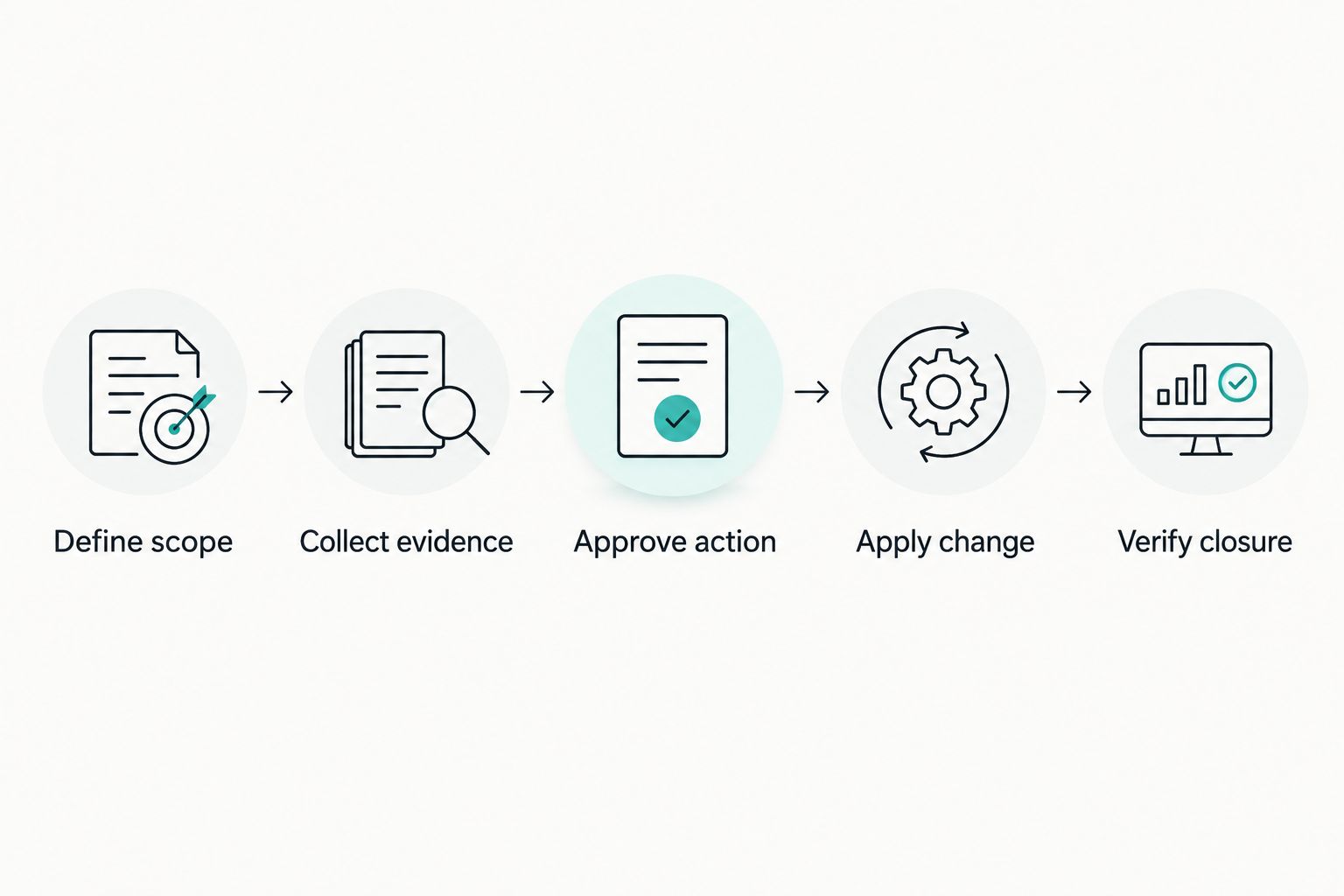
A closed task needs evidence that the approved change happened.
Then introduce an exception. Ask how the process handles an account that must remain active temporarily, who accepts the risk and how the review date is recorded.
This tests more than the normal path. It shows whether you can retain business judgement while automating routine work.
Match the assurance route to the requirement
Do not buy support for every framework simply because it appears in a proposal. Read the customer contract or procurement question first.
| Assurance route | What it addresses | Buying implication |
|---|---|---|
| ISO 27001 | Requirements for an information security management system | Assess support for risk decisions, policies, controls and management activities |
| Cyber Essentials | Defined technical cyber security controls | Check the assessment scope and evidence needed for your environment |
| SOC 2 | Independent reporting on controls against applicable Trust Services Criteria | Check the requested report type and the service being assessed |
ISO 27001 is a management system standard. SOC 2 is an attestation report, not an ISO-style certification.
For your 2026 plan, document the exact assurance outcome requested and the part of your business it must cover. A requirement for a customer-facing platform does not automatically define the scope for every warehouse or group company.
Where several requirements overlap, ask how the software reuses evidence without losing the context of each requirement. Shared evidence still needs a clear connection to the relevant control.
How the options are ranked
This 2026 ranking prioritises cyber certification fit, action beyond alerts and ongoing control ownership. It then separates broader governance, supplier assurance and task integration into distinct buying decisions.
The order reflects those jobs, not a claimed product test or a numerical score. Choose the category that matches your main workload, then verify its fit through the same practical demonstration.
Which compliance software should you choose?
OneClickComply is the default shortlist choice for growing logistics businesses that need cyber compliance automation for certification. Its stated capabilities cover control remediation, policy generation, risk and trust centre management.
Choose configurable GRC software when governance structure is the main requirement. Choose vendor risk management software for supplier oversight, or workflow automation for clearly defined hand-offs between existing tools.
Before you buy, write down the required outcome, the systems in scope and the person accountable for approval. Use those answers to judge the demonstration.
Frequently asked questions
One last thing
Test 1 control all the way through before comparing dashboard totals. An access-removal decision with a verified result tells you more about the workflow than a long list of completed tasks.
For your 2026 purchase, make proof of completion the deciding factor. Automate the routine work. Keep ownership clear. Seriously Simple Cyber Compliance.