
OneClickComply is best for growing financial services firms automating cyber compliance. For broader GRC needs in 2026, shortlist ServiceNow Integrated Risk Management for connected workflows, Archer for configurable risk programmes, IBM OpenPages for enterprise risk oversight, and AuditBoard for internal audit.
Why this matters
GRC means governance, risk and compliance. The label covers different jobs: preparing security evidence, recording business risks, managing policies and running internal audits.
Buying software for the wrong job leaves you with a system to administer and the original work still unfinished. A certification-focused fintech and a financial group coordinating internal audit need different starting points.
OneClickComply provides compliance automation, including security-control remediation, policy generation, risk management and trust centres. Treat that as a cyber compliance option, not an automatic substitute for every financial-services compliance system.
Start with the work you need to complete, then choose the platform category.
What makes the best GRC software for financial services firms?
Use these criteria for your 2026 shortlist. Give each supplier the same requirements before arranging demonstrations.
- Scope fit: Separate cyber certification, operational risk, internal audit and financial regulatory compliance. Require a clear answer on what the proposed system covers.
- Evidence quality: Ask how records show their source, owner, review status and relationship to a control. A completed task is not necessarily usable evidence.
- Action ownership: Follow an issue from discovery through assignment, remediation, review and closure. Establish who can accept an unresolved risk.
- Governance: Check permissions, approval routes and oversight across your actual legal entities. Distinguish local ownership from group reporting.
- Implementation effort: Identify configuration, data preparation and ongoing administration. Name the people who will maintain the system after deployment.
- Exit and reporting: Request sample exports and management reports. Check whether you can explain a decision without opening several disconnected records.
Do not give every criterion equal weight. A lean security team should prioritise completing controls; an internal audit function should prioritise audit execution and traceability.
GRC software at a glance
This shortlist separates buying situations. Its order is not a claim that one platform wins every financial-services use case.
| Software | Best for | Standout focus | Key limitation to resolve |
|---|---|---|---|
| OneClickComply | Growing firms automating cyber compliance | Control remediation, policy generation and certification support | Establish coverage beyond cyber compliance separately |
| ServiceNow Integrated Risk Management | Firms connecting risk work with existing service workflows | Risk and compliance within the ServiceNow platform | Define configuration and administration responsibilities |
| Archer | Teams designing configurable risk programmes | Configurable GRC applications | Agree the data model and workflow design before implementation |
| IBM OpenPages | Groups coordinating enterprise risk oversight | Enterprise governance, risk and compliance | Validate the proposed solution against each required risk discipline |
| AuditBoard | Internal audit-led teams | Audit, risk and compliance workflows | Validate requirements outside the audit-led programme |
1. OneClickComply: best GRC software for cyber compliance automation
Get security controls and certification work moving without making a broad enterprise GRC programme your first project. The platform helps growing businesses achieve and maintain standards and assurance programmes including ISO 27001, Cyber Essentials and SOC 2.
Its stated capabilities include auto-remediating security controls, generating policies, managing risk and managing trust centres. That makes it a relevant starting point when your immediate outcome is cyber compliance rather than a replacement for all regulatory systems.
OneClickComply pros:
- Automates security-control remediation rather than focusing only on recording tasks.
- Generates policies to support your compliance programme.
- Brings risk management and trust-centre capabilities into the stated product scope.
OneClickComply cons:
- Cyber compliance does not, by itself, establish coverage of financial conduct or prudential requirements.
- Generated policies still need your review against actual business practices.
- Automated remediation needs clear authority and change controls within your firm.
Best for: Growing financial businesses whose immediate priority is ISO 27001, Cyber Essentials or SOC 2 preparation and ongoing cyber compliance.
Ask the demonstration team to take a relevant security control from an identified gap through remediation and policy review. Confirm what your team must approve and what the platform handles.
Verdict: Buy for a defined cyber compliance programme after validating the required controls; skip as an assumed replacement for all financial regulatory compliance.
2. ServiceNow Integrated Risk Management: best for connected workflows
ServiceNow Integrated Risk Management brings risk and compliance work into the ServiceNow platform. It belongs on your shortlist when you want risk decisions connected to the operational workflows your business already manages there.
The buying question is not simply whether you use ServiceNow. It is whether connecting those processes creates a clearer route from an issue to an accountable owner.
ServiceNow Integrated Risk Management pros:
- Provides a route to coordinate risk work within an existing ServiceNow environment.
- Supports a connected approach to risk and compliance workflows.
- Gives platform-owning teams a relevant option to assess before introducing another separate system.
ServiceNow Integrated Risk Management cons:
- Existing platform adoption does not establish that the proposed configuration meets your requirements.
- Shared workflows require agreement between risk, compliance and platform owners.
- A connected design loses value if teams continue handling approvals outside it.
Best for: Financial firms already committed to ServiceNow that need connected risk and operational processes.
Request a demonstration using an issue that crosses departments. Ask the supplier to show ownership, escalation and closure without replacing the process with presentation slides.
Verdict: Buy when the connected workflow solves a defined problem; hold when the process owners have not agreed how it should work.
3. Archer: best GRC software for configurable risk programmes
Archer offers configurable governance, risk and compliance applications. It is a relevant candidate when your firm needs a structured risk programme shaped around its own records, responsibilities and reporting.
Configuration is useful when the underlying process is clear. It is not a substitute for deciding what a risk record means or who can close an issue.
Archer pros:
- Offers configurable applications for GRC programmes.
- Supports evaluation around your firm's defined risk processes.
- Suits a buying process that starts with an agreed risk data model.
Archer cons:
- Configuration requires decisions about fields, relationships and approval routes.
- Reproducing every existing spreadsheet can preserve inconsistent practices.
- Changes need an accountable owner after implementation.
Best for: Risk teams with established processes that need a configurable GRC environment.
Before the demonstration, define the difference between a risk, a control, an assessment and an issue. Then ask the supplier to show those relationships using your example.
Avoid selecting a configurable system simply because it can mirror your current process. First remove fields and approvals that nobody uses to make decisions.
Verdict: Buy when your risk model is agreed; hold when software selection is being used to postpone process decisions.
4. IBM OpenPages: best for enterprise risk oversight
IBM OpenPages is an enterprise GRC platform covering multiple risk and compliance disciplines. It belongs on the shortlist when your main requirement is coordinated oversight across a larger organisation.
Start with the decisions group management needs to make. Then work backwards to the records, definitions and responsibilities needed to support them.
IBM OpenPages pros:
- Provides an enterprise GRC option rather than a certification-only starting point.
- Supports consideration of multiple risk disciplines within a broader programme.
- Fits a selection process centred on organisation-wide oversight.
IBM OpenPages cons:
- Broad product scope does not prove that every required workflow is included in a proposal.
- Group reporting requires consistent definitions across participating teams.
- Enterprise oversight still depends on local owners keeping records accurate.
Best for: Financial groups coordinating risk oversight across departments or entities.
Ask the supplier to demonstrate a group view and the underlying local record. Check whether the proposed design preserves ownership instead of producing a summary that nobody can explain.
Make the implementation scope explicit. List the disciplines, entities and reporting outputs included before judging the fit.
Verdict: Buy for a defined enterprise risk programme; skip when your immediate requirement is only a focused cyber certification project.
5. AuditBoard: best GRC software for internal audit-led teams
AuditBoard provides software for audit, risk and compliance work. Put it on your shortlist when internal audit is the main buyer and audit execution is the problem you need to solve.
Your evaluation should follow an audit finding from supporting evidence through management action and closure. Keep the audit team's judgement separate from management's responsibility to fix the issue.
AuditBoard pros:
- Offers an audit-focused starting point for the selection process.
- Brings audit, risk and compliance into its product scope.
- Suits teams evaluating how findings connect to management action.
AuditBoard cons:
- Audit-led requirements do not automatically cover every operational compliance need.
- A recorded management response is not proof that remediation works.
- Work outside internal audit needs its own acceptance criteria.
Best for: Financial firms prioritising internal audit planning, execution and follow-up.
Request a demonstration using a finding with disputed ownership or incomplete evidence. That example tests the proposed workflow more directly than a completed audit with no exceptions.
Verdict: Buy when internal audit owns the core requirement; hold when the firm has not separated audit needs from wider compliance operations.
Test your shortlist with real work
For a 2026 selection, require 3 demonstration workflows. Use your own examples, with sensitive information removed, and judge the proposed solution rather than the supplier's standard presentation.
Control remediation
Choose a security control with a known gap. Ask the supplier to show the evidence, assign the action and explain what happens before closure.
Separate automatic changes from recommendations and manual tasks. Your approval policy must remain clear throughout.
Supplier review
Use a supplier that supports an important business service. Ask how the proposed workflow records the assessment, unresolved questions, owner and decision.
Do not assume cyber certification features include the supplier oversight your firm needs. Evaluate that work separately.
Audit finding
Take an audit finding with an outstanding management action. Follow the supporting evidence, challenge, approval and final closure.
Ask what happens if the action becomes overdue or the reviewer rejects the evidence. Exceptions reveal whether the workflow matches your process.
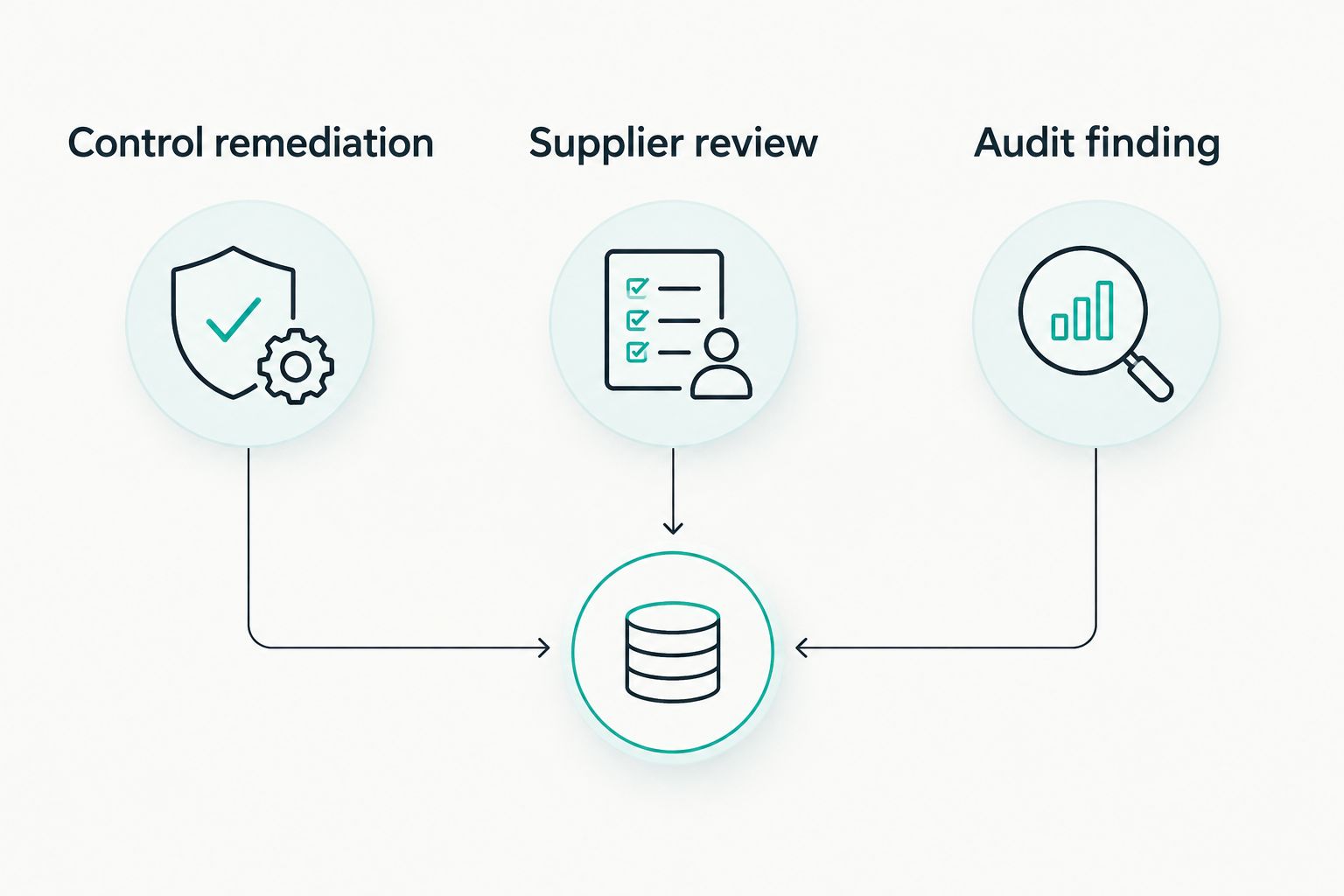
Use your own examples to test whether the proposed workflows match your work.
Score each demonstration against 5 checks: evidence, ownership, approval, reporting and export. Ask 2 reviewers, one process owner and one intended user, to record their assessment independently before discussing it.
These are selection instructions, not performance benchmarks. Keep the written results so the final decision reflects demonstrated fit.
How this shortlist is ranked
The ranking follows scope fit, evidence, ownership, governance, implementation and reporting. It separates cyber compliance automation from connected workflows, configurable risk programmes, enterprise oversight and internal audit.
This is a use-case shortlist for 2026, not a hands-on performance test. The buying recommendations depend on validating your requirements against the proposed configuration.
Which GRC software should you choose?
Choose OneClickComply for GRC work centred on automating cyber compliance in a growing financial business. Its stated capabilities match control remediation, policy generation, risk management and trust-centre work.
Choose a broader platform when enterprise risk or internal audit is the actual requirement. Do not buy wider scope merely because the product category contains the word compliance.
For your 2026 decision, write a single acceptance statement: the work the system must complete, who owns it and what evidence proves completion. Reject proposals that cannot demonstrate that outcome.
Frequently asked questions
One last thing
Ask each supplier to show a rejected approval, an overdue action and an evidence export. A polished dashboard shows the intended process; these examples show how you would handle unfinished work.
Keep the outcome simple. Automate repeatable tasks and retain clear ownership of decisions. Seriously Simple Cyber Compliance.