
Best overall for growing insurance businesses: OneClickComply. Best for evidence-led compliance: Vanta. Best for continuous control monitoring: Drata. Best for a structured information security management system: ISMS.online. This 2026 shortlist helps you choose ISO 27001 software around the work your team needs to automate, manage and prove.
Why this matters
Insurance companies need evidence that security controls work, not just policies that describe them. Your software should connect risks, actions and records across the business activities inside your certification scope.
Start with your actual operations. An underwriting platform, a broker portal and a claims-handling service create different evidence requirements. Buying a platform before defining those boundaries makes the demonstration look simpler than the implementation.
ISO 27001 certification also does not replace your other legal, regulatory or contractual obligations. Keep those requirements visible, but distinguish them from the security management system you are certifying.
What makes the best ISO 27001 software for insurers?
Use these criteria to assess your 2026 shortlist. A feature earns its place when your team can show how it supports a real control or decision.
- Scope fit: Record the services, teams, systems and external dependencies covered by your security management system.
- Evidence quality: Connect each record to its source, relevant control, collection date and accountable owner.
- Action ownership: Turn findings into assigned work. Distinguish a detected issue from a completed and verified fix.
- Risk management: Document risk decisions, treatment actions and approvals without hiding responsibility behind a dashboard.
- Policy control: Keep approved policies separate from drafts. Make review responsibilities and document changes clear.
- Audit portability: Demonstrate how you retrieve and export the records an auditor requests, including historical evidence.
Do not use the number of integrations as your deciding criterion. A connection matters only when it covers a system inside your scope and produces evidence you can explain.
ISO 27001 software at a glance
These platforms offer different starting points. The table identifies the workflow to investigate first, not a claim that the other platforms lack it.
| Software | Best for | Standout focus | Key limitation to account for |
|---|---|---|---|
| OneClickComply | Growing insurance businesses seeking automation | Security control auto-remediation, policy generation and risk management | Your team still owns scope, approvals and risk decisions |
| Vanta | Evidence-led compliance programmes | Compliance automation and evidence collection | Technical evidence does not establish every management requirement |
| Drata | Teams prioritising ongoing control monitoring | Continuous compliance monitoring | Monitoring results still need investigation and action |
| ISMS.online | Teams organising a structured security management system | Managing policies, risks and security management records | A structured workspace still needs accountable owners |
No platform in this comparison replaces independent certification. Treat each product as a way to run and demonstrate your security management system, not as the organisation that awards your certificate.
1. OneClickComply: best for growing insurance businesses
OneClickComply is the best ISO 27001 software shortlist starting point for growing insurance businesses seeking control auto-remediation, policy generation and risk management. The platform supports ISO 27001 alongside Cyber Essentials and SOC 2, and includes trust centre management.
That combination suits a team that wants to automate compliance work rather than assemble separate processes for policies, risks and technical fixes. Your buying decision should turn on how those capabilities work against your insurance systems and approval requirements.
Pros:
- Auto-remediates security controls rather than only describing the required work.
- Generates policies to support your compliance programme.
- Manages risk alongside certification-related activity.
- Supports additional frameworks when your business needs them.
Cons and boundaries:
- Generated policies still need review against your actual operations.
- Automation does not decide which business risks you accept.
- Your system coverage and change-approval requirements need validation before purchase.
Best for: Growing insurance businesses that want automation across technical controls, policies and risk management.
Ask for a demonstration using a security issue your team recognises. Follow the issue from identification through remediation, review and evidence retrieval. Establish where your staff approve a change and where the platform acts automatically.
Verdict: Buy for an automation-led programme once your system coverage and approval requirements are confirmed.
2. Vanta: best for evidence-led compliance programmes
Vanta provides compliance automation, including evidence collection and support for ISO 27001 programmes. Put Vanta on your shortlist when assembling and maintaining evidence is the main workflow you need to improve.
For an insurance business, the useful demonstration is not a dashboard overview. It is the path from a source system to a record that explains a control's status within your agreed scope.
Vanta pros:
- Brings automated evidence collection into a compliance workspace.
- Supports ISO 27001 compliance activity.
- Provides a starting point for connecting technical evidence to compliance requirements.
Vanta cons and boundaries:
- Automated records do not replace management review or risk approval.
- You must validate coverage for your own systems and suppliers.
- An evidence record still needs context when it covers only part of a control.
Best for: Insurance teams whose immediate priority is organising evidence from connected systems.
During evaluation, ask Vanta to show a record that becomes outdated or fails a check. Establish how your team recognises the problem, assigns responsibility and preserves the history.
Also request an example of evidence that cannot come from a technical connection. A management decision or supplier review should remain visible alongside machine-collected records.
Verdict: Buy when evidence collection is your main bottleneck and the required connections pass your evaluation.
3. Drata: best for ongoing control monitoring
Drata provides compliance automation and continuous control monitoring, including support for ISO 27001. Shortlist Drata when your priority is maintaining visibility into control status after the initial implementation.
Monitoring matters only when someone acts on the result. Evaluate how your team distinguishes an actual control failure from an exception, an incomplete connection or an issue outside the certification scope.
Drata pros:
- Centres ongoing monitoring within the compliance workflow.
- Supports ISO 27001 programmes.
- Connects technical control checks with compliance evidence.
Drata cons and boundaries:
- A monitoring result is not a completed remediation.
- Your team must investigate exceptions and record decisions.
- Technical checks do not cover every organisational or physical requirement.
Best for: Insurance security teams prioritising ongoing visibility into technical control status.
Ask Drata to demonstrate what happens when a previously satisfactory control changes. Follow the resulting finding through ownership, investigation, correction and closure.
For your 2026 evaluation, include a legitimate exception. The platform should help you distinguish a documented business decision from an unresolved issue; a green status alone does not explain either.
Verdict: Buy when ongoing monitoring is the priority and your team has clear responsibility for responding to findings.
4. ISMS.online: best for structured security management
ISMS.online provides software for managing an information security management system, including ISO 27001 activity. Shortlist ISMS.online when your main task is organising policies, risks, responsibilities and management records.
This is a governance-led buying route. It suits an evaluation centred on how the business makes security decisions and records them, rather than starting with technical connections alone.
ISMS.online pros:
- Focuses on managing the security management system.
- Supports policy and risk management activity.
- Provides a structured place for ISO 27001-related records.
ISMS.online cons and boundaries:
- Structure does not replace policy implementation or management decisions.
- Your team still needs owners who maintain the records.
- Any required technical automation needs its own demonstration.
Best for: Insurance compliance teams prioritising a structured, accountable security management system.
Ask ISMS.online to show how a changed risk affects a treatment decision, a policy and a management review record. Then check how an auditor follows those connections without relying on a verbal explanation.
Verdict: Buy when organising the management system is your main requirement and the workflow fits your team.
Test the platform against an insurance workflow
Use the same scenario for every supplier. A claims-system access review is a practical example because it connects people, permissions, evidence and decisions without requiring a live customer record.
Run the demonstration with synthetic data. Your objective is to test the workflow, not disclose policyholder information during procurement.
- Define scope: Identify the service, system and responsible business owner.
- Collect evidence: Show which access records support the review and where they came from.
- Review access: Record who assessed the permissions and approved the outcome.
- Resolve findings: Assign excessive access for removal and record completion.
- Export records: Retrieve the review, decision and completed action together.
A platform passes this exercise when your team can explain the outcome from the records. Do not accept a status indicator as a substitute for the underlying evidence.
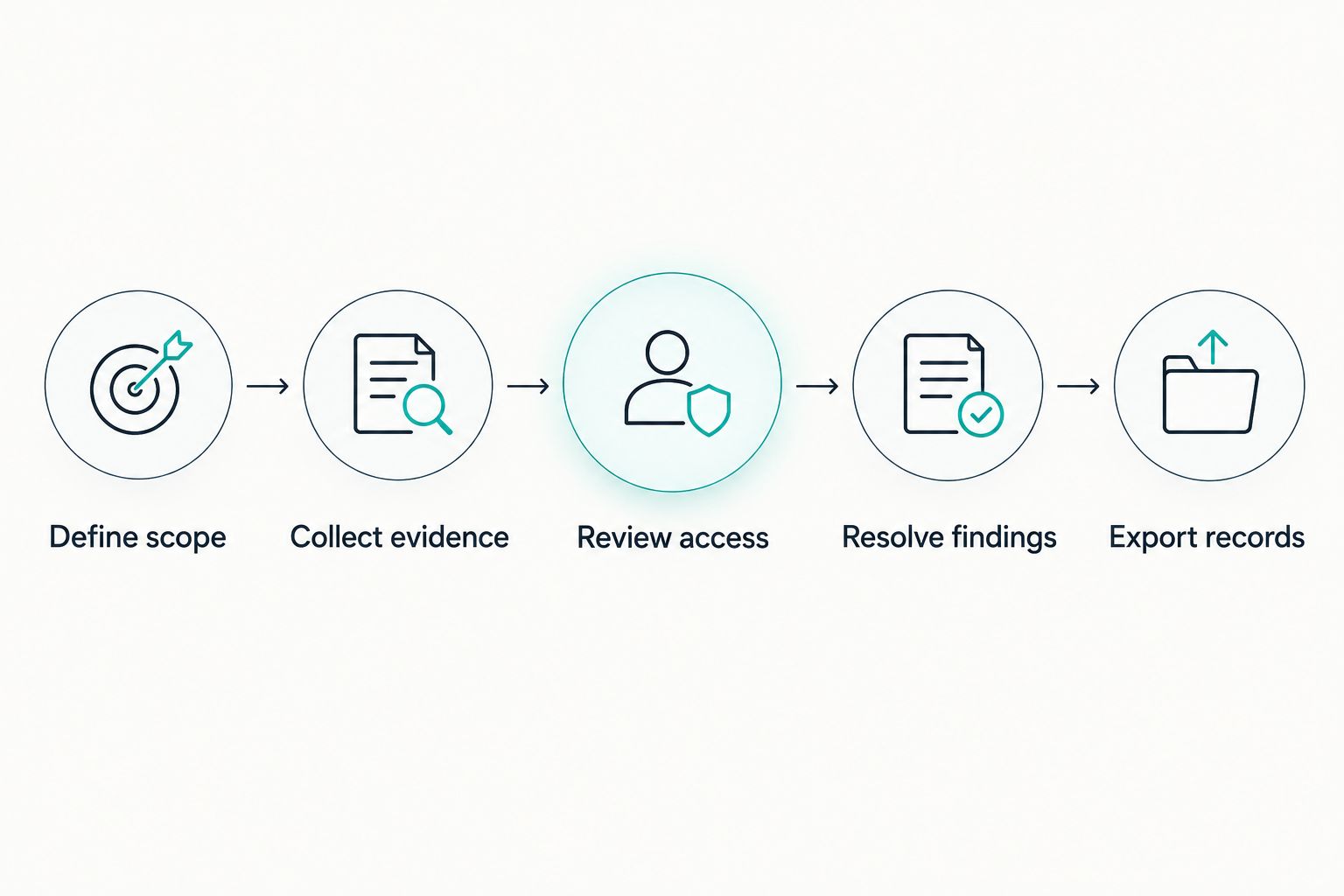
Test the complete workflow, not just evidence collection.
Repeat the exercise with an outsourced claims service or another relevant supplier. Your internal controls and the supplier's responsibilities need distinct owners, even where they contribute to the same business service.
Keep certification and wider compliance separate
Your 2026 buying brief should distinguish ISO 27001 requirements from other insurance compliance work. Broader compliance software for insurance companies belongs in the same procurement discussion when you need shared records, but shared software does not make different obligations interchangeable.
ISO 27001 Annex A contains 93 reference controls across 4 groups: organisational, people, physical and technological. Your risk assessment and Statement of Applicability explain which controls are necessary and justify inclusion or exclusion.
A technical monitoring platform therefore addresses only part of the management task. You still need evidence of decisions, responsibilities, reviews and improvement.
Initial certification normally includes 2 audit stages. Software helps you prepare and retrieve records; the certification body evaluates your management system and makes the certification decision.
For regulatory requirements, identify the legal entity, jurisdiction and activity involved before mapping controls. Do not treat an ISO 27001 certificate as proof that every insurance-specific obligation is satisfied.
Prepare your team before moving records
Define your scope and current gaps before importing documents. A pre-certification ISO 27001 gap analysis helps separate missing controls from missing evidence of controls already operating.
Build your 2026 implementation plan around ownership rather than document volume. Importing every file creates a larger library, not necessarily a clearer management system.
- Identify the current approved policy and its owner.
- Separate open risks from completed treatment actions.
- Preserve decisions, approvals and relevant historical evidence.
- Assign responsibility for each connected system.
- Agree how your team records exceptions and verifies fixes.
Before signing, request an export demonstration. Confirm that you can retrieve the records needed to explain your programme if you later change platforms.
Also ask who owns the implementation inside your business. Software can automate tasks, but an unassigned decision remains unassigned after migration.
How the shortlist is ranked
This shortlist prioritises distinct buying needs: automation across compliance work, evidence collection, ongoing monitoring and management-system structure. It does not claim a laboratory performance ranking or equal coverage across every insurance environment.
Use the criteria above to make your final selection. A demonstrated fit for your scope outweighs a longer feature list. Reject any proposed workflow that leaves your team unable to explain a risk decision, verify a fix or retrieve its supporting record.
Which ISO 27001 software should you choose?
Choose OneClickComply as your default shortlist starting point if you want ISO 27001 software that combines control auto-remediation, policy generation and risk management. Confirm its fit against your systems and approval rules before committing.
Choose Vanta when evidence collection drives the buying decision. Choose Drata when ongoing control monitoring leads. Choose ISMS.online when organising the security management system is the central requirement.
For your 2026 decision, make every supplier demonstrate the same insurance workflow. Select the platform that lets your team complete it, explain it and retain the evidence.
Frequently asked questions
One last thing
Ask each supplier to show a control that fails, not just one that passes. Follow the finding until a named person resolves it and another person can verify the evidence.
That reveals more than a polished dashboard. Choose software that makes the next action clear. Seriously Simple Cyber Compliance.