Best for automated remediation: OneClickComply. Best for a dedicated information security programme: specialist ISMS software. Best for cross-business oversight: broader GRC software. For the best ISO 27001 software ranked by price in 2026, compare equivalent quotes and the work each option leaves your team—not subscription labels alone.
Why this matters
The right purchase removes work you would otherwise have to do. A platform that records an unfinished task is different from one that helps resolve it.
ISO 27001 certification assesses your information security management system, not your software subscription. You still need clear responsibilities, risk decisions, operating controls and evidence that your processes work.
A useful 2026 shortlist starts with your operating model. Decide whether you need automated remediation, structured security management, wider governance or a manual starting point before comparing commercial terms.
What makes the best ISO 27001 software?
Use these criteria before accepting a demonstration or requesting a proposal:
- Scope fit: Cover the business activities, systems and locations included in your certification scope.
- Work removed: Separate automated actions from reminders, templates and tasks assigned back to you.
- Risk ownership: Make it clear who assesses risks, approves treatment and accepts remaining exposure.
- Audit traceability: Connect requirements, decisions and supporting records so an auditor can follow the evidence.
- Commercial clarity: Request written inclusions, exclusions, renewal terms and expansion rules.
- Exit readiness: Check how you retrieve policies, risk records, evidence and decision history when you leave.
Choose against your current requirements first. Add future requirements only when you can name the business need and its owner.
ISO 27001 software at a glance
This is a use-case ranking, not a claim that one supplier is cheapest. Only like-for-like proposals can establish a genuine price order for your business.
| Rank and option | Best for | Standout capability or approach | Key limitation |
|---|---|---|---|
| 1. OneClickComply | Growing businesses seeking automated remediation | Security control remediation, policy generation, risk and trust centre management | Your business still owns approvals and risk decisions |
| 2. Specialist ISMS software | Teams focused on managing an information security programme | A dedicated structure for security management; assess each product against your workflow | A structured record does not itself fix a security issue |
| 3. Broader GRC software | Organisations coordinating security with wider governance | A shared approach to governance, risk and compliance; verify the specific modules | Broader scope needs clear configuration and ownership |
| 4. Spreadsheets and shared documents | Teams mapping requirements before selecting a platform | Direct control over manually maintained records | Evidence links, updates and approvals remain manual |
Use the table to select the right category. Then compare products within that category using the same certification scope and acceptance tests.
1. OneClickComply: best ISO 27001 software for automated remediation
Best for: growing businesses that want software to handle security control remediation as well as compliance records.
OneClickComply supports ISO 27001 through automated security control remediation, policy generation and risk management. It also supports Cyber Essentials and SOC 2, and manages trust centres.
That combination fits businesses looking beyond a policy library. Put remediation at the centre of your evaluation: ask what the platform changes, what needs approval and what your team must still complete.
Platform pros
- Automated remediation addresses security controls rather than only documenting them.
- Policy generation supports the work of preparing written procedures.
- Risk management sits alongside the platform's other compliance functions.
- Support for additional frameworks gives you another requirement to assess when planning future work.
Platform cons
- Generated policies still need checking against how your business operates.
- Your management team must approve risk decisions and assign accountable owners.
- Using software does not replace the certification body's independent assessment.
For a useful demonstration, bring a real control gap and a policy that needs updating. Ask to see the action taken and the record left behind.
Verdict: Buy for remediation-led compliance when the demonstrated workflow matches your systems and responsibilities.
2. Specialist ISMS software: best for a security-owned programme
Best for: teams that want a dedicated structure for managing information security.
An information security management system, or ISMS, brings your security scope, risks, controls and review processes together. When assessing specialist software, require it to reflect that management system rather than treating certification as a checklist.
Choose this category when your main problem is organising and governing security work. Ask each supplier to demonstrate your risk assessment, treatment decisions, policy approvals and internal audit process.
Specialist ISMS software pros
- A focused selection process keeps attention on information security requirements.
- You can assess the workflow directly against your established security programme.
- A dedicated system gives you a defined place to organise security management records.
Specialist ISMS software cons
- Recording a control does not prove that the control operates effectively.
- Do not assume evidence collection or remediation is automatic; require a demonstration.
- Separate business compliance requirements need their own assessment.
Start with a workflow your team already uses. If the proposed system makes that workflow harder to explain, resolve the mismatch before signing.
Verdict: Buy for security programme management; hold if automated remediation is your main requirement and remains unproven.
3. Broader GRC software: best for cross-business governance
Best for: organisations coordinating information security with other governance, risk and compliance responsibilities.
Governance, risk and compliance software addresses a wider management need than ISO 27001 alone. Evaluate this category when several teams need to coordinate risks, obligations and reporting.
The deciding factor is shared work. Name the processes that genuinely need to connect before selecting a broader platform.
Broader GRC software pros
- The category suits a buying brief that extends beyond information security.
- A shared governance approach gives different teams a common structure to evaluate.
- Cross-business requirements can be assessed within the same procurement exercise.
Broader GRC software cons
- Extra scope creates additional configuration and ownership decisions.
- Broad capability descriptions do not establish depth in ISO 27001 workflows.
- Buying modules without named users and processes adds unnecessary complexity.
Require an ISO 27001 demonstration separately from the wider governance presentation. Your security team needs to see its daily work, not only management dashboards.
Verdict: Buy when cross-business governance is a defined requirement; skip for an ISO-only brief without that need.
4. Spreadsheets and shared documents: best for initial requirement mapping
Best for: teams defining scope and responsibilities before choosing dedicated software.
Spreadsheets and shared documents provide a manual way to organise risks, actions and policy records. They are an operating approach, not an equivalent replacement for compliance automation.
Use them to clarify what your future platform must manage. Keep record ownership explicit and avoid treating a populated template as proof that a control works.
Spreadsheets and shared documents pros
- You control the fields, structure and terminology.
- You can map requirements before committing to a platform design.
- Simple records make a useful starting point for discussing responsibilities.
Spreadsheets and shared documents cons
- Your team must maintain updates and evidence references manually.
- Approval history needs a deliberate process outside an ordinary task list.
- The documents do not remediate security controls.
If this is your starting point, read the guide to migrating from spreadsheets to a compliance platform. Define the records you need to preserve before choosing their destination.
Verdict: Hold as a preparation method; skip as your automation choice.
How to rank proposals by price without misleading yourself
Compare the same work over the same period. For your 2026 buying exercise, request a 12-month view and a 3-year view so you can assess the initial commitment and renewal structure separately.
These are comparison windows, not promised implementation or certification timelines. Ask every supplier to use the same scope and state its assumptions in writing.
Scope
Specify the legal entities, locations, workforce and systems included. State whether you need ISO 27001 alone or support for additional frameworks.
Inclusions
List the functions you expect: policies, risk management, evidence handling, remediation and reporting. Separate included capabilities from optional services.
Internal work
Ask who connects systems, checks generated policies, approves changes and follows up unfinished actions. Record the work your business retains instead of assuming that automation removes every task.
Renewal
Request the renewal mechanism and the events that change your agreement. Include growth, additional entities, new frameworks and changes to the service scope in your questions.
Exit
Ask what you can export and in which formats. Include attachments, historical decisions and links between records—not just the latest policy files.
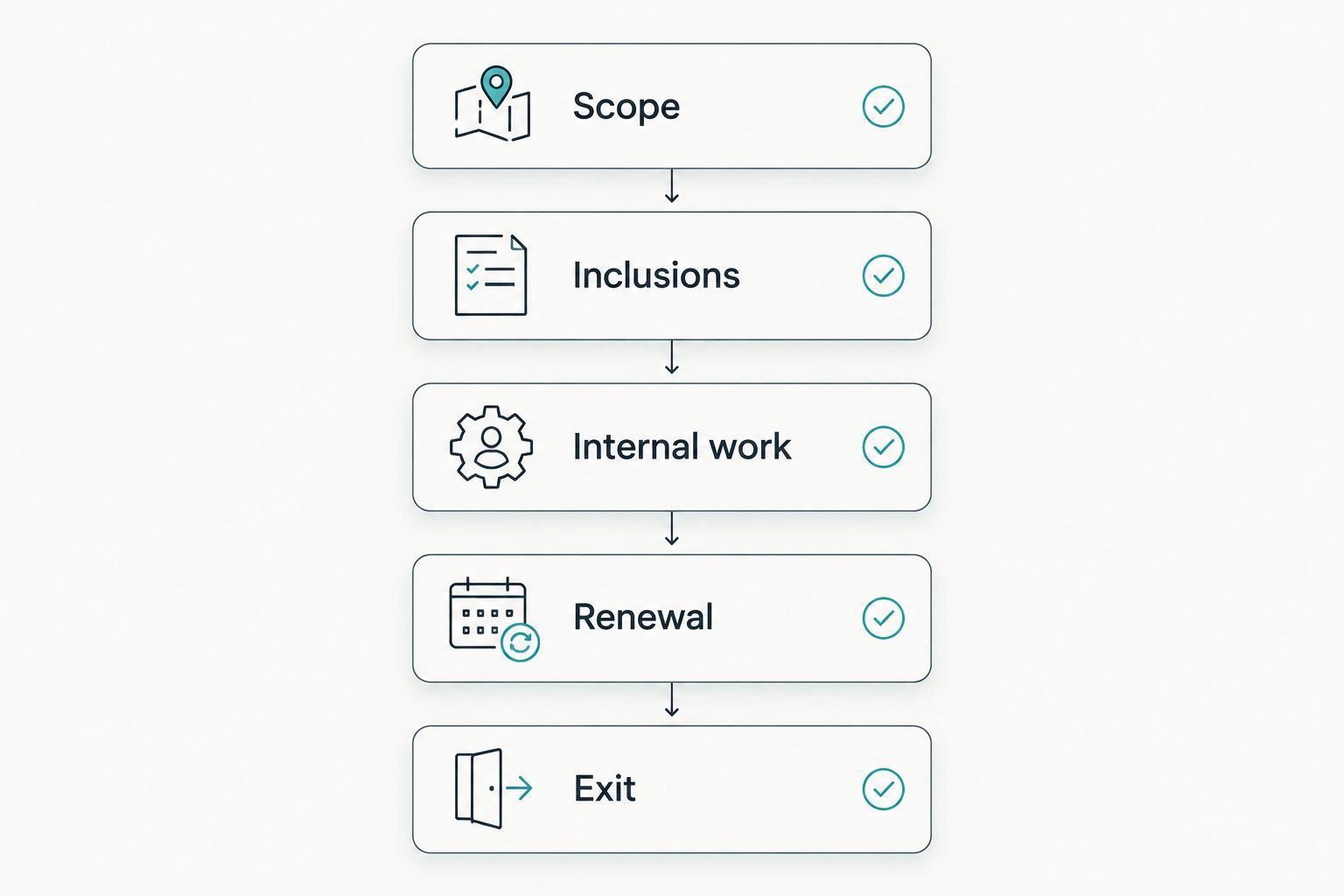
Compare equivalent scope before deciding which proposal offers the better fit.
Keep certification assessment separate in your comparison. Ask who provides it, what the engagement covers and which responsibilities stay with you.
Run a demonstration that tests the work
Give each shortlisted supplier the same 60-minute agenda. This is a suggested evaluation format, not a claim about how long implementation takes.
- 15 minutes: Control gap. Show a real issue and ask how the system records, assigns and resolves it.
- 15 minutes: Policy approval. Follow a policy from preparation through review and approval.
- 15 minutes: Audit trail. Trace a requirement to the evidence and the accountable owner.
- 15 minutes: Exit check. Inspect an export and confirm what history it preserves.
Use your own examples wherever possible. A polished demonstration of an unrelated workflow does not answer whether the software fits your business.
For 2026 procurement, make the acceptance conditions explicit before agreeing commercial terms. Record which actions happen automatically, which require approval and which remain manual.
How this ranking works
The order prioritises distinct operating needs: automated remediation, dedicated security management, wider governance and manual preparation. It does not present unverified supplier prices as a market league table.
The criteria are scope fit, work removed, ownership, traceability, commercial clarity and exit readiness. Use them to reject unsuitable options before comparing equivalent proposals.
Which ISO 27001 software should you choose?
OneClickComply is best for growing businesses seeking ISO 27001 software with automated remediation, policy generation and risk management. Make that your starting point when those are the tasks you want to automate.
Choose specialist ISMS software when organising the security management system is the priority. Choose broader GRC software when other business functions have defined requirements that must sit alongside security.
Keep spreadsheets for requirement mapping when you are still deciding what the platform must do. Do not mistake manual records for an automated operating model.
Your 2026 decision should end with a clear division of responsibility. Know what the platform handles, what your team approves and what the certification body assesses.
Frequently asked questions
One last thing
Test the exit before you approve the purchase. An export of current documents is not the same as a usable record of approvals, risk decisions and supporting evidence.
Ask someone who did not attend the demonstration to follow the exported records. If they cannot connect a decision to its owner and evidence, ask the supplier to resolve that gap.
Make the work clear. Automate what fits. Keep responsibility visible. Seriously Simple Cyber Compliance.