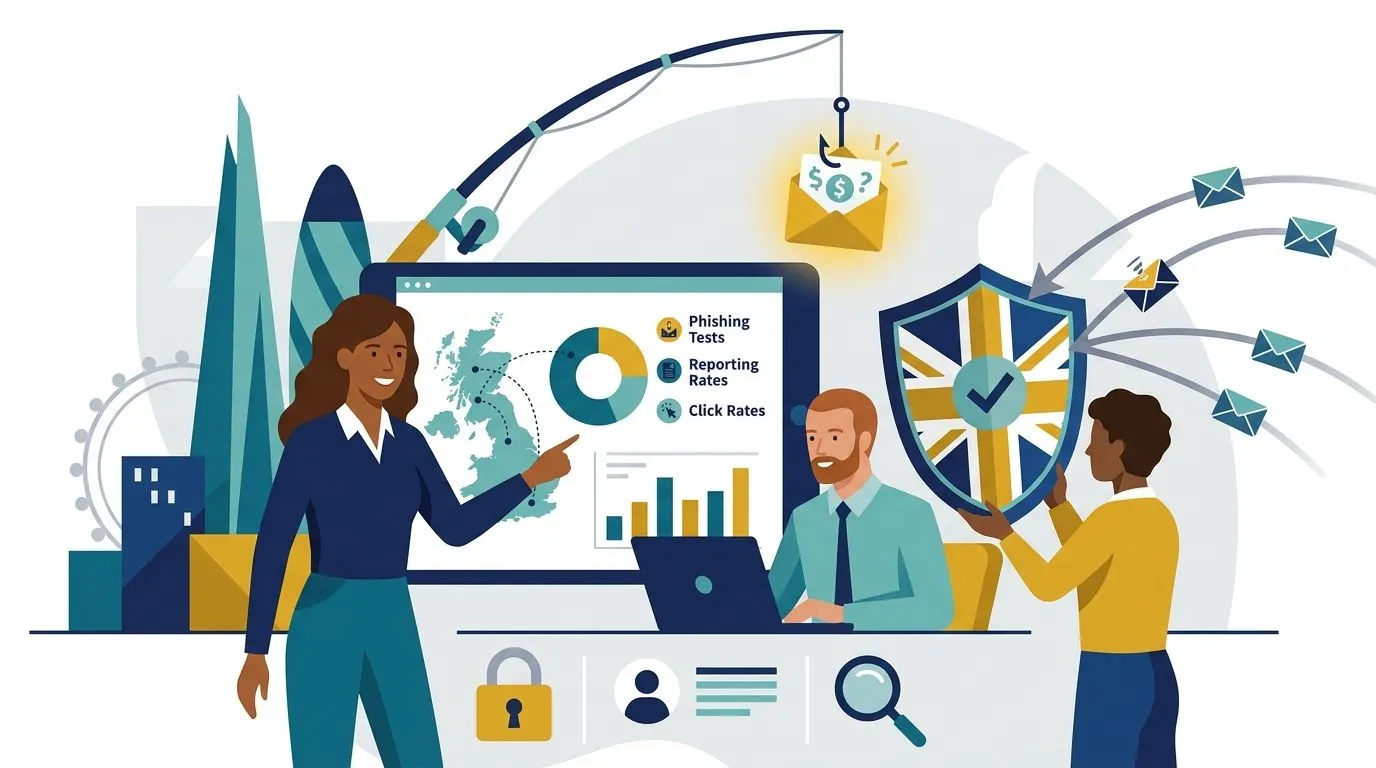
Six phishing simulation platforms get compared here for UK SME teams choosing one in 2026, with a straight verdict on which to buy, which to hold off on, and which to skip.
Why this matters
Phishing is still the entry point for most breaches hitting UK small businesses, and a simulation platform is how you find out who clicks before an attacker does. Cyber Essentials certification runs on a 12-month renewal cycle, and assessors increasingly expect evidence that staff get tested, not just trained.
Picking the wrong phishing simulation platform UK teams end up ignoring is a common failure mode — tools that generate reports nobody reads don't reduce risk. The six platforms below cover the realistic range of UK SME buyers in 2026, from five-person teams to 300-seat firms with an in-house security lead.
If security awareness training already lives somewhere in your stack, read the security awareness training platforms for UK SMEs comparison alongside this one — simulation and training are usually bought as a pair, not separately.
What makes the best phishing simulation platform
- Template relevance — UK-specific lures (HMRC, Royal Mail, Microsoft 365 login pages), not just US-style templates
- Reporting for audits — exportable click-rate and completion data that maps to Cyber Essentials or ISO 27001 evidence requests
- Setup time — a platform a two-person IT team can configure in under a day
- Remediation flow — automatic follow-up micro-training triggered by a failed simulation, not a manual email
- Integration — works with Microsoft 365 or Google Workspace without custom development
- Pricing transparency — per-seat quoting you can budget against, not a sales-call-only model
Phishing simulation platforms at a glance
| Platform | Best for | Standout feature | Key limitation |
|---|---|---|---|
| usecure | Lean UK SME teams | UK-specific template packs, fast setup | Smaller enterprise reporting suite |
| KnowBe4 | Multi-language, large orgs | Largest simulation template library | Overkill for under-20-person teams |
| Hoxhunt | Engagement-driven teams | Gamified scoring instead of shame-based reporting | Less useful if you only need compliance evidence |
| Proofpoint Security Awareness | Existing Proofpoint email security stack | Deep integration with Proofpoint threat data | Standalone buyers pay for stack lock-in |
| CultureAI | Human risk analytics | Behaviour signals beyond click rate | Newer platform, thinner UK case history |
| Sophos Phish Threat | Sophos endpoint customers | Bundled into existing Sophos console | Weak outside the Sophos ecosystem |
1. usecure: best phishing simulation platform for lean UK SME teams
usecure runs phishing campaigns and micro-training from one dashboard built with UK small business buyers in mind, and it ships with lure templates written around UK brands and government services.
usecure pros:
- UK-relevant phishing templates out of the box
- Fast onboarding without a dedicated security admin
- Automatic remediation training for staff who click
usecure cons:
- Reporting depth thins out once you pass a few hundred seats
- Fewer language options than the larger US platforms
Best for: UK SMEs under 200 staff running their first structured phishing programme. Verdict: Buy.
2. KnowBe4: best phishing simulation platform for large template libraries
KnowBe4 has built one of the widest phishing template and training-content libraries on the market, covering multiple languages and industry-specific lure scenarios.
KnowBe4 pros:
- Largest simulation template catalogue available
- Multi-language support for distributed teams
- Mature reporting dashboards for security leadership
KnowBe4 cons:
- Setup and admin overhead outpaces what a 10-person team needs
- Pricing structure favours larger seat counts
Best for: UK groups with 300+ staff across multiple sites or languages. Verdict: Buy — if you're at that scale.
3. Hoxhunt: best phishing simulation platform for gamified engagement
Hoxhunt frames phishing simulation as a game with scoring and levels rather than a pass/fail exercise, aiming to keep staff engaged rather than defensive about failed tests.
Hoxhunt pros:
- Gamification drives higher voluntary reporting rates
- Positions security as a shared score, not individual blame
- Adaptive difficulty as staff improve
Hoxhunt cons:
- Gamified framing doesn't map cleanly to audit-ready compliance reports
- Less useful if your only goal is a Cyber Essentials evidence pack
Best for: Teams prioritising culture change over pure compliance ticking. Verdict: Hold — pilot it before a full rollout.
4. Proofpoint Security Awareness: best phishing simulation platform for existing Proofpoint stacks
Proofpoint Security Awareness plugs into Proofpoint's email security threat intelligence, so simulations can reflect lure patterns Proofpoint is already seeing hit your inboxes.
Proofpoint Security Awareness pros:
- Simulation content informed by live threat intelligence
- Tight integration if you already run Proofpoint email filtering
- Strong reporting for regulated sectors
Proofpoint Security Awareness cons:
- Little standalone value without the wider Proofpoint stack
- Buying in just for simulation is expensive relative to the feature set
Best for: Firms already on Proofpoint for email security. Verdict: Buy — only if you're already a Proofpoint customer.
5. CultureAI: best phishing simulation platform for human risk analytics
CultureAI moves past click-rate as the only metric and tracks broader employee security behaviour signals to build a human risk profile per team.
CultureAI pros:
- Goes beyond simple click/no-click reporting
- Useful for security teams building a risk register by department
- Behaviour data can feed into wider security posture reviews
CultureAI cons:
- Newer entrant with a thinner UK SME reference base than KnowBe4 or usecure
- More setup complexity than a simple simulation-only tool needs
Best for: Security teams that already track risk beyond phishing alone. Verdict: Wait — solid concept, still building UK track record.
6. Sophos Phish Threat: best phishing simulation platform for Sophos endpoint customers
Sophos Phish Threat sits inside the same console as Sophos endpoint protection, letting IT teams that already run Sophos add simulation without a second vendor login.
Sophos Phish Threat pros:
- One console alongside existing Sophos endpoint tools
- Straightforward for teams that don't want a standalone security awareness vendor
- Reasonable template set for common lure types
Sophos Phish Threat cons:
- Weak proposition if you don't already run Sophos endpoint
- Template and reporting depth trail the dedicated platforms above
Best for: IT teams already standardised on Sophos. Verdict: Buy — only inside the Sophos ecosystem, Skip otherwise.
How this list was ranked
Each platform got measured against the six criteria above: UK-relevant templates, audit-ready reporting, setup time, remediation flow, integration, and pricing transparency. Platforms that only excel at one criterion — like Sophos Phish Threat's console integration — get a narrower "best for" label rather than a blanket recommendation.
Which phishing simulation platform should you choose?
If you run a UK SME under 200 staff with no dedicated security hire, usecure is the default buy — UK-specific templates and a setup time measured in hours, not weeks. Scale past a few hundred seats or need multi-language coverage and KnowBe4 becomes the stronger pick. Already locked into Proofpoint or Sophos for email and endpoint security? Buy the bundled option before adding a seventh vendor login.
Whatever you pick, run campaigns on a recurring schedule through 2026 rather than a single annual test — one-off simulations tell you almost nothing about whether behaviour actually changed. Pair the results with your renewal cycle: onboarding employees into your compliance programme is the natural point to slot in a first simulation, before the annual Cyber Essentials reassessment lands.
Automate the Cyber Essentials evidence trail
OneClickComply handles the certification paperwork phishing tools don't touch.
Frequently asked questions
One last thing
Assessors reviewing a Cyber Essentials or ISO 27001 application don't pull phishing simulation dashboards — they ask for evidence packs, policy documents and control mappings, usually as screenshots or spreadsheets someone assembled by hand. The phishing platform reduces click-through risk; it does nothing for the certification paperwork sitting next to it. OneClickComply automates that second half — the evidence collection and compliance automation work that Cyber Essentials and ISO 27001 renewals actually require every 12 months. Seriously Simply Cyber Compliance means the phishing tool handles behaviour, and OneClickComply handles the audit trail.